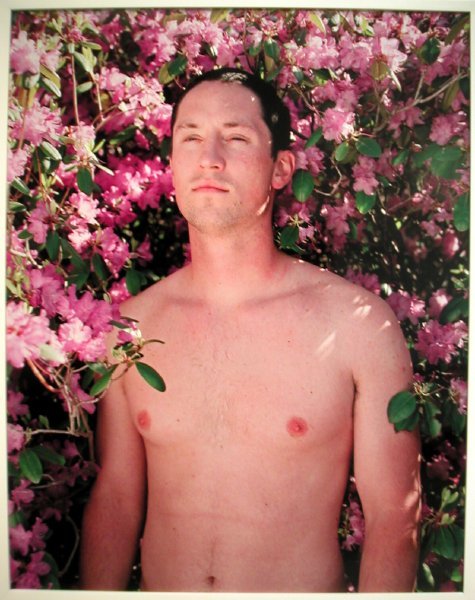
Jesse Burke at the Rhode Island School of Design

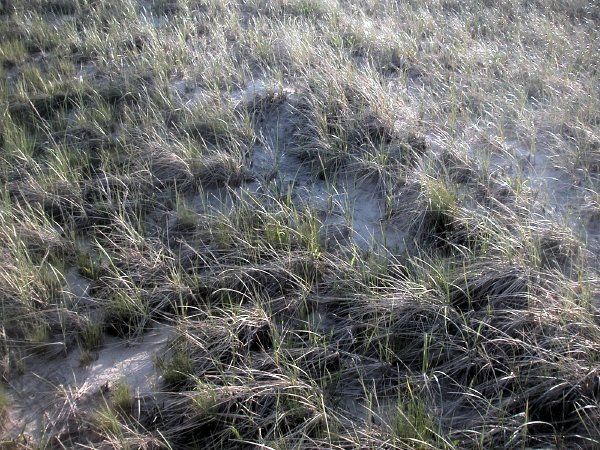
Burkeazaleas.jpg
Jesse Burke Pink & Black 2005 C-prints detail view of installation
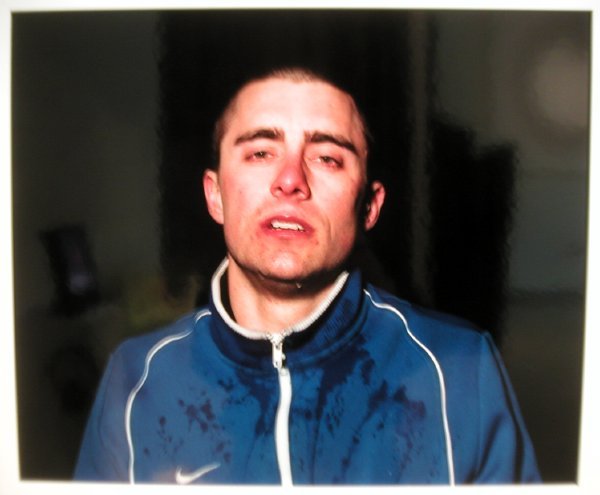
BurkeNils.jpg
Jesse Burke Pink & Black 2005 C-prints detail view of installation

The two images above are elements of a larger work by Jesse Burke which we encountered while in Rhode Island last week.
While we were having dinner in Providence we met several young artists who were dining together at the next table. They all had some connection to the Rhode Island School of Design, and before we left the city we visited that school’s installation of work by artists who had just completed its graduate program. There we encountered this piece by Jesse Burke, one of the people we had spoken to at the restaurant. We thought his Pink and Black was the strongest work in the entire show. I will be very surprised if he isn’t adopted by a good New York gallery very soon.
The complete work we saw at the RISD Museum is shown below.
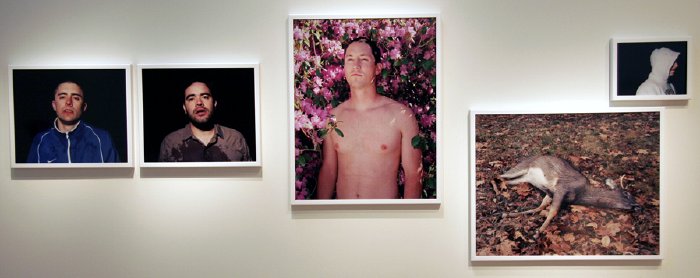
Burkepinkandblack.jpg
Jesse Burke Pink & Black 2005 C-prints

The artist’s statement:

The idea of masculinity is so incredibly fragile, so sought after, because of what it stands for, because of the history of men. A delicate balance exists between the heroic ideal of masculinity – strength, endurance, toughness – and the true, fragile reality of men as seen through my eyes. My work is an autobiographically driven investigation into the notions of masculine identity and the presence of vulnerability and sensitivity that acts as forces against the mythology of male dominance and power.
My notions of what it means to be a man are romantic. I believe an innate part of our psyche needs us to be the Iron John of Robert Bly, yet we are responding to that primal urge in a new way. We have grown into a new fragility. We identify and illuminate within ourselves what it means to be men through the examples we see in our families, in the media, and in our peers. We are bombarded by images defining what it means to be male, and we are helpless but to give in part way to these campaigns. We are fragile.
I photograph my life and the lives of the men in my social and family circles in an attempt to understand from where our ideas of masculinity originate. As the author I act as an interpreter of a specific culture and mythology. I am most drawn to the moments when we are vulnerable or emasculated; where there is a presence of a rupture or wound inflicted in some way, whether it be physical, emotional, or metaphorical. I employ concepts such as male bonding and peer influence, masculine rites and rituals, homosocial desire, physical exertion, and our connections to one another as well as the landscape that we interact within to expose these instances.

[image at the bottom from Jesse Burke]
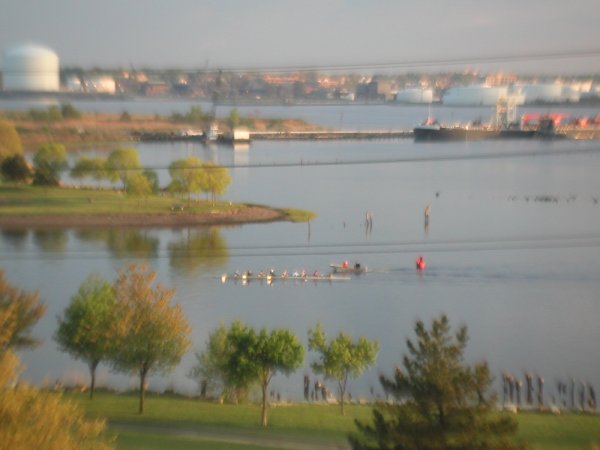
the modern waterscape: sometimes a strange aesthetic mix

ProvidenceHarbor2.jpg
untitled (eight with cockswain) 2005

I captured this view of the Providence harbor off India Point at dusk last week. The suggestion of a vaseline-covered lens is just that: The instability of a zoom in low light did all the dreamy work.
We’re back from New England and trying to catch up on schedules interrupted for over a week. I took almost no photographs while we were gone, partly because we were serious about our roles as family tour guides. Also our internet connections were never very reliable so posting of any kind, especially from Rhode Island, was almost impossible.

still mustering

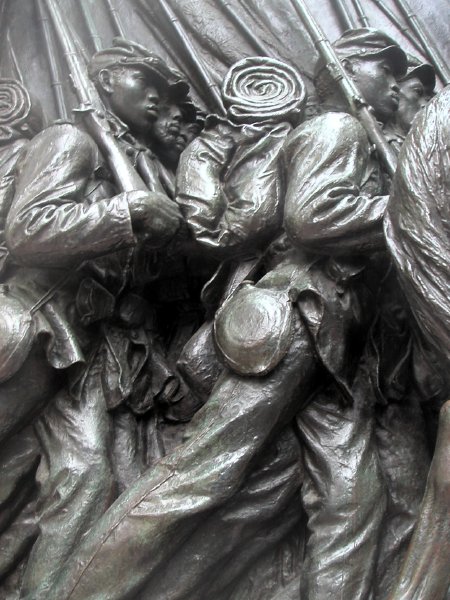
St.Gaudens54thRegiment.jpg
untitled (54th Regiment Memorial detail) 2005

From the Boston African-American National Historic site:

Denied equal pay, African American soldiers in the 54th Regiment refused pay for 18 months until Congress agreed, in 1864, to pay them the same rate as White soldiers. In the midst of intense opposition by the government and the public, Colonel Shaw and the men of the 54th Massachusetts Regiment struck a blow for American freedom and proved that racial unity ultimately triumphs over hatred. The high relief bronze statue, designed by renowned sculptor Augustus St. Gaudens, is a testament to this triumph. Financed primarily through a fund established by Joshua B. Smith – former slave, state representative, caterer, and former employee in the Shaw family household – the monument was dedicated in a ceremony on Boston Common in 1897. This ceremony was attended by Booker T. Washington, Sargent Carney, and Charles Elliott, then president of Harvard University. The engraving on the back of the monument is taken from Elliott’s dedication speech. In 1982, 64 names of soldiers from the city of Boston who died at the Battle of Fort Wagner were inscribed at the bottom on the back of the monument.

they just want to sing

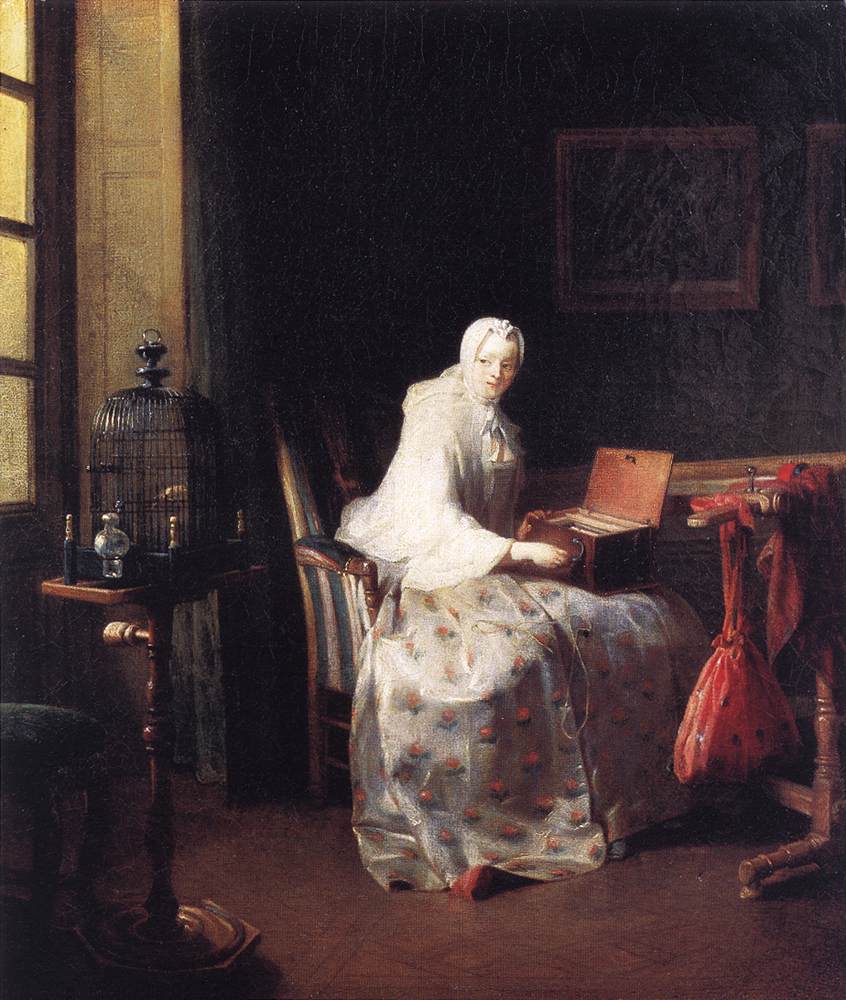
Chardincanary.jpg
Jean-Baptiste-Siméon Chardin The Canary oil on canvas 19.75″ x 17″

I’d love them even if they didn’t sing, but they do, and now we’re learning how much they want to, and why they want to.
Because of the beautiful garden which is enclosed by our two relatively-low-rise Manhattan apartment buildings lying along the great eastern flyway, we can easily imagine that we live inside an aviary. I recognize the sounds of sparrows, blue jays and mourning doves, and I’m proud and delighted to know the distinct call of the male cardinal who shares the courtyard with a mate who is almost as red as he is, and sometimes he comes to visit our own small garden annex one story up, but I have no idea who is producing the other delightful sounds which come from our wonderful arboretum/sanctuary.
The other afternoon, just after a guest had remarked upon the quiet of our apartment (at least the north side), I found myself resting on a bed near an open window trying to determine what I could detect of the machine sounds of the great city which surrounds our walls.    . . . nothing. Instead I found myself enchanted by what seemed to be an avian composition more exotic than usual, composed mostly of percussive clicks acccompanied by a gentle whistle (think Martin Denny‘s “exotica”). When it’s the real thing, and you don’t need mosquito netting, it’s sheer ecstasy.
This morning while reading the papers I came across one of those odd news/feature reports which manage to overshadow everything else I may have read that day, the sort of find which makes reading hard copy news still worth its demands in time and forearm disturbance.
New York Newsday‘s staff writer Jamie Taylan (undoubtedly another bird lover, but then who isn’t?) reports that birds raised in isolation can learn a complex tune not part of their heritage but will switch to their mating song once spring arrives, even if they’ve never heard it before.

Scientists at Rockefeller University in Manhattan found that young male canaries raised in the lab had no trouble learning a computer-generated song that had no resemblance to the song their father would normally teach them.
But one morning, the scientists arrived at the lab to discover that the birds, on the brink of adulthood, were chirping the song they were destined to sing – even though they had never heard it before. The research appears today in the journal Science.
. . .
Somehow, [former post-doctoral student at Rockefeller Timothy J.] Gardner said, they do their own editing, splicing and rearranging of the computer-generated song so that they are singing the song, speaking the language understood by songbirds.
. . .
Gardner and his colleagues, including Rockefeller neuroscientist Fernando Nottebohm, say that the mature birds in the experiment sing their species-specific song, yet every once in a while the old riff from their youth can be heard.
. . .
Nottebohm said that the ability of the songbirds to sing two distinct types of song “is reminiscent of people speaking two languages and being able to use both. Not a small feat for birds.”

But, sitting next to a tiny animated parakeet by a window at the edge of a garden filled with his chattering distant relatives, at least the news about two languages doesn’t surprise me at all.

[image from Web Gallery of Art]

Jürgen Mayer H. and Alex Schweder at Henry Urbach

MayerHJurgen.jpg
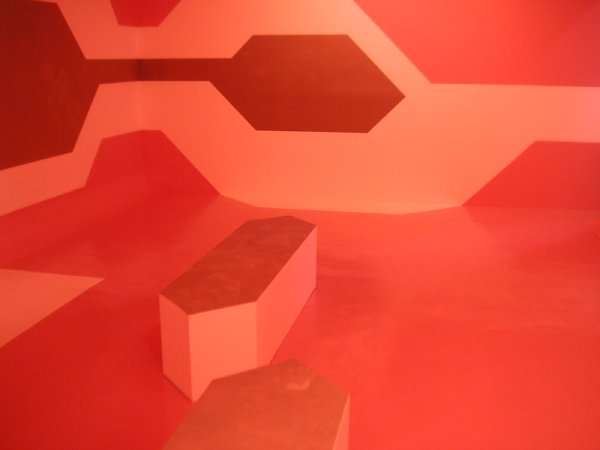
Jürgen Mayer H. In Heat detail of room-size installation/painting

SchwederAlex.jpg
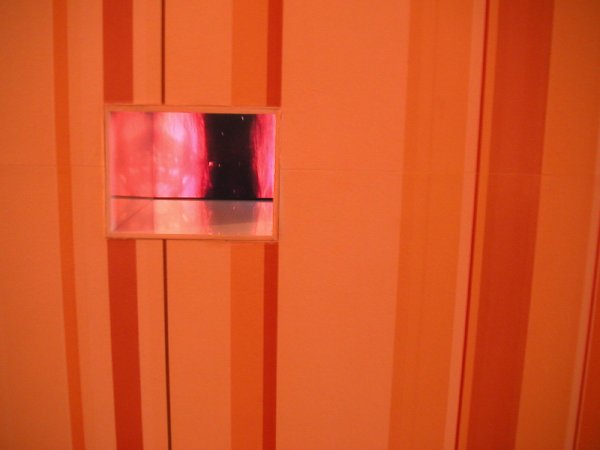
Alex Schweder Lovesick Room detail of room-size installation

I’d want to do a post on this show even if the images weren’t so spectacular, and I now have an additional reason to do so: Only tonight, as I read the press release while typing these lines, did I learn that this is the last exhibition for Henry Urbach Architecture in the current space (no further information, and the gallery site is “under construction”). Henry is a very special gallerist; I hope we will soon be pleasently surprised with the announcement of his next chapter.
Both artists in the current show are architects who have worked both here and in Europe. On 26th Street this month Mayer H. has built a three-dimensional painting which incorporates all six planes of the gallery and which includes seating as well. Some of the surfaces lose color with body contact, however fleeting. Schweder has covered the walls of the adjacent gallery space with “striped wallpaper that emits a delicious, cake-like odor.” In a recess on one wall a small monitor projects a moving endoscopic image, suggesting that the visitor is located both inside and outside of this fragrant architectural body.

David Ratcliff at Team Gallery

RatcliffDavid.jpg
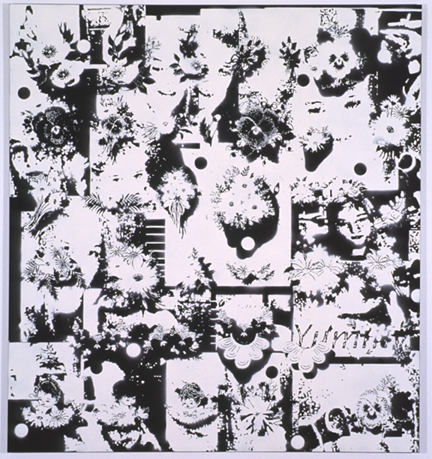
David Ratcliff Embroidery 2005 acrylic on canvas 72″ x 66″

RatcliffDavidfloatation.jpg
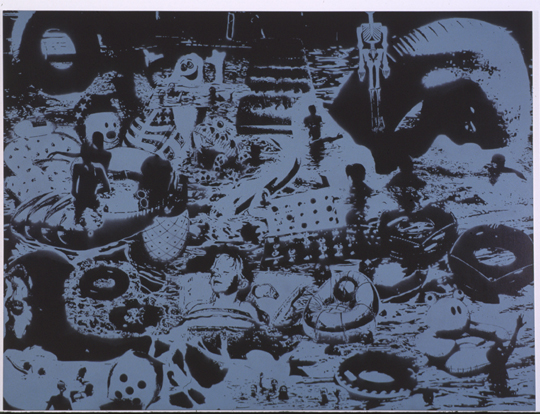
David Ratcliff Floatation 2005 acrylic on canvas 72″ x 96″

The show was over even before we got home on Saturday after visiting it for the first time, so I can’t blame my current indisposition for this belated encomium.
I thought David Ratcliff’s recent show at team was absolutely beautiful, and I didn’t even think of Warhol until someone else brought up the name.
I also had not yet had the advantage of information the gallery supplied about Ratcliff’s inspirations and his process. From the press release:

David Ratcliff’s first solo exhibition takes as its title a line from Bret Easton Ellis’ novel American Psycho. Ratcliff’s compendium paintings share with Ellis something of the elegant formal violence that seemed the only way to give voice to the decade that most relished acquisition for acquisition’s sake. As a matter of fact, Walead Beshty, the artist and writer, has called Ratcliff’s new works “1980’s history paintings.”
. . .
Ratcliff, like Ellis, is fond of lists, allowing the gathering together of signs to do the work of cultural critique. In a sense, the collecting together of material is as crucial as the manner in which it is deployed.

For his imagery Ratcliff builds his own stencil cartoons on his computer and then prints them onto paper which he cuts out and attaches to the surface of a black-painted canvas. He chooses a single vibrant color for each piece and sprays the surface. The wet paint destroys the stencil and leaves the edges of the images somewhat less than precise.

[images from team gallery]

just resting a bit

Have I missed anything?
I’ve been neglecting the blog this week because I’ve been down with a wicked flu accompanied by an impressive body temperature. For a couple of days I could barely think, I ached everywhere, so that even moving my fingers around the keyboard seemed out of the question, and it even hurt to touch my skin.
We have to be ready to leave Saturday for a week in New England with family, regardless of how I’m feeling, so it’s time to start getting myself together.
Maybe I can do a post later today.