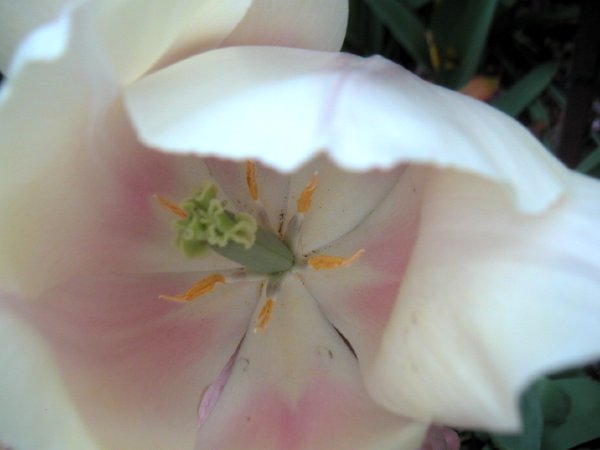
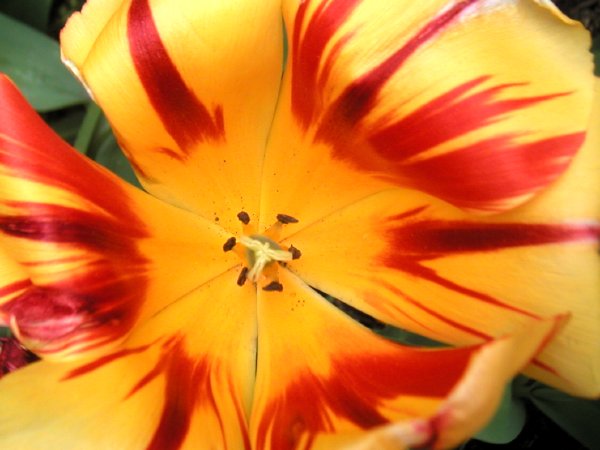
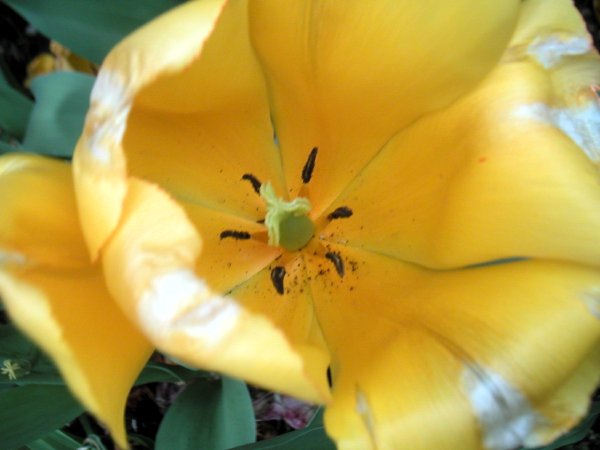
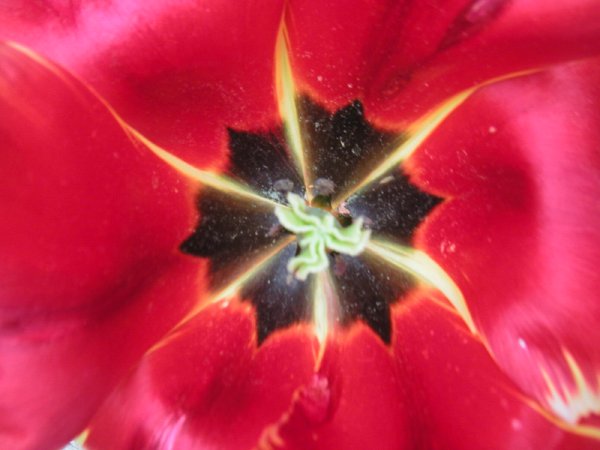
I’m very happy that I waited until this evening to capture these beauties in the center of our garden court. Now in the process of disappearing, they were never so deeply sensual, especially on close acquaintance.
are we finally going to get real Smart?
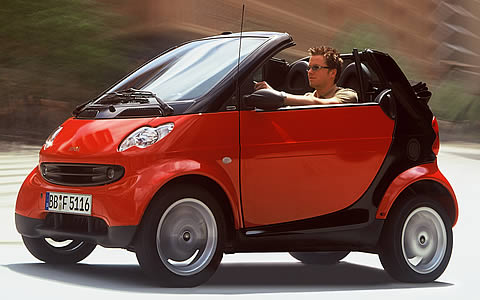
no armor and no hairshirt
The Washington Post reported three weeks ago (in an article syndicated in excerpts today in New York Newsday) that DaimlerChrysler has finally decided to let us dumb Yankees have a chance to buy the company’s brilliant design concept for the twenty-first century, the Smart two-seater, called the fourtwo.
For the last few years they had been planning to introduce a much larger SUV version [huh?] of the tiny car which endeared itself to [smart] Europeans from the moment it hit the road in 1998. Now it looks like Americans’ affection for the SUV has begun to cool, at least partly because we are rapidly closing the gap between the cost of gasoline here and in Europe, and 50 to 70 mpg is beginning to look very attractive. Several months back the company cancelled its ill-conceived steroid-Smart project.
DaimlerChrylser was about to make a big mistake, Warren Brown argues in his piece:
The United States is a part of the world. In terms of consumption of the world’s resources, especially fossil fuels, it is one of the greediest parts. We often have a hard time here distinguishing between water and gasoline, which is why we waste both.
At the moment, the United States is also the world’s single largest automotive market, which means that it’s the most lucrative. Big money seems to dance well with big cars and trucks, and we have developed an entire ritual, replete with mythological beliefs, to keep the rhythm going.
Big is better, ba-boom, ba-bang. Big is safer, ca-choom, ca-chang! Ain’t nobody if you drivin’ small; but you’re ruling the world if you ridin’ tall!
Given that nonsense, it was understandable that the people at DaimlerChrysler initially were suckered into the idea of bringing the first Smart to the United States as the Smart ForMore SUV. Americans understand SUVs, DaimlerChrysler reasoned. They don’t understand micro-cars.
But a Smart SUV had no originality and couldn’t possibly have stirred the imagination as the original concept has. Also it couldn’t have competed on a cost basis with the crowded existing market of down-sized imitators of up-sized armored-personnel-carrier wannabees, and the burden on pricing imposed by shipping costs and an increasingly-unfavorable exchange rate would have sealed its fate even before it could show whatever stuff it might have.
It matters not that the City Coupe and its other two-seat iterations have not earned a penny since their introduction in 1998. What matters is that they have stirred consumer imagination, and that they are selling, albeit not yet at a profit. With a few fixes — a slightly larger wheelbase, better automatic and/or manual transmissions and a tad more cargo room — they could become as much of a hit as the now-famed Mini Cooper, or even bigger.
That is what DaimlerChrysler now plans to do with the Smart two-seater in the U.S. market. It is going to make the car a bit larger but do nothing to destroy its urban funkiness. It will meet all existing U.S. safety and tailpipe emissions rules, of course; and, yes, adhering to those tougher standards will mean an increase in price.
But the Smart City Coupe and its mini-two-seater siblings now have something going for them that they did not have before — an American reality check on spending at the gas pump. Growing world oil demand and consumption mean we can say goodbye to the days of dirt-cheap gasoline here.
If that’s not enough to attract our attention, it also comes as a convertible. Take that, Toyota! The Prius highbrid won’t even offer a sunroof as an option, because Toyota says it would compromise its streamlined gasoline efficiency. But we shouldn’t be required to wear hairshirts just because we want to be a little more green.
[image originally from the Brazilian site, carsale]
the World Trade Center site as a grand public plaza
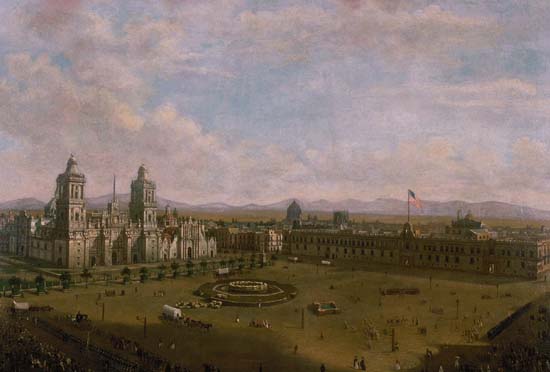
Pietro Gualdi Grand Plaza of Mexico City, Following the American Occupation of September 14, 1847 1847 oil on canvas [one of my all-time favorite public squares, for the richness of its life – once we left]
Over seventy years ago the Empire State Building was completed within thirteen months and yet we’re still staring at a hole downtown.
As we approach the fourth anniversary of the attacks on the World Trade Center we have no idea what’s going to be built on the still-empty site. Every intended purpose and every proposed design has ended up being compromised or rejected for one reason or another.
Except for the shopping mall.
The cultural spaces are out; people are apparently terrified of the idea of sitting at a desk high above “ground Zero,” so no one is talking about building the tall office buildings first included in the proposals; and no one knows where the little Greek church is going to be. The only projects now left on the table are something called the “Freedom Tower,” which has just been put on hold once again (because of the name, it’s a not-so-surprising augury for Bush’s America) and the even more tenebrous “Freedom Museum.” The current state of plans for a memorial to the events of September 11 is a mess, and it was ill-conceived from the start.
And as far as real freedom is concerned, forget about it; gotta stay off the grass and stay off the streets. Maybe watch it on TV.
So I have a modest proposal to resolve the problem. Actually it’s not modest in its implications or in the scale of its ambitions, only in the simplicity of its utility and its physical design.
New Yorkers have been told that they have no right to assemble in large numbers in Central Park to party or address political grievances, and they have seen how impossible it is to find any alternative in a city without great open public spaces. I suggest that the site of the old World Trade Center be made a true monument to freedom by reserving every acre of its surface as a public square devoted solely to the enjoyment of the people and to their right of expression, whether in joy or in anger.
It absolutely must not be a lawn however, even if there were any way to ensure that great assemblies of people would not damage it. We need a great plaza worthy of a great city. Plazas welcome free assembly. Downtown, in the new World Trade Center there will be trading in ideas and grass is not part of the kit.
We would be perfectly happy with cut stone or the happy-sounding, gravel-like surface used almost universally in the grand parks of European towns and cities. Trees, yes. Include trees perhaps, but only around the perimeter. London Plane trees would do just fine. Above all, let us have light and air. Freedom thrives on it.
ADDENDUM: A year and a half ago, Barry did a post describing a provocative, minimalist WTC proposal from Ellsworth Kelly, although his concept involved the grass thing.
[image from Louisiana State Museum]
Tim Thyzel and Lot-ek at the new Cynthia Broan
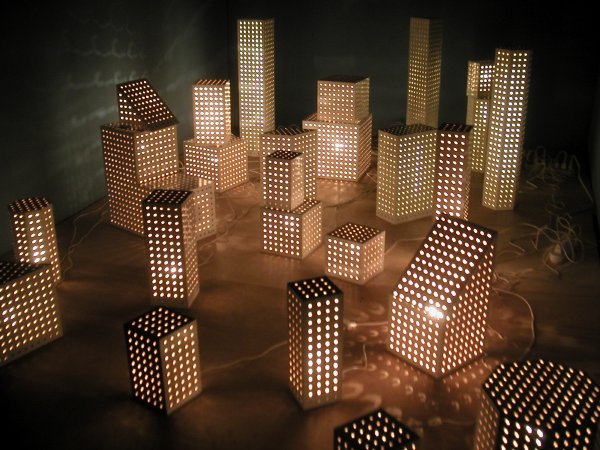
Tim Thyzel Dot Lights 2004-2005 26 pegboard and electrical light constructions, variable dimensions, installation view
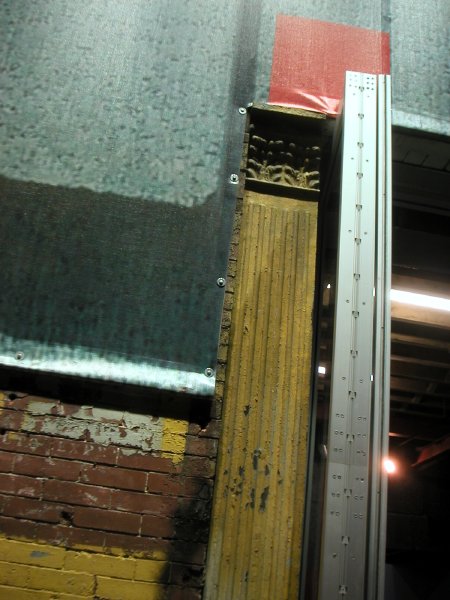
LOT-EK Cynthia Broan Gallery 2005 billboard-style facade with retained elements, detail
Cynthia Broan returned to Chelsea tonight, with a bang, after a two years’ absence. Her beautiful new gallery on West 29th Street is a former garage which has transformed by the architectural firm LOT-EK into what appears to be the perfect gallery instrument, an exhibition space with moving walls and a billboard-style facade. Tonight we saw a clean blue box. Yes, the walls were painted a medium blue to set off more than a dozen of Tim Thyzel’s minimal, mostly-white sculptural forms, assembled from ordinary commercial display materials.
From the press release:
Slots & Dots, sculptor Tim Thyzel’s third solo show with the gallery, utilizes the slotwall and pegboard commonly seen in low-end retail stores to create a series of sculptures which reflect on formal aspects of art and architecture as well as issues of merchandising and consumer appeal. Also known as MDF (medium density fiberboard), slotwall accommodates hardware such as hooks and shelving for interchangeable retail display. Several of the works shown include these hooks to add both texture and context to the work. The crisp white laminate, punctuated with lines and holes, transcends its usual application to construct a series of towers and stacks, which are both elegant and humorous.
Nicole Cherubini’s interior light
multiplying light
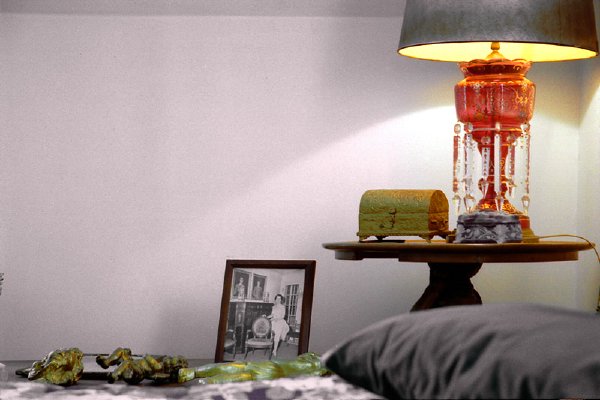
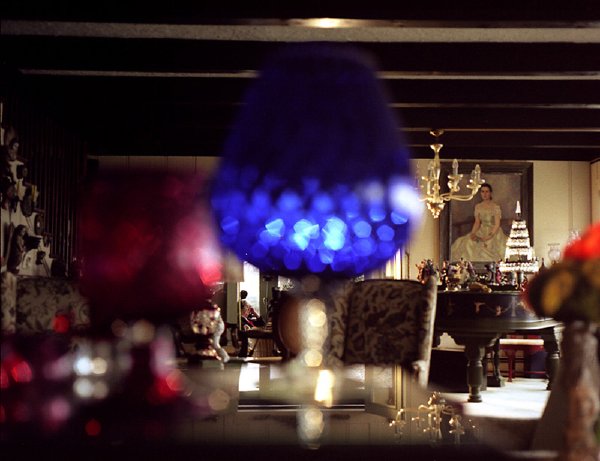

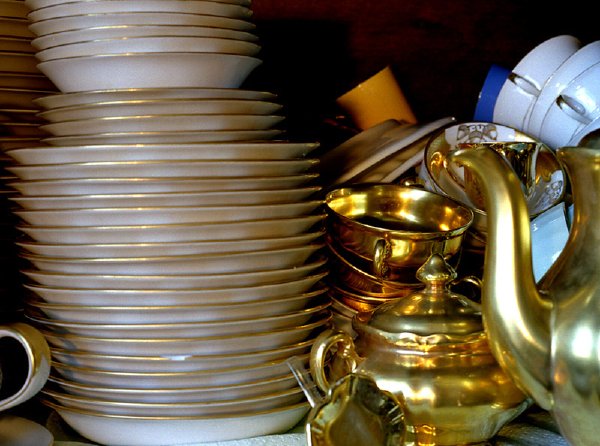
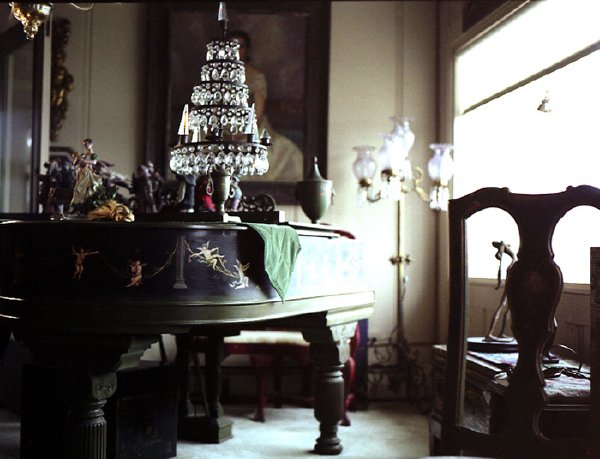
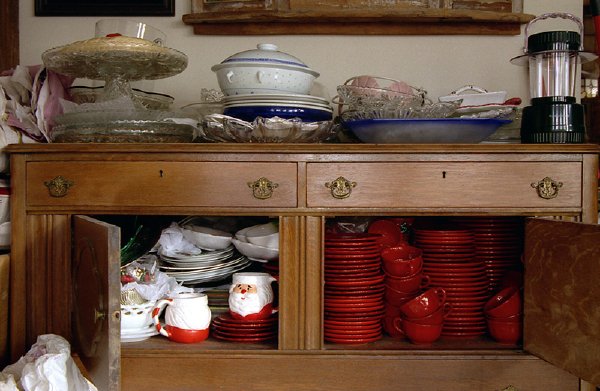
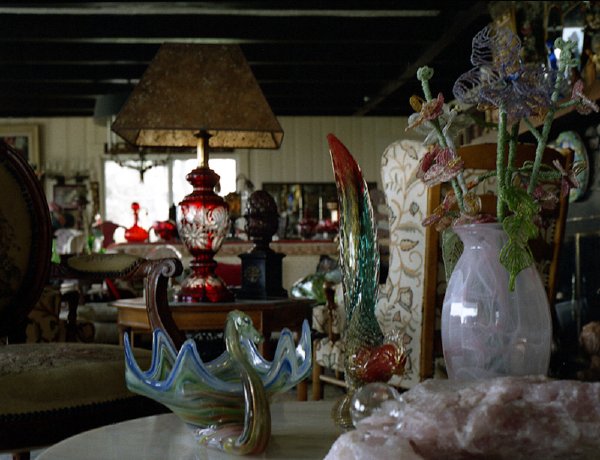
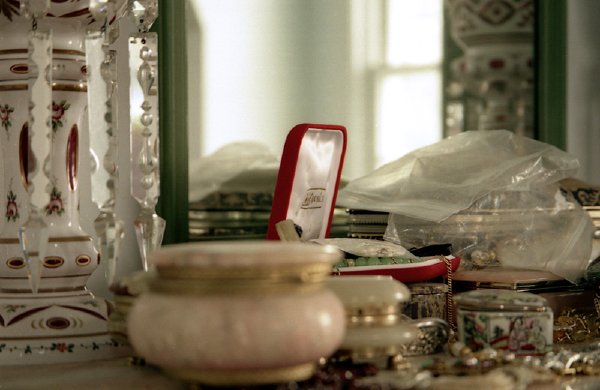
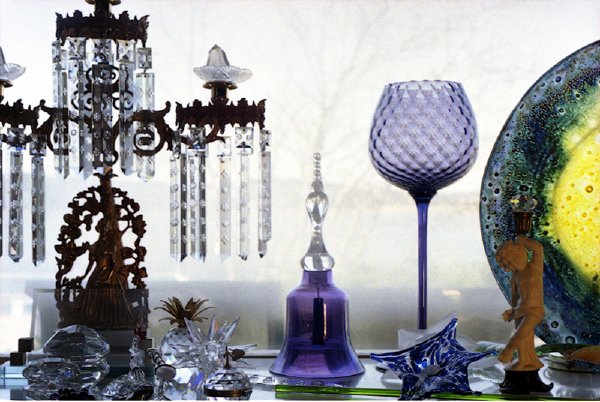
We’re planning a trip to Boston and southeastern New England this month. One of the things I’m most looking forward to is seeing Cape Cod for the first time since moving from Rhode Island twenty years ago, especially since this will be Barry’s first visit. It may seem strange, but while looking at these photographs of old things in interior spaces, I’m thinking of the extraordinary fresh light I’ve always associated with that long, sandy peninsula surrounded by the sea. The old house which shelters this furniture, ceramic and glass stands at the very entrance to the Cape and even its darker corners somehow share in that light.
I first saw these gorgeous prints attached to the wall of Nicole Cherubini‘s pottery studio last week. I couldn’t get them out of my mind, so I asked her if I could have some jpegs to go with a short post. Once I had them on the screen in front of me I decided I couldn’t leave out any of them, so I’ve included thumbnails of each.
She sent this short note to accompany them:
These images are from an on-going project documenting my grandmother’s house, both the interiors and insides. By cataloguing her surroundings, I am able to enter into this developed aesthetic and come to a more complete understanding of excess, abundance and at times, their subsidiary, decay. These intimate portraits function as both finished works as well as source material for other works.
The final pieces are 30″x40″ highly saturated C-Prints mounted on
aluminum.
Wellll, . . . maybe I’ll admit that at this moment the last image is my favorite.
[images from Nicole Cherubini]
Felix Gonzalez-Torres and Roni Horn at Andrea Rosen
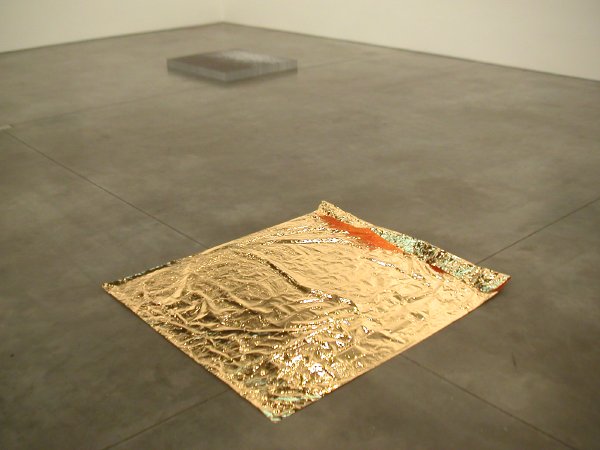
installation view of Roni Horn’s Gold Field (1992) in the foreground and Felix Gonzalez-Torres’s Untitled (1991) in the rear
The press release for the second in the Andrea Rosen Gallery‘s series of two-person exhibitions [closed last Saturday] exploring the affinities between Felix Gonzalez-Torres� and other artists� works included this excerpt of a 1990 text by Gonzalez-Torres read by Roni Horn at his memorial service:
L.A. 1990. Ross and I spent every Saturday afternoon visiting galleries, museums, thrift shops, and going on long, very long drives all around L.A., enjoying the �magic hour� when the light makes everything gold and magical in that city. It was the best and worst of times. Ross was dying right in front of my eyes. Leaving me. It was the first time in my life when I knew for sure where the money for rent was coming from. It was a time of desperation, yet of growth too.
1990, L.A. The Gold Field. How can I deal with the Gold Field? I don�t quite know. But the Gold Field was there. Ross and I entered the Museum of Contemporary Art, and without knowing the work of Roni Horn we were blown away by the heroic, gentle and horizontal presence of this gift. There it was, in a white room, all by itself, it didn�t need company, it didn�t need anything. Sitting on the floor, ever so lightly. A new landscape, a possible horizon, a place of rest and absolute beauty. Waiting for the right viewer willing and needing to be moved to a place of the imagination. This piece is nothing more than a thin layer of gold. It is everything a good poem by Wallace Steven is: precise, with no baggage, nothing extra. A poem that feels secure and dares to unravel itself, to become naked, to be enjoyed in a tactile manner, but beyond that, in an intellectual way too. Ross and I were lifted. That gesture was all we needed to rest, to think about the possibility of change. This showed the innate ability of an artist proposing to make this place a better place. How truly revolutionary.
This work was needed. This was an undiscovered ocean for us. It was impossible, yet it was real, we saw this landscape. Like no other landscape. We felt it. We traveled together to countless sunsets. But where did this object come from? Who produced this piece that risked itself by being so fragile, just laying on the floor, no base, no plexiglass box on top of it�. A place to dream, to regain energy, to dare. Ross and I always talked about this work, how much it affected us. After that any sunset became �The Gold Field.� Roni had named something that had always been there. Now we saw it through her eyes, her imagination.
The images on the stack of Gonzalez-Torres’s take-one-with-you’s are of a blue-grey horizonless ocean.
It was a breathtaking installation of seriously-wonderful work.
but it’s haaaaard worrrrrrrk
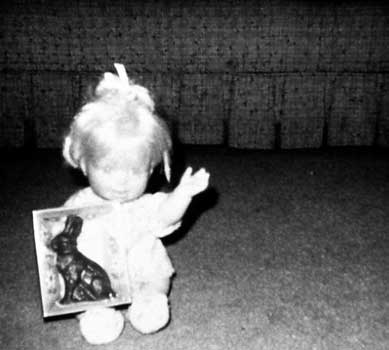
Steed Taylor Doll With Chocolate Bunny 1964 photograph 15″ x 15″
Even my mother might have shown she was impressed this time, and it was never easy to get her to show enthusiasm with our little accomplishments (she let us think she just expected them): I’m the curator for this month’s Visual AIDS web gallery.
There’s lots more in the statement, where I probabaly overdid it.
[image from thebody.com]
Smolka photo found!
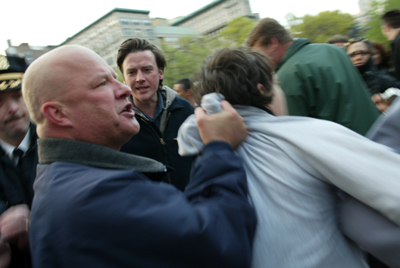
Chief Smolka doing his thing
UPDATE/FOLLOW UP: When I posted my April 30 story, “political police thuggery in New York,” I wrote that I was unable to find the dramatic photograph which acccompanied the print edition of the NYTimes article. I’ve now located it on New York indymedia, thanks to the photographer, Antrim Caskey.
I’ve also changed my post’s link for the Times news story to this indymedia site, reducing the chances that it will disappear very soon. There are some additional comments about the incident on this site, including a call for photographs and video from anyone who witnessed it.
[image by Antrim Caskey from nyc.indymedia]
“Pink Houses”

heroes at large
We met these two extraordinary men for the first time this afternoon. Until then our knowledge and experience of the nobility and the courage of John Schenk and Robert Loyd had been limited to the incredible reports which regularly came to us from Barry’s wonderful mother Earline, their good friend and neighbor.
John and Robert are visiting New York this week from Conway, Arkansas, because their story and that of their now thoroughly-notorious pink Victorian house is being told in a documentary which is part of the New York Independent Film and Video Festival.
Barry has already written more about the couple and the film, “Pink Houses.” We will be seeing it tomorrow night, Tuesday, at 6 o’clock. He’s included an article from the Arkansas Democrat-Gazette, a statewide paper.
While the film is presented from the viewpoint of these two men, it also includes comment from a representative of the Family Council a Little Rock-based organization that promotes traditional family values and television footage of Greenbrier farmer Wesley Bono talking about his decision to spread a dump-truck load of manure along streets around the Pink House on the day of last summers gay-pride parade.
“It didnt stop us,” Schenck says in the film, while standing outdoors with Loyd. “It smelled horrible for a couple of days, but were used to dealing with manure.”
. . .
In their 19 years in the Pink House, the two say, people have driven by and shouted derogatory names, shot at their house, broken their car windows and destroyed holiday decorations.
“One year we had a 9-foot Energizer bunny,” Loyd says. “It was decapitated Easter morning. I thought that was a little extreme.”
And some of us once assumed that the big city queer owned the breed’s style and courage.
Details: The 51-minute film will be screened at 6 o’clock on Tuesday, May 3rd, on screen 6 of the Village East Cinema, 181 2nd Avenue at 12th Street.
[image original source not available at this time]
more LMCC artists
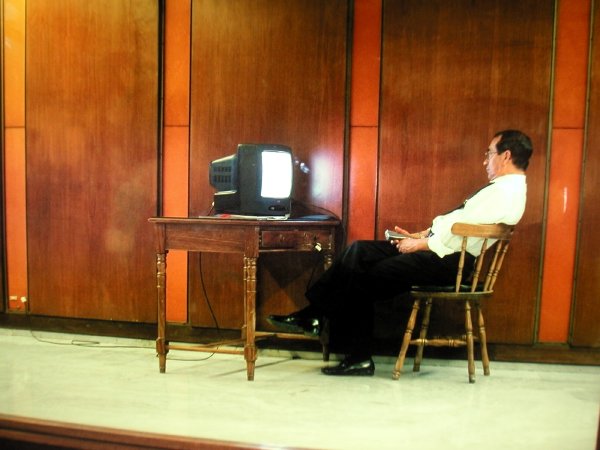
Yolanda del Amo (large detail of lightbox image)
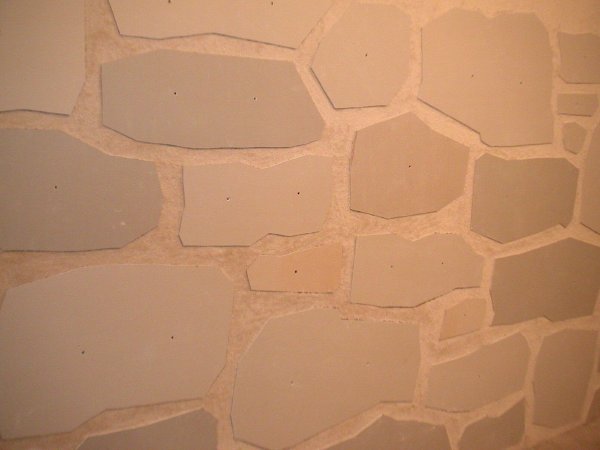
Oona Stern (detail of wall installation)
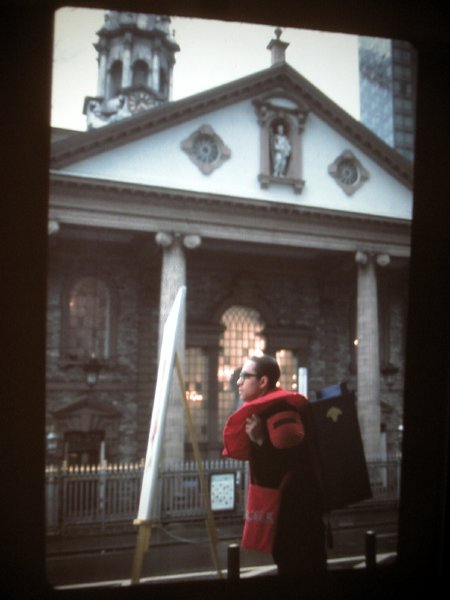
Nicolás Dumit Estévez (view of installation with still from video)
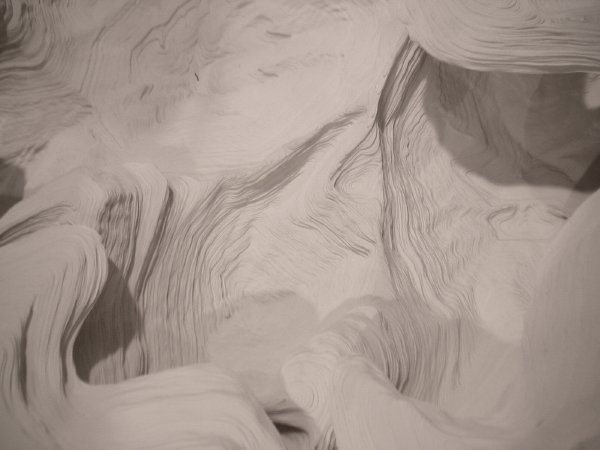
Noriko Ambe (detail of cut paper sculpture)
On Thursday I wrote about Jesse Bercowetz and Matt Bua and what I saw in their temporary Lower Manhattan Cultural Council studio. Yolanda del Amo, Oona Stern, Nicolás Dumit Estévez and Noriko Ambe are just four other artists included in the recently-completed session of the “artists-in-residence” program at the LMCC, and since I managed to leave with some interesting images of their work I’m including them here.
I really regret not trying to pull one of Olalekan B. Jeyifous’s exciting large-scale drawings/investigations of a future Manhattan, but I would be seriously wrong not to include him here. Unfortunately his site doesn’t include current work and it only begins to describe the scale and brilliance of what he is doing today.
For notes on each of these artist’s current work see the LMCC site.