NYPD says “Happy Earth Day!” by stealing NYers’ bikes

NYPD_junks_bikes.jpg
gone, but surely not forgotten

It’s Earth Day. It’s also the day the White House and the City of New York decided to junk hundreds of bikes, the vehicles used by New Yorkers to reduce their carbon footprint.
From Gothamist, two hours ago:

Obama has no idea what he just got himself into. Someone sent this photo to the blog This Is FYF, which reports that “citing security concerns that bikes might be secret pipe bombs, NYPD officers clipped the locks of hundreds of bikes along Houston Street this morning in preparation for President Obama’s speech at Cooper Union. The bikes were unceremoniously put in the back of the truck. Onlookers were not given information as to what would become of the bikes. Happy Earth Day!”

Those bikes are at least as important to their riders as cars are to their drivers, and, in some cases, represent as major an investment for their owners as a car does for those who like piloting their own multi-ton metal vehicles around the city. Would the NYPD be so cavalier in junking hundreds of those precious planet-scarring cars?
The history of the NYPD’s war on bikes tell us that for the men and women in blue today’s crackdown on innocent parked bikes is a win-win situation: The cops get to pretend they’re guarding us from terrorists, and at the same time they’re reducing the actual number of bikes (and, perhaps more crucially, discouraging potential riders from thinking of bikes as a reasonable alternative to cars).
Has anyone noticed the stories in the media and the glossy posters telling us that in just about one week we can begin celebrating the fact that “May is Bike Month in New York City!“? Someone should share the information with the City authorities.
And perhaps in one final note here, prollyisnotprobably reminds us that Bicycling Magazine put NYC within the top ten on its list of the most cycling friendly cities in the country. The prollies had already suggested our city doesn’t belong there.

RELATED: “NY activists drop rainforest banner at City Hall

[image by Anthony Rebholz/Thisisfy via Gothamist]

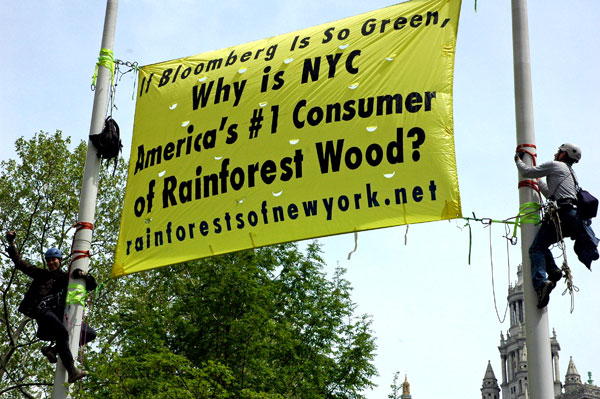
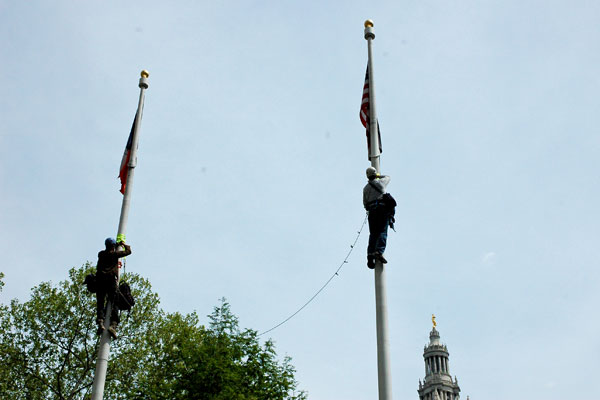
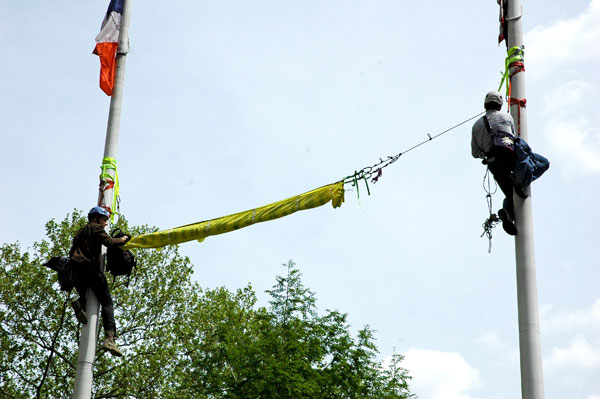
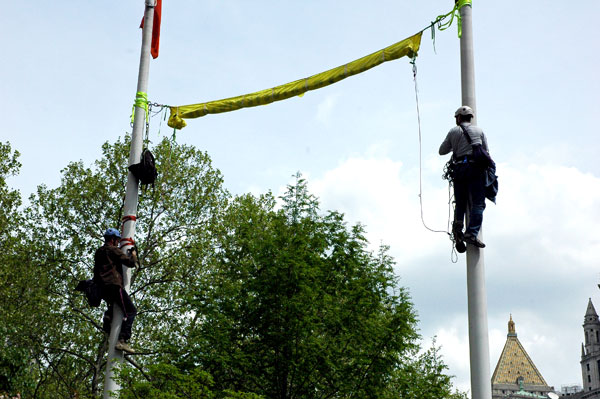
NY activists drop rainforest banner at City Hall

rainforest_bannner_38.jpg

UPDATE: [2 PM, APRIL 22, 2010] Both Tims were released a short while ago, after an arraignment in which each was charged with two misdemeanors: “Obstruction of Government Administration” and (a Parks violation) “Unlawful Posting of Sign”; each was also charged with one violation: “Disorderly Conduct”

ADDENDUM: [April 22, 2010] Tim Keating discusses the issues in this excellent Rainforest Relief video, recorded on a New York subway platform in April, 2008

Added six hours after this post was published: It’s just like the late 80s and 90s: We’re still having to learn to do stunts and run through hoops just to get the attention of elected officials, bureaucrats, journalists and the people who take and handle our money, in the hope of persuading them, or their handlers, to do what they should have been doing all along. It seems to be the new American way.

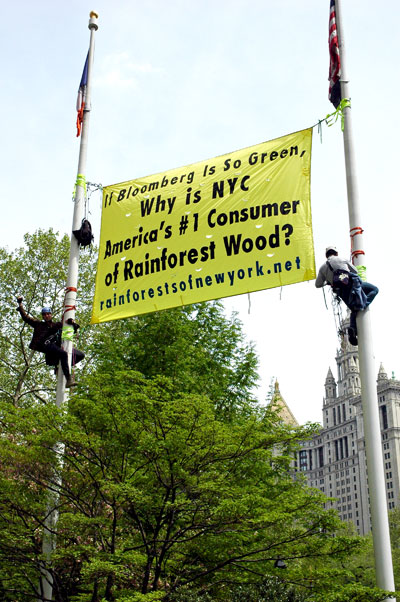
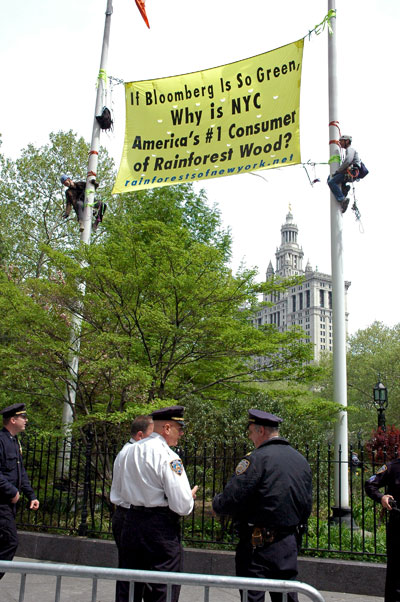
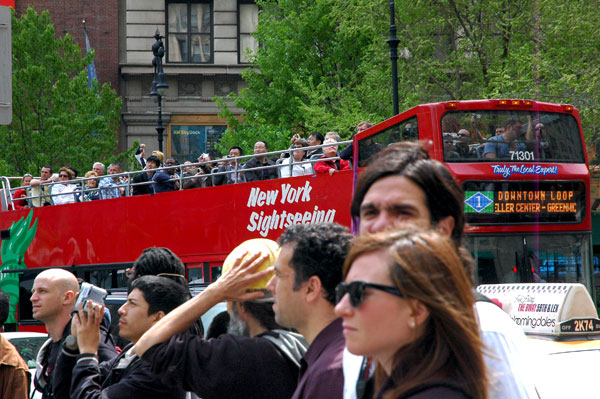
Two intrepid activists from the group, “Rainforests of New York” (yeah, New York rain forests: we’re actually the country’s #1 ongoing consumer of the irreplaceable wood from the planet’s vanishing tropical rain forests) at midday today shimmied up two of the 40-foot flagpoles planted at the foot of City Hall Park. There the team, Tim Doody and Tim Keating, masterfully strung a handsome 150-square-foot banner broadcasting, to Mayor Bloomberg, the people of New York, tourists on foot and sitting in open-top buses, and by now the whole world, the gross hypocrisy of a city which talks green while refusing to acknowledge its dependence on “exotic wood” products purchased (with public money) from those whom our building appetites reward for continuing to destroy rain forests and altering the entire world climate.
The action was organized by Rainforest Relief and the New York Climate Action Group [NYCAG]
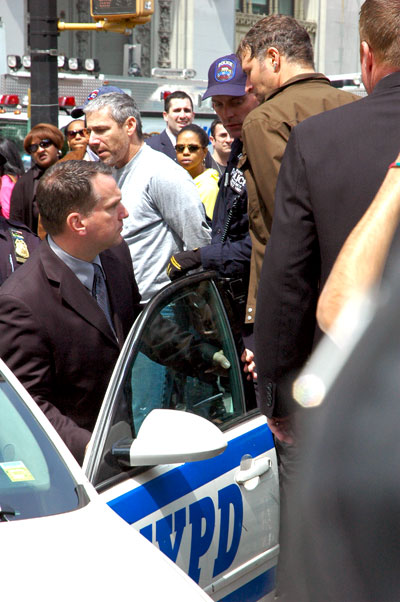
The banner was unfurled some time after noon, and it was still in place at 1:45 pm, well after the triumphant climbers had lowered themselves to the ground. They were arrested by gloved members of the “Police Emergency Service” while being hailed by the supportive lunchtime crowd, which then saw them driven off to the First Precinct.

rainforest_bannner_17.jpg

rainforest_bannner_23.jpg

rainforest_bannner_22.jpg

rainforest_bannner_31.jpg

rainforest_banner_63.jpg

rainforest_banner_67_b.jpg

rainforest_bannner_95.jpg

Harold and Clay: bond annulled, separated, effects seized

Before_Stonewall_2.jpg
[still from the documentary, “Before Stonewall“; it is not a picture of Harold and Clay]

UPDATE: County settles with Clay out of court

ADDENDUM: This is a link to a page on the NCLR site which includes a picture of the couple and more of a background on what they had together, and what was taken from them. Note also that Harold and Clay had taken the precaution of naming each other both beneficiaries of their respective estates and agents for medical decisions, and the authorities still proceeded as if they had no personal or legal relationship.

This is the basic story: Harold Scull, 88, and Clay Greene, 77, a couple for 25 years, and living together for 20 years, were physically and permanently separated, forcibly, when Harold was injured two years ago in a home accident. Clay was not permitted to see his partner or have any say in his care. Their property was summarily seized and auctioned off to pay for Harold’s medical care and for the cost of the separate nursing homes to which the county had assigned them. Harold died a few months later and Clay was only informed of the fact days after. Neither had seen the other in the interim, and the home, possessions and virtually all property and personal mementos they shared had been disposed of by the county.

When I heard about these horrors via an email from a friend I first thought was that the account must be an invention, perhaps a cruel scam, but then, registering the integrity of my source, and seeing the story verified elsewhere, I was horrified and revolted. My stomach turned.
This is the kind of thing many might have thought could only exist as an invention, a hypothetical worse-case scenario constructed to help advance an understanding of the importance of securing the human rights of a large portion of humankind in this country, and beyond. It certainly wasn’t something that happened in a civilized society today, to people like, well, us.
So, are we really living in post-Stonewall world?
The nightmare for Harold and Clay began only two years ago, and it didn’t happen in, say, . . . Arkansas. I’m picking on that state because, for me, there the political is personal: Arkansas is where my partner Barry was born and grew up, but we refuse to visit friends and family there, for a number of reasons, many of them related to the primitive laws and customs it uses to condemn and endanger relationships like our own.
No, this story unfolded in California, and in fact in the San Francisco Bay area. Moreover, the local media, in the form of the Sonoma County, New York Times-owned paper, the Press Democrat, has refused to cover the story or the legal case being advanced by the surviving partner, Clay Greene.
It’s pretty clear that queers still aren’t safe anywhere in this country.
I’m copying here the account which appears on the site of the NCLR [National Center for Lesbian Rights]:

Greene v. County of Sonoma et al.
Clay and his partner of 20 years, Harold, lived in California. Clay and Harold made diligent efforts to protect their legal rights, and had their legal paperwork in place�wills, powers of attorney, and medical directives, all naming each other. Harold was 88 years old and in frail medical condition, but still living at home with Clay, 77, who was in good health.
One evening, Harold fell down the front steps of their home and was taken to the hospital. Based on their medical directives alone, Clay should have been consulted in Harold�s care from the first moment. Tragically, county and health care workers instead refused to allow Clay to see Harold in the hospital. The county then ultimately went one step further by isolating the couple from each other, placing the men in separate nursing homes.
Ignoring Clay�s significant role in Harold�s life, the county continued to treat Harold like he had no family and went to court seeking the power to make financial decisions on his behalf. Outrageously, the county represented to the judge that Clay was merely Harold�s �roommate.� The court denied their efforts, but did grant the county limited access to one of Harold�s bank accounts to pay for his care.
What happened next is even more chilling: without authority, without determining the value of Clay and Harold�s possessions accumulated over the course of their 20 years together or making any effort to determine which items belonged to whom, the county took everything Harold and Clay owned and auctioned off all of their belongings. Adding further insult to grave injury, the county removed Clay from his home and confined him to a nursing home against his will. The county workers then terminated Clay and Harold’s lease and surrendered the home they had shared for many years to the landlord.
Three months after he was hospitalized, Harold died in the nursing home. Because of the county�s actions, Clay missed the final months he should have had with his partner of 20 years. Compounding this tragedy, Clay has literally nothing left of the home he had shared with Harold or the life he was living up until the day that Harold fell, because he has been unable to recover any of his property. The only memento Clay has is a photo album that Harold painstakingly put together for Clay during the last three months of his life.
With the help of a dedicated and persistent court-appointed attorney, Anne Dennis of Santa Rosa, Clay was finally released from the nursing home. Ms. Dennis, along with Stephen O’Neill and Margaret Flynn of Tarkington, O’Neill, Barrack & Chong, now represent Clay in a lawsuit against the county, the auction company, and the nursing home, with technical assistance from NCLR. A trial date has been set for July 16, 2010 in the Superior Court for the County of Sonoma.
[there is a pdf link to the complaint filed in Clay Greene’s name at the bottom of the NCLR page itself]

Suggested media contacts:
Catherine Barnett, Executive Editor, The Press Democrat
Arthur Sulzberger Jr., Chairman & Publisher of the New York Times
Richard Berke, Assistant Managing Editor of the New York Times
Adam Nagourney , the chief national political correspondent for the New York Times

[image from flickr]

working title: Easter

emu_and_ostrich_eggs_greenmarket.jpg

Barry and I don’t observe anything religious, but we can’t help it if our historical memories kick in once in a while. Usually it involves a good meal, and there’s definitely one of those in the works for tomorrow, which happens to be the day celebrated as Easter by some.
Easter has come to be associated with colored eggs, but I think it was only a coincidence that I came across these giants earlier this week.
The picture is of some of the ostrich and emu eggs being sold by Roaming Acres (Sussex County, New Jersey) at the Union Square greenmarket on every Friday. The off-white and the dark blue/green colors are achieved without benefit of coloring. The big birds responsible, while hardly native to these climes, are actually local stock (as they must be, by greenmarket regulations, and in their case also “all natural”). The farmer himself sells the big eggs (one ostrich egg equals 18-24 chicken eggs) both fresh and hollowed out. He also offers ostrich meat and handsome ostrich leather goods, but the emu are cherished for their eggs alone (both with and without original content).
This picture, or one similar, will probably soon find its way onto our food blog, since I picked up a frozen ostrich fillet while I was there. We already have an ostrich egg sitting on a table in the parlor, one I brought with me when I moved back from South Africa 35 years ago, but I have my eye on one of those dark emu beauties.

“ECSTATIC” at St. Cecilia’s Parish

It’s probably not technically a pop-up show. It’s also not merely another spawn (if here a silver lining) of our continuing Great Recession, like most of the new spaces hosting new art in New York and elsewhere. Then could we be watching the birth of a Greenpoint Biannual, a shelter for the emerging artists’ own periodic “cross section of contemporary art production”, to borrow a phrase from the Whitney itself?
Barry and I were in the former Catholic St. Cecilia Convent last Sunday for the second time in six months. Once again Father Jim, the pastor of the parish had generously and visionarily turned the space over to some young curators and artists. The Round Robin Collective‘s “ECSTATIC“, both an exhibition and a series of events and performances, assembled by a group of invited artists, ends its four-week run this Sunday. An excerpt from the statement which appears on the show’s website:

While some of the participating artists’ work deals directly with notions of ecstasy, the title of the show does not allude to an overt theme in the work presented; rather, it refers to the process of making and encountering art and the results produced from inspired relationships.

Yes!
Three floors of the formerly-empty rooms of the nearly century-old building are filled by underknown artists with interesting new work in virtually every medium. I had been eagerly anticipating a visit, because of the pleasures we had encountered last September in the show put together by a different group of artists, but almost as soon as we walked in I thought I had died and gone to heaven. There are certainly great pleasures to be found in visiting museums and galleries, but they are nothing like those associated with the immediacy and serendipity of sharing in the work of good artists in any medium when they decide to put on a show with only a minimum of structure or system provided from without.
While some of the work may not completely unfold while competing with the intrusiveness of the abandoned-convent environment (just about the opposite of the clean white box so associated with the exhibition of art in the late twentieth century), in many if not most cases the circumstances of the installations seem ideal, oddly better than what a gallery might provide.
The list of artists includes: Lisa Boumstein-Smalley, Mary Billyou, Amanda Browder & Stuart Keeler, Caroline Burghardt, Lisa Caccioppoli, Ofri Cnaani, Chris Cobb, David Coyle, Jeff DeGolier, Martin Esteves, Gisela Insuaste, Jamie Kim, Stephanie Liner, Deirdre McConnell, Katherin McInnis, Emcee C.M., Master of None, Huong Ngo, Christopher Rose, Stephanie Rothenberg, Dorothy Royle, Matthew Spiegelman, Janos Stone, Cassie Thorton + Action Club, Jenny Vogel & David McBride, and Audra Wolowiec.
For more on “ECSTATIC”, see Daniel Pearce’s piece on IDIOM.
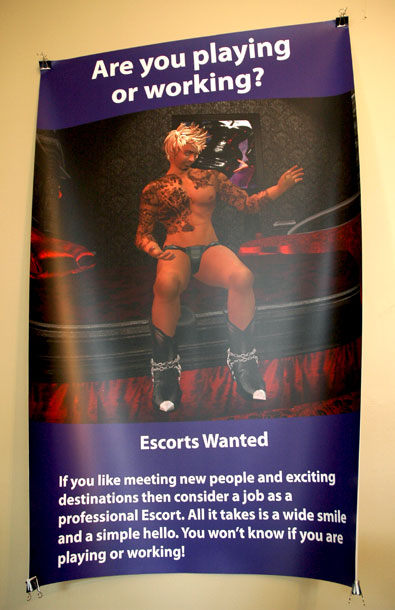
Stephanie_Rothenberg_Are_You_Playing.jpg
Stephanie Rothenberg
Stephanie Rothenberg installed a fairly-convincing office environment in a room just inside the front door of the convent. This image is of only one of a handful of posters suggesting advertising for an imagined employment agency. From the “Ecstatic” site:

Stephanie Rothenberg’s interdisciplinary practice merges performance, installation and networked media to create provocative interactions that question the boundaries and social constructs of manufactured desires. Her recent work investigates new models of online labor and the virtualization of the global workplace, referencing post-colonial as well as DIY historical precedents.
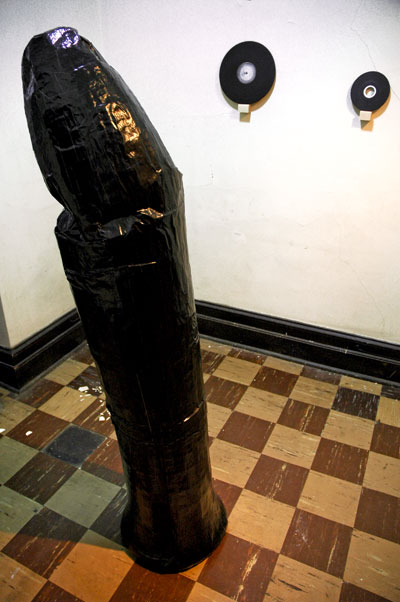
Martin_Esteves_Audra_Woloweic.jpg
Martin Esteves Come to Mock Stay to Rock and Audra Woloweic howl and sounds of silence
The advertised sole purpose of this five-foot-tall phallic standing sculpture, the work of Martin Esteves, was to fulfill the role occasionally assigned to its medium: Something you bump into while looking at the art on the walls. In this case, neither the sculpture, which rocks on a soft base, nor the bumpee’s soft rump would likely be harmed.
The filed-down vinyl records mounted on the wall are the work of Audra Woloweic, whose work addresses sounds, forms of communication and, according to the statement on her own site, “ephemeral moments of the everyday”.
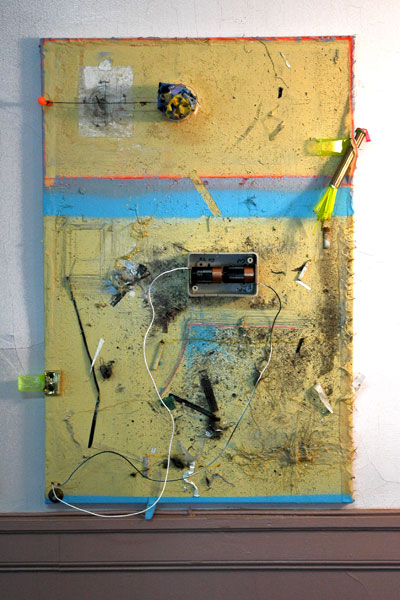
Jeff_DeGolier.jpg
Jeff DeGolier Stride 2009 hair, woodglue, duracell batteries, hair, spraypaint, housepaint, electric motor, wire, glue bottle, etc. on found canvas
Jeff DeGolier‘s gently-animated piece appeared to be both an integral part of the disintegrating interior of the old building and its (please excuse the expression in this context) its transfiguration.
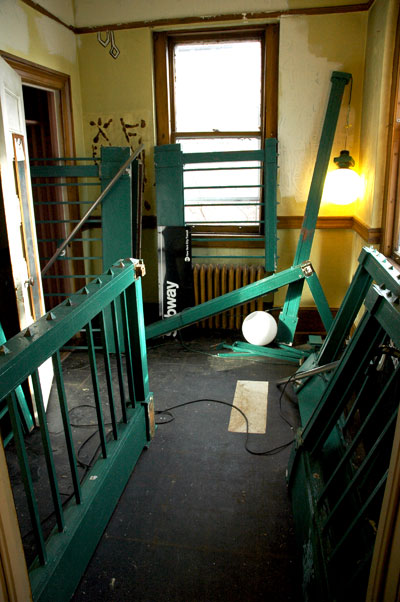
David_B_Smith_Brina_Thurston.jpg
David B. Smith and Brina Thurston
David B. Smith collaborated with Brina Thurston to de-install her large site specific outdoor sculpture from a show ending at Socrates Sculpture Park, cut it into pieces small enough to fit into his car, and re-install it in a small residential room in the convent. The original sculpture, entitled Master-Station, is a life-size replica of a NYC subway entrance, complete with functioning globe lamps.
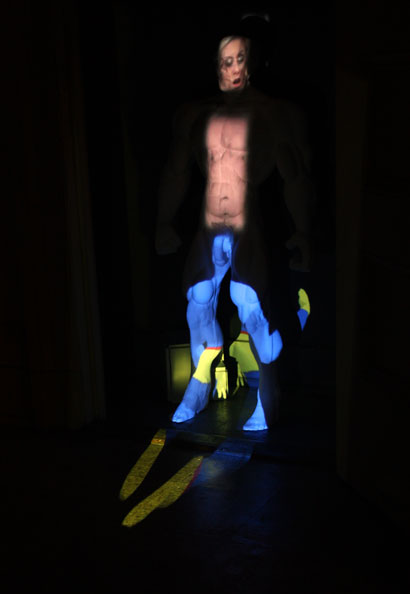
Janos_Stone_Someone_Like_You_the_artist_photo.jpg
Janos Stone I Never Thought I Would Meet Someone Like You
Janos Stone‘s installation began with his creation of a monstrously-muscled heroic nude male figure upon which three distinct images were projected, changing male and female faces of porn actors at the top, pornographic videos in the center, and at the bottom a colorful Second Life figure. I’ve checked out his site since leaving “ECSTATIC” and we both visited with the artist on Friday night at his current show at SLAG Gallery, “LMIRL“, and talked to him about his future projects. My head’s now spinning.
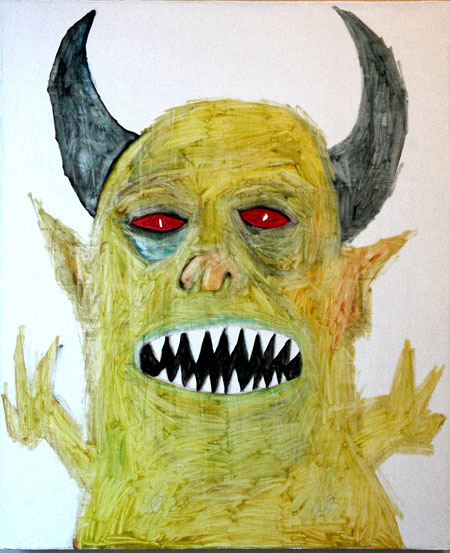
David_Coyle_I_Killed_the_Monster.jpg
David Coyle I Killed the Monster 2008 oil on canvas 24″ x 20″
David Coyle‘s paintings appear somewhat unremarkable at first, but their severe honesty, humor, and (I don’t think I’ve used this word before) painterly grace brought me back to their small cell-like room several times.
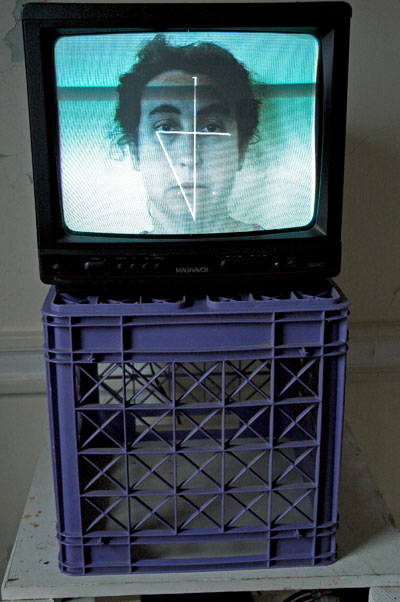
Mary_Billyou_monitor.jpg
Mary Billyou Subspace Face
A simply-rigged monitor showed Mary Billyou‘s looped video combining a severe frontal view of the artist’s own face with a simple matrix, and was a part of a larger installation with a strong historical context. While it was fairly mesmerizing it remained pretty enigmatic absent more information.
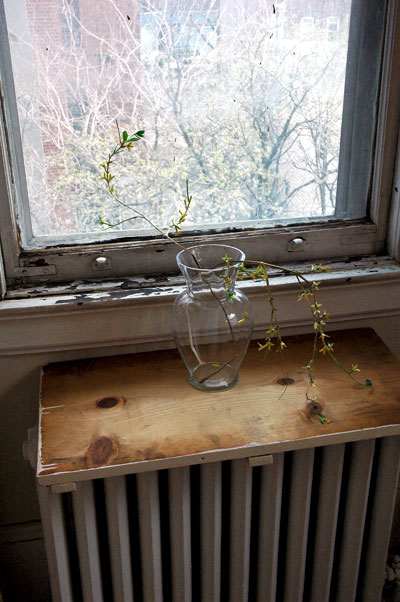
Dorothy_Royle_Forsythia.jpg
Dorothy Royle
Dorothy Royle’s installation of a glass vase of hand-made forsythia branches just inside a window was literally an unfolding performance: The artist visits the site regularly to gradually open up, and wither. The label informed us also that “. . . bright green leaves will grow from ends of the strongest branches. Inevitably, some petals will fall”.
Emcee_C_M_Master_of_None.jpg
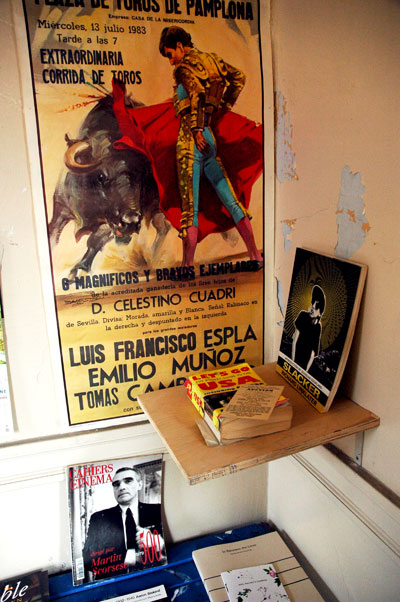
Emcee C.M., Master of None Reading/Radio Room
The installation by this collaborative, which tells us that its work always “combines large-scale public, social and collaborative event-based projects with a more internal process of self-reflection through fiction, storytelling, and filmmaking. This corner of the building, titled “Reading/Radio Room”, could easily cocoon a visitor for hours.
Ofri_Cnaani_turntable.jpg
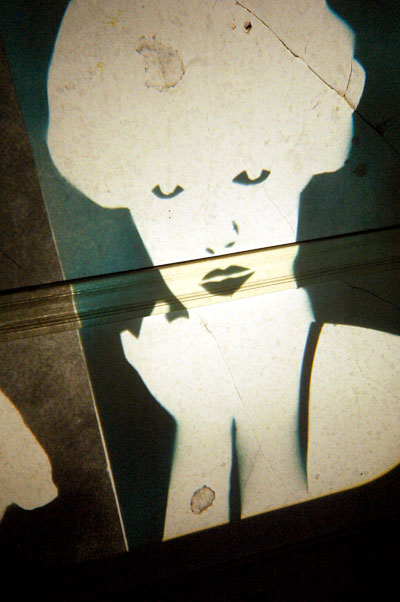
Ofri Cnaani
Ofri Cnaani‘s art evokes the magic of the ancient magic lantern, but she addresses gender, architectural space, myth and reality in seductive imagery and movement. I first encountered her work in 2008 and I find myself captivated once again.
Matthew_Spiegelman_3.jpg
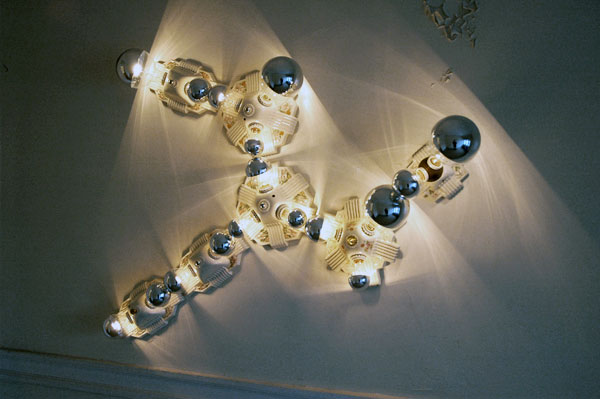
Matthew Spiegelman
Matthew Spiegelman has assembled several lighting installations inside the convent, each of them abstracted from homey old lighting fixtures and each more infectiously joyful – and oddly spooky – than the next.
Amanda_Browder_hands.jpg
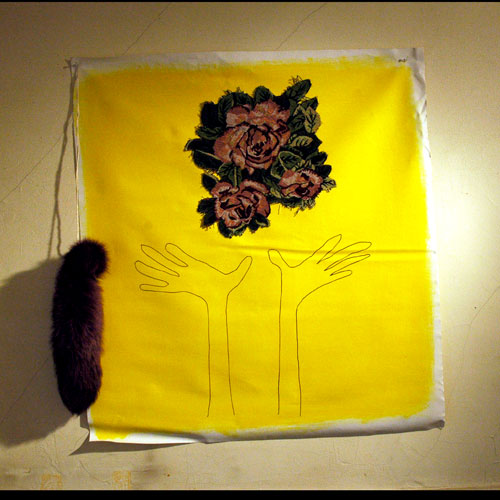
Amanda Browder Future Telling 2010 discarded (found): painted canvas, embroidery, marker, fur
Amanda Browder‘s piece was in a room which appeared to include both her own work and pieces done in collaboration with Stuart Keeler, but this piece appears to be identified as her own creation.
Action_Club.jpg
Cassie Thornton + Action Club
I haven’t been able to track down anything on the installation identified as “Cassie Thornton + Action Club” (or, variously, “Action Team”), but the planned chaos of the broom closet-size installation pictured here, and the scrim composed of countless found objects of all sizes which has been assembled in front of the third-floor hallway window just beyond, somehow suggested an advanced postmodern intelligence, and the scrappy art which can ultimately humanize it.

[Janos Stone image from the artist]

BAMart Silent Auction Ends at 8PM Today

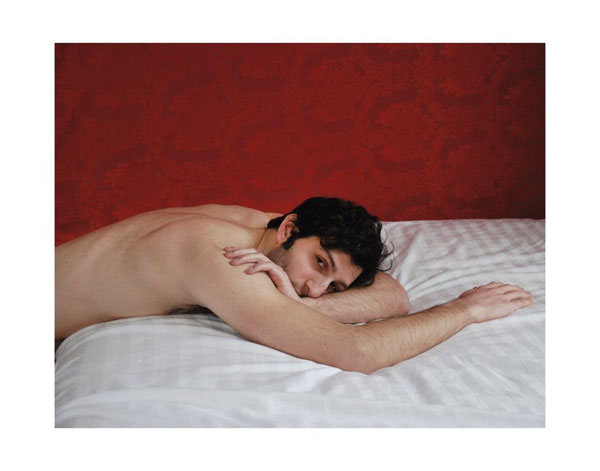
DoeringerEric_Kawara.JPG
image from Eric Doeringer’s “Bootleg Series”, in a group combining five individual pieces, 2001-2005, all ink and acrylic on canvas, the works range between 5″ x 7″ and 8″ x 10″

Elkins-Amy.jpg
Amy Elkins David, New York, NY 2008 C-print, edition 1/5 11″ x 14″

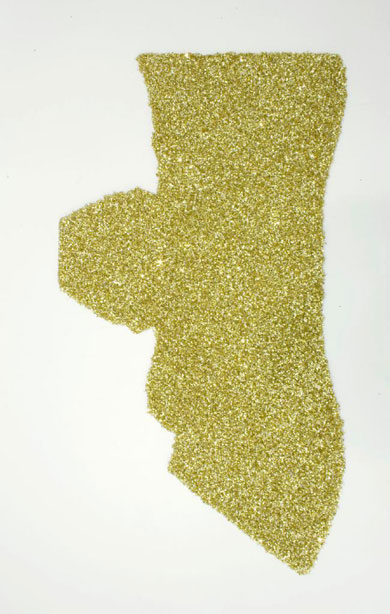
Feher-Tony.jpg
Tony Feher Untitled 2008 glitter and spray adhesive on unfolded box
11.5″ x 6.25″

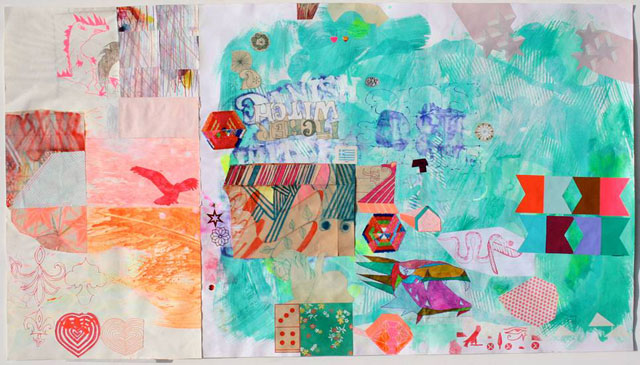
Chung-Donna.jpg
Donna Chung Untitled 2005 mixed media on paper 19.5″ x 35″

Hanson-Erik.jpg
Erik Hanson Ladies of the Canyon 2007 oil on canvas 20″ x 16″

Plumb-Colleen.jpg
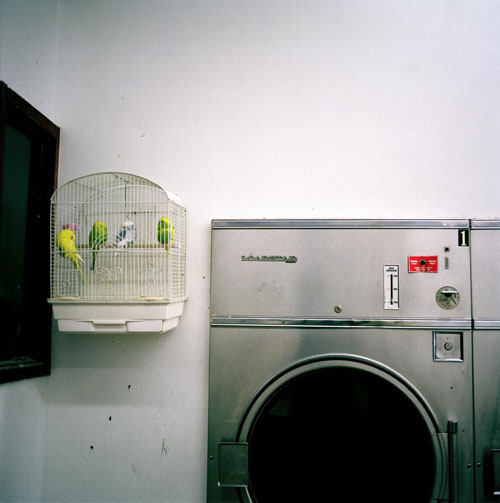
Colleen Plumb Laundromat 1997 C-print 19″ x 19″, edition 4/10

William_Powhida_How_the_New_Museum.jpg
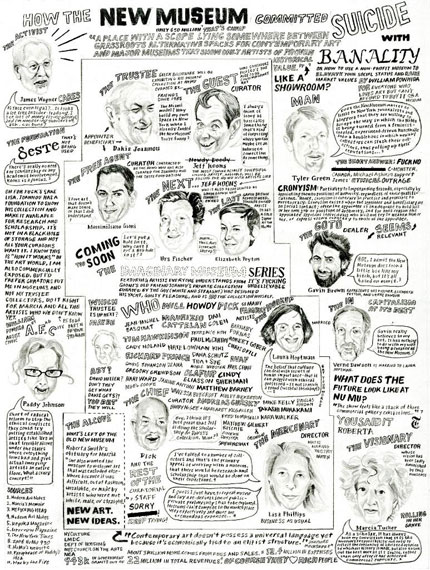
William Powhida How the New Museum Committed Suicide with Banality 2009 archival inkjet print on paper 17.5″ x 14″, edition of 20, AP 4/4

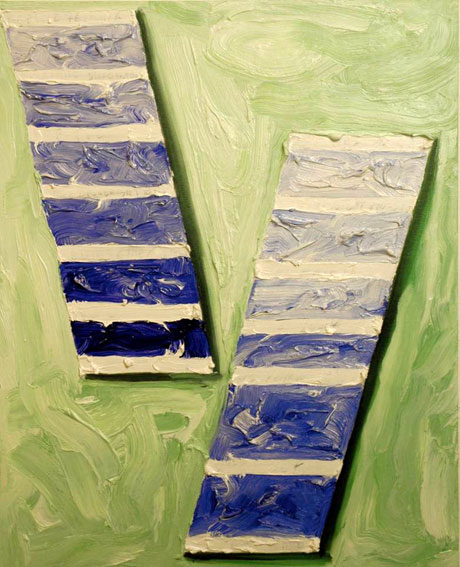
Braman-Sarah.jpg
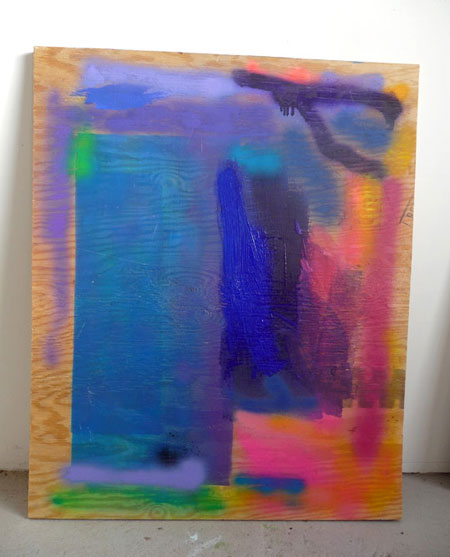
Sarah Braman Swimmy 2010 paint on plywood 35″ x 28″

Guenther-Andrew.jpg
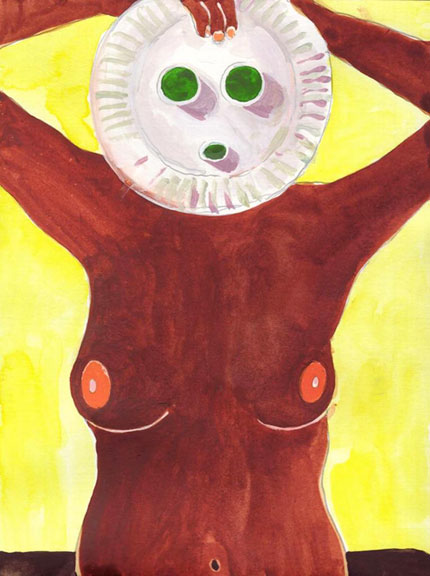
Andrew Guenther Plate Face (green eyes) 200 watercolor and pencil on paper
8″ x 6″

I just took another look at the BAMart Silent Auction site today and I ended up excited on two accounts: for BAM’s early success (many of the works are already above their estimates) and for the terrific opportunities available to patrons and visual art lovers who may have a little extra cash right now.
I’ve uploaded images of some of the works here, but there are some 150+ others on the BAMart site.
It’s not necessary to go anywhere to be a part of the event; the dedicated site shows all the works, describes the details, and makes it easy to bid.
The bidding ends at 8 this evening.

[images from the BAMart site]

potted spring excitement, with no bulb in sight

Wild_Chinese_Ginger_flower.jpg
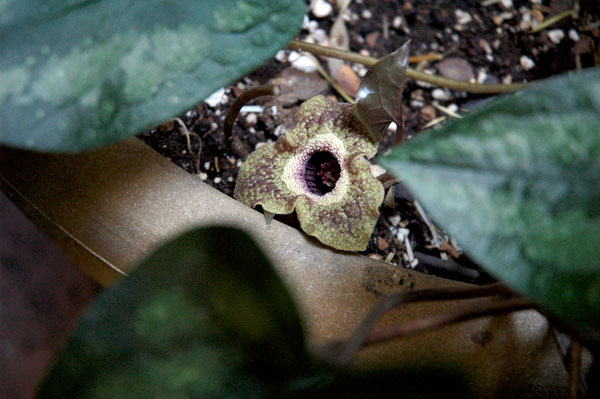
Chinese Wild Ginger Asarum Splendens

Spring comes to the sunless recesses of our roof garden.
I must leave to others, meaning anyone who can plant or is able to overlook gardens touched directly by the rays of our life-sustaining star, the delights of brightly-colored bulb flowers. Our own garden pleasures are more subtle, and sometimes more exotic.
The odd growth shown above is apparently a flower, but there is always only one (it’s in a pot after all). It appears each year at this time within the very healthy clump of evergreen wild Chinese ginger which has naturalized itself in one of our terrace pots. It’s surprisingly hard, or woody, to the touch. It is, as might be easily imagined, even more bizarre before it actually opens to (barely) announce itself: The first time I spotted it, at least five years ago, I thought it was a piece of debris fallen from an upstairs window. I was about to pull it out when I noticed that it was somehow connected to the tangle of shiny green leaves all around it which had miraculously survived the winter unaltered.
With all respect to the excellent mushroom and the magical truffle, this node? appears to be somewhere on the evolutionary ladder between fungi and what we think of when we say “flower”, regardless of its actual botanical status. While it certainly suggests a sexual appurtenance, it also looks like it would have no interest in, and no chance of, attracting the reproductive ministrations of a bee.

Iannis Xenakis, and some very good company

Xenakis_Pithoprakta_video.jpg
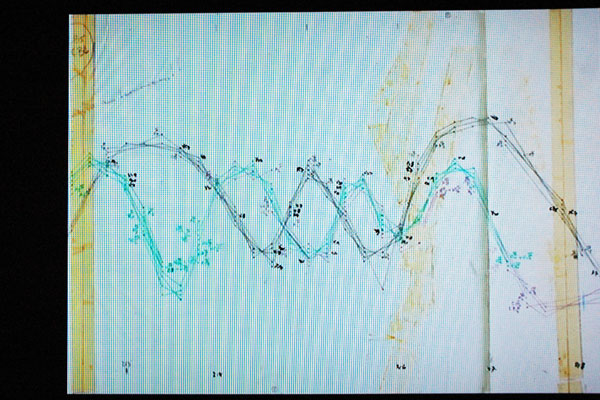
large detail of a still from a video of Iannis Xenakis’ “Pithoprakta” (1956), which has the composer’s sketches and renderings accompanying the piece itself [currently installed at the Drawing Center]

I love music, especially unfamiliar music, and since I’ve now been listening to the stuff for a good part of a century, that means my taste may not be shared with most people. The music of Iannis Xenakis (1922-2001) is a case in point, but judging from the fuss being made over this composer recently, and that without the excuse of a major anniversary, maybe I’m about to go mainstream for once.
It’s been a couple months since I first decided to do a post about the wealth of opportunities we’ve been given lately to hear the Greek-born composer’s powerful and very idiosyncratic music. It’s now the middle of March and most of the concerts to which I’d been looking forward have already happened. I’m ashamed to admit I’ve only been to two. The first was �Xenakis & Japan�, at Judson Church February 28, an evening of music and dance devoted to the composer’s interest in Japanese music and theater and presented by the Electronic Music Foundation.
I find it extremely difficult to write about music on this blog, even though all my life it’s been at least as important to me as the visual arts, and probably more so. I’ve had no significant education in anything other than the liberal arts (which, contrary to what some think, actually do not actually include any form of “art”). I am able to write about the visual arts at least tentatively, from my position as an unlearned, passionate observer, and not least because I have the help of a camera. The performing arts however are a serious problem for me, since I am normally unable to photograph the art, and stock promotion photos which are seen over and over again bring nothing new to the subject. The performing arts are an incredible challenge.
In fact I had little excuse to miss the opportunity of writing a short bit about Xenakis, since here there was a real possibility of including images. I’m thinking of the beautiful studies with which the composer rendered his aural creations on paper (creations which he sometimes described with performances in light and space as well). Maybe only John Cage‘s own lyrical (yes, lyrical) drawings could match their output, their dynamism, and their beauty.

john_cage_chess_pieces.jpg
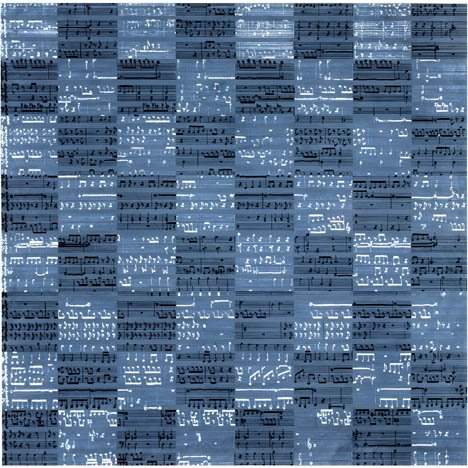
score for John Cage’s “Chess Pieces” (1944)

There were some eight or so concerts of Xanakis’ music listed on the press announcement released perhaps two months ago by the Drawing Center, and over the following weeks I learned about a number of others. We’ve now moved beyond all their dates, but the composer/architect/artist’s sketches and renderings remain on view on Wooster Street (with pretty extensive musical accompaniment on headphones) through April 8th.
In the second recent concert I attended in which his music was programmed it seemed to have been designed to play a minor role, as surprising as that may seem to anyone acquainted with it. In a concert at the Paula Cooper Gallery on Tuesday evening Xenakis was only one of three contemporary composers featured and his contribution was both the shortest and the only one which did not require a dozen or more players.
In addition to the visual art she exhibits in her eponymous gallery, Paula Cooper has always hosted, in the description found on the gallery site, “concerts, music symposia, dance performances, book receptions, poetry readings, as well as art exhibitions and special events to benefit various national and community organizations”. The page also reminds us that, “For 25 years until 2000, the gallery presented a much celebrated series of New Year�s Eve readings of Gertrude Stein�s ‘The Making of Americans’ and James Joyce�s ‘Finnegans Wake.’�
I remember many of these occasions, including two important ACT UP fund-raising auctions Cooper hosted in 1990 and 1991, which were extremely important for AIDS activism, and for me.
Gertrude Stein came back to the the Paula Cooper Gallery this week, through a performance of Petr Kotik‘s “There is Singularly Nothing”. The instrumental frame of the performance, by his own instrumental group, The Orchestra of the S.E.M. Ensemble, was an intensely-elegant affair. This roughly one-hour work, which incorporates a delicious text [“Composition as Explanation“] from Gertrude Stein, an American treasure, was first performed in the early seventies and re-invented, with different directives to the four singers, for the March 16 performance.
Collaborating with the SEM for the evening was the new-music concert series, Interpretations 21. A small vocal ensemble, augmented by Thomas Buckner and Gregory Purnhagen, who had solos in the Satoh piece, was shared by the two larger works.
The concert had begun with the world premier of Somei Satoh‘s “The Passion”, an oratorial using an abbreviated version of the Christian biblical text described by the name. I cannot account for the choice of subject by a Japanese composer whose own experience and music are both actually founded in the philosophies of Shintism and Zen Buddhism. I did recognize some poetic allusion, although perhaps accidental, in the fact that the performance of this Passion took place in a room dominated by a full-size sculpture of the scaffold used to hang the workers known as the Chicago anarchists or “the Haymarket Martyrs” in 1887. The installation was created by Sam Durant, the artist currently being exhibited in the gallery, whose recent work work has dealt with capital punishment.
Xenakis’ 1976 virtuoso piece, “Mikka ‘S‘”, for solo violin, followed the Satoh piece. The performer, Conrad Harris, stood high above the audience, at one corner of the scaffold Durant intended, bare of all but its familiar water dispenser, to double in function as a worker�s break room.

A postscript, from the text of the Kotik piece, Gertrude Stein on “modern composition”:

Those who are creating the modern composition authentically are naturally only of importance when they are dead because by that time the modern composition having become past is classified and the description of it is classical.

[image of Cage’s notations from greg.org]

the last hour of Man Bartlett’s “24h #class action”

Man_Bartlett_the_last-balloon.jpg
the last balloon

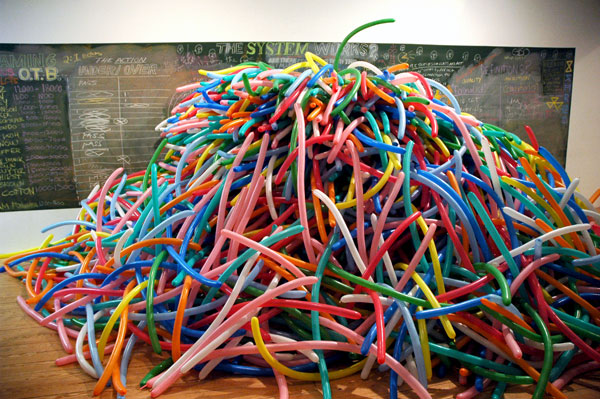
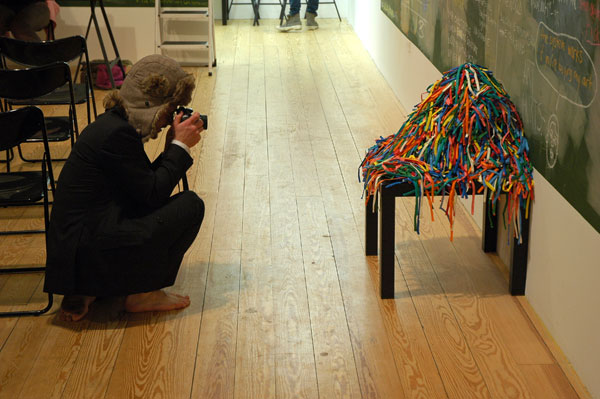
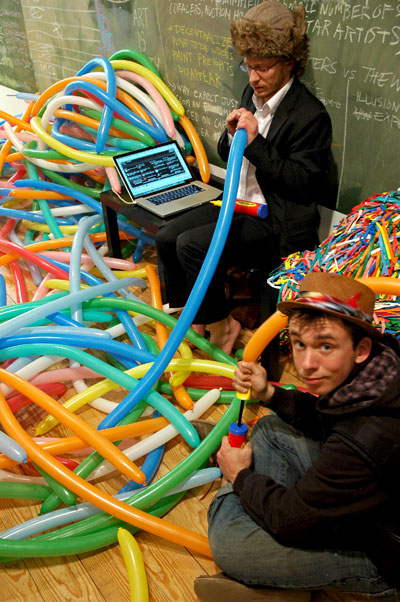
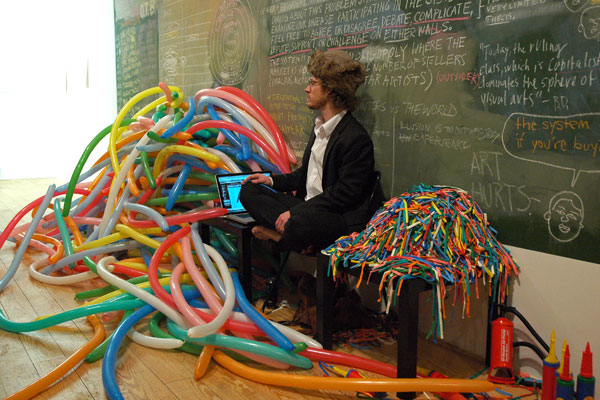
I had contributed something like a hundred or so inflated balloons to Man Bartlett’s “24h #class action” the day before, but when I arrived at Winkleman Gallery Thursday afternoon around 4:15, almost 24 hours later, it was too late to add to my score. The artist however had been going strong all that day and throughout the night before. I managed to capture one of the last long, narrow balloons he tossed onto the sculpture from the cubby he had created behind it.
Thousands of inflatables were about to disappear at the stroke of a pin, without ever having achieved a single polished mirror finish.
It was picture time.

Man_Bartlett_cubby.jpg
the sculptor and his tools

Man_Bartlett_initial_attack.jpg
final group intervention commences

Man_Bartlett_blood_lust.jpg
the attack underway

Man_Bartlett_last_gasp.jpg
last pops/wheezes

Man_Bartlett_shells.jpg
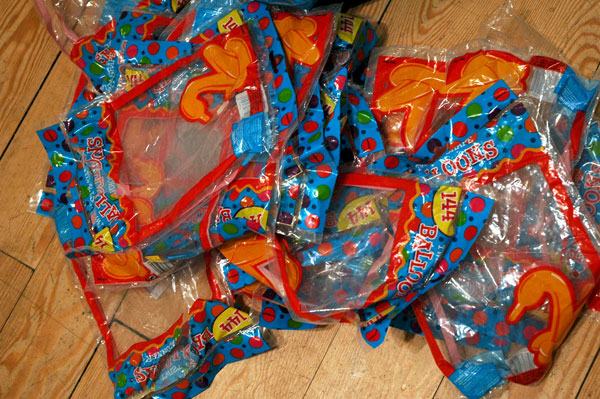
empty packaging, sadly showing suggested Koonsian applications

Wednesday’s crowded #class schedule

Man_Bartlett_balloon_potential.jpg
not a puppy in site

Wednesday’s schedule for #class began at 2 with a “Feminist Tea Party” hosted by artists Caitlin Rueter and Suzanne Stroebe. I saw some of it at home on the streaming video (while drinking coffee) but was unfortunately not able to make out most of the discussion. I arrived at Winkleman just as they were leaving with the accoutrements (tablecloths and porcelain cups; the finger sandwiches, cookies, and cupcakes presumably having already been shared with the issues).
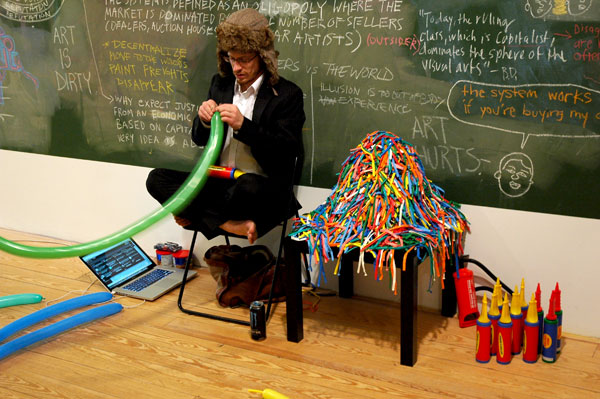
Man Bartlett was just about to begin his own much-anticipated 24 hour event, “24h #class action“, described on the site as “a marathon group intervention involving systematically blowing up hundreds of skinny balloons and popping them, without creating or harming any cute little puppies.” Any reference to proceedings inside the big bucks Olympian “art” world of bright shiny stuff, paid santa’s workshop helpers, and undisguised commerce – certainly including the current New Museum show – is not a coincidence. More from the artist:

A simple physical action, over time, can radically shift consciousness, specifically when combined with �real� and �virtual� social interactions. It is in this context that �24h #class action� plans to poke a pin into Koonsian psychological dramas.
Beneath its surface this intervention is an exercise in futility and one of joyous absurdity. The balloons will only take their long, phallic shape, without further form, and will eventually be liberated or executed. Is it possible to both celebrate and critique? Does it matter that risks were taken by Koons (and others) to create this ridiculously expensive series? Is ambition alone worth applause? Is the fact that 5 balloon dogs were fabricated a triumph? Is it �relevant?� What I�m grappling with is a complex relationship to the artist�s work, and really to all Art and Everything. And duration exposes fascinating avenues in the headspace to drive down.
Or, you know, we�re just blowing up balloons that we get to pop at the end, which is fun too.

Man_Bartlett_snaps_stack.jpg
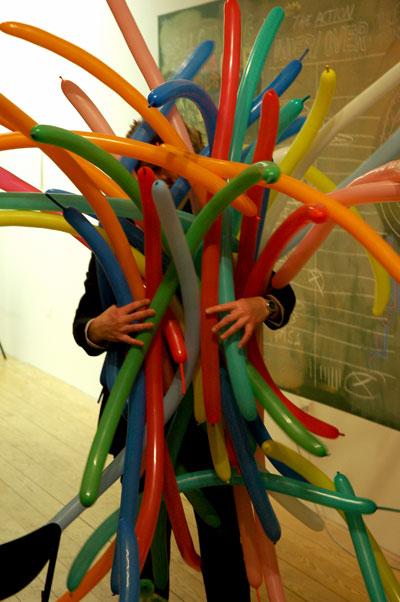
the artist contemplating his canvas

Man_Bartlett_holding_balloons.jpg
and getting into his metier

Man_Bartlett_starting.jpg
less than 24 hours to go

Man_Bartlett_Shalin_Scupham_balloons.jpg
Shalin Scupham joins the “group intervention”


Man_Bartlett_Watching_Magda.jpg
the artist during Magda’s presentation

Bartlett and his helpers began blowing up balloons at five, but took a break a little over an hour later when Magda Sawon of Postmasters Gallery arrived to host “Ask the Art Dealer.” She had vowed to “truthfully answer any and every question posed to her as long as it does not involve her weight, social security number or other people’s money.” She was incredible. Barry and I had already thought of her as a community hero, but now she belongs to the world.

Magda_Sawon_#class.jpg
Magda holds the room enthralled

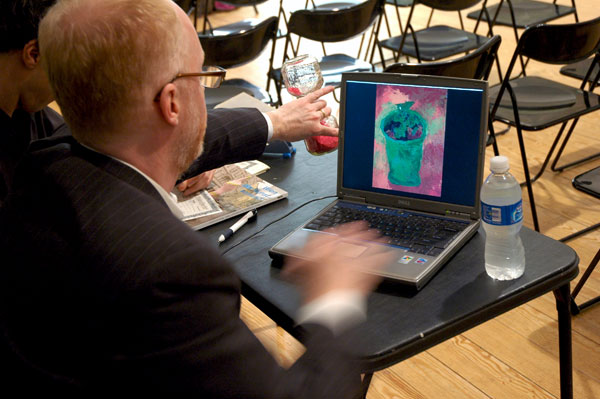
Ed Winkleman, the gallerist who made #class possible, was also in the space yesterday, with the third session of his own intervention (as a gallery owner) in what he had titled, “Shut Up Already…I’ll Look at Your Art!“. The project, the fruit of an artist’s “anonymous proposal”, according to Winkleman, (someone tell me whether that anonymity is still being maintained) has him working out a pledge that he would spend a portion of his time during #class in viewing, for no less than 10 seconds each, images submitted via an open call on the internet. The third of seven rules specifies that he and his guests would be “monitored by a volunteer as they view the work to assure full compliance with the rules.” On Wednesday his monitor was the artist Bernard Klevickas. Images of work he has seen can be found here.

Ed_Winkleman_Shut_up.jpg
a very open call