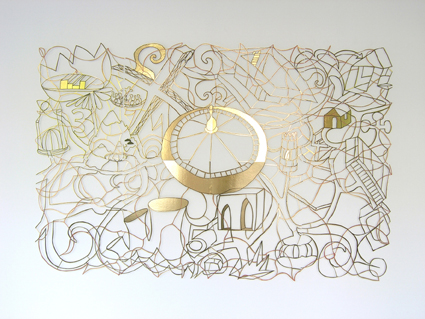
Stefan Saffer Goldkante [Gold Edge – ed.] 2004 marker, golden foil, cardboard, cut-out, shadow on the wall 81″ x 120″ (8 panels)
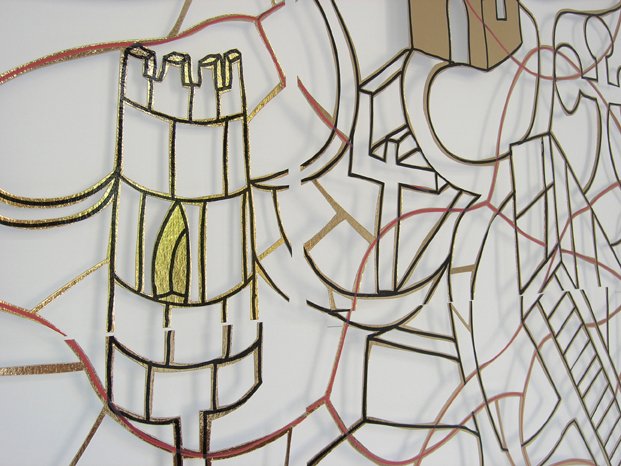
Goldkante detail
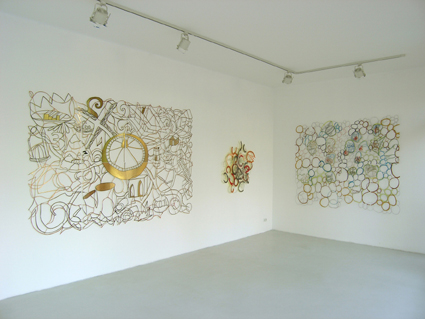
installation view with Goldkante on the left, Bohemia on the right, center piece not identified
We first saw the German artist Stefan Saffer’s work last year at a studio show of the Whitney Independent Study Program (ISP). We really liked it at first sight, and our enthusiasm has built with every exposure since. We almost missed meeting the artist that first afternoon, but someone pointed him out to us as we were leaving and he became instantly unforgettable. Saffer is an articulate, and charming, intelligent and well-educated artist with an extraordinary familiarity with and curiosity about his world. His honest and open face is wonderfully distinctive, but perhaps the more remarkable considering the usual fine scale of his adopted medium he is also impressive for his heroic size (I checked, his hands alone seem to be larger than mine, and I have a span of nearly ten inches).
Saffer creates gorgeous, delicate-appearing paper (usually) cutouts which evoke entire literary (usually) worlds in wonderful graphic almost-narratives which will reveal their secrets to the patient viewer, but only reluctantly. Each of these truly sculptural pieces, whether worked from a sheet of thin cardboard only a few inches in length and resting on pins projecting from a wall or cut from heavy sheet metal and installed in a public square, boldly resists confinement to the two dimensions normally expected of its form. Because of its relationship to the wall or physical space outdoors, Saffer’s work is always three-dimensional – at the very least.
The shadow which gives the paper works such dimension is probably seen to the best advantage in the image of the artist’s Forest below.
Because of the richness of their sources and their materials, and the artist’s creative imagination, these pieces never come close to repeating themselves. Lately Saffer has begun to experiment with using more than one layer of cut material, so it’s clear we’ve only begun to see what he can do. Although his curriculum vitae is very impressive, he looks like he may still be in his twenties.
Saffer’s galleries are müllerdechiara in Berlin and Kate MacGarry in London.
Additional works appear below as thumbnails which can be enlarged by clicking onto the images.
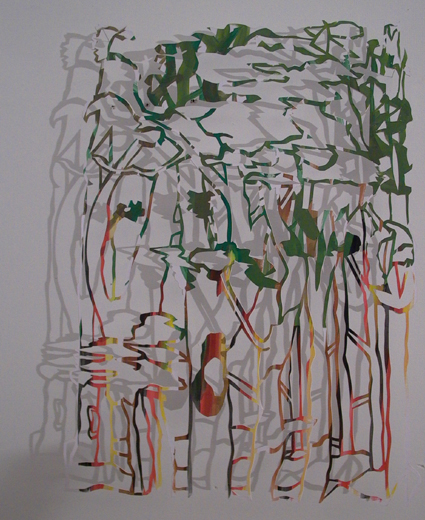
Stefan Saffer Forest 2005 gouache, lead pencil, cardboard, drawing cut-out, shadow on the wall 16″ x 23″

Stefan Saffer Rainer Maria 2004 the poem “the Panther” informs a small cut-out paper cage 10″ x 2″ x 6.25″
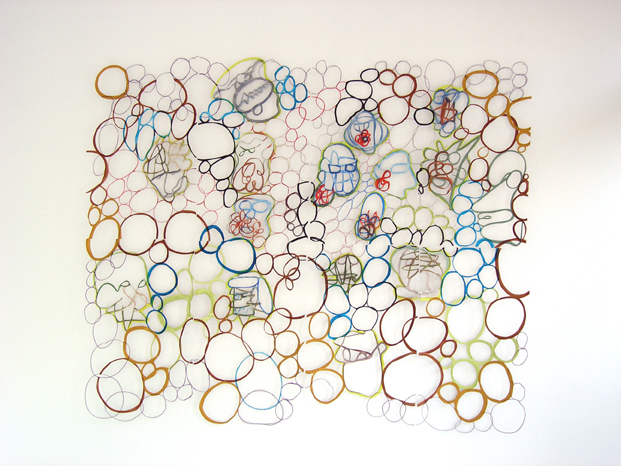
Stefan Saffer StagNation 2004 gouache, cardboard, drawing cut-out, shadow on the wall 81″ x 94.5″
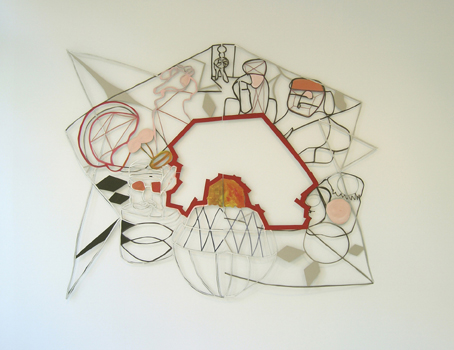
Stefan Saffer The Meeting 2004 gouache, color pencil, cloth tape on cardboard, cut-out, shadow on the wall 67″ x 78.75″ (4 panels)
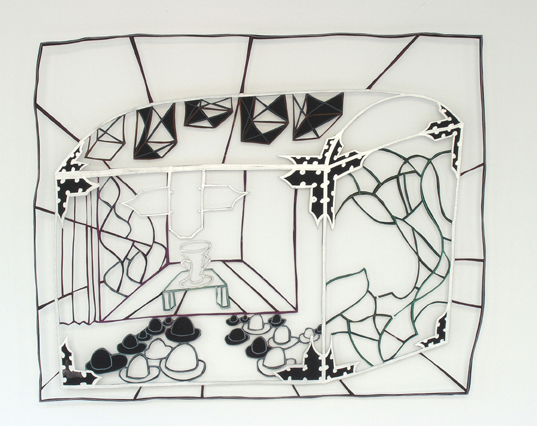
Stefan Saffer Bohemia 2004 color pencil, marker on colored cardboard, cut-out, shadow on the wall 45.25″ x 25.5″
[images from Stefan Saffer]
Jules de Balincourt at Zach Feuer Gallery
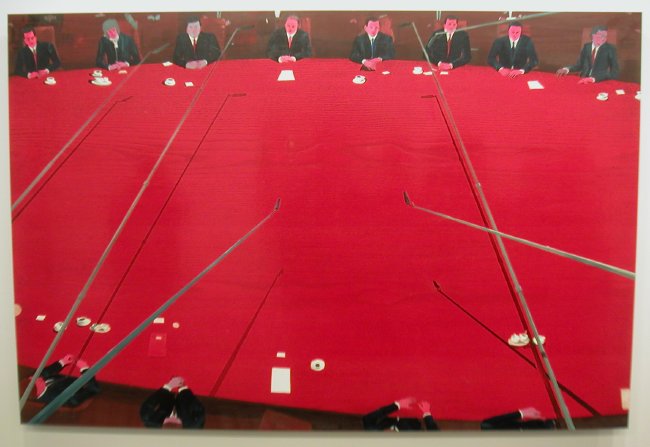
Jules de Balincourt The Watchtower 2005 oil, enamel and spray paint on panel 31″ x 39″
It’s just a terrific show.
Jules de Balincourt’s “This Is Our Town” opened at Zach Feuer’s 24th Street gallery tonight. Barry and I have two pieces we purchased two years ago, before his first one-man show at what was then called LFL Gallery. I have no idea what it would cost to enlarge our modest holdings today, but it wouldn’t surprise me if everything we saw there is already sold. That likelihood and especially our limited household budget mean that from now on I’m going to have to be content with visiting other spaces to see what this artist continues to do with a brush (and occasionally some spray paint or very-mixed media*).
But if it was both constructive and great fun being there early as excited collectors, there’s still loads of excitement in the looking and I’d strongly encourage anyone interested in painting in this new Age of Terror not to miss the show. From the press release:
As suggested by the show’s title, taken from the scoreboard overlooking Madison Square Garden, “This Is Our Town,” explores a tension between leisure, survival, and the polarized paranoia between “us” and “them.” Themes of surveillance, destruction, and looming breaches of privacy comprise this series of playfully sinister works.
Righteous social or political outrage has rarely gone down so gracefully – or so beautifully. The colors alone are worth writing home about, but you’re going to have to be there to really see them.
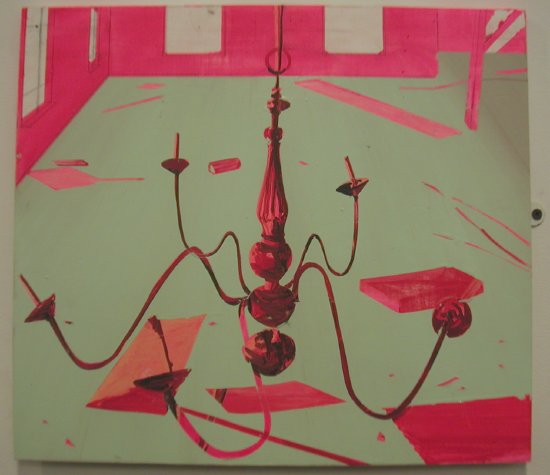
Jules de Balincourt Untitled 2005 oil and enamel on panel 13″ x 15″
*
Don’t miss the Personal Survival Doom Buggy. Well, actually there’s not a chance you might.
Bombay Talkie
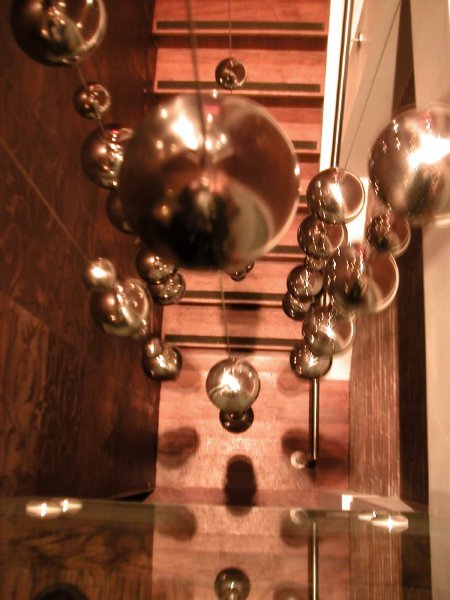
untitled (Talkie stair sculpture) 2005
Sorry, but I forgot to ask for specifics about the sculpture, since we were virtually closing the restaurant Wednesday night when I snapped this image and there was no one around at the time who might have been helpful.
We were leaving our new neigborhood “nouvelle” Indian restaurant, Bombay Talkie. This had been our third visit, a late supper with a friend following the new David Mamet play at the Atlantic Theater Company. Our little party gave mixed reviews for both the restaurant and the play, but in Chelsea, which sadly does not have a single really decent restaurant (okay, maybe one), the fact that the run of this convenient and at least slightly diverting eatery will be longer than the somewhat baffling “Romance” means that we will probably be back.
Federico Solmi at Boreas
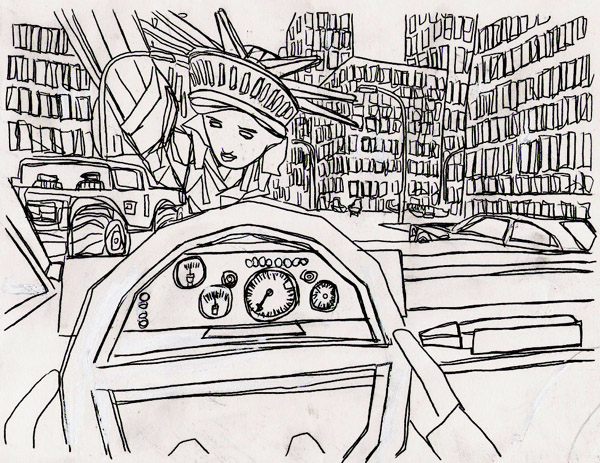
Federico Solmi Rush to Hospital II
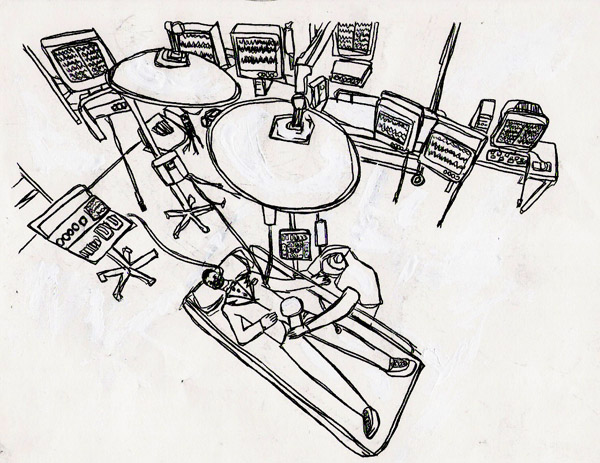
Federico Solmi Inside Hospital
Federico Solmi has this fantasy (fantasy fantasy?) about being Rocco Sifreddi,* super-celebrity, fellow-Italian porn star, and he has hand-drawn some 400 frames in order to assemble his own four-minute animated movie, “Rocco Never Dies.” The gallery site offers an excerpt for viewing.
But although in the film Rocco actually does die (of a heart attack, after participating in a large-scale orgy strapped-down as an important cog in “The Fucking Machine”), judging from his own much more creative role in this exercise, Solmi should have a great (art) career ahead of him.
Now that I brought it up, I think I should include an image of that infernal machine, so here it is:
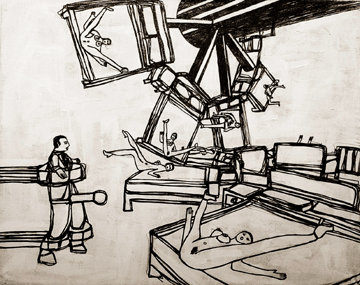
Federico Solmi The Fucking Machine
This neat little show, installed in the second gallery at Boreas, includes a large number of related drawings and several paintings. The paintings are executed on a stiff gauze medium, lightly prepared with a white base, before they receive the elegant line of his black marker. They are extremely attractive, as much as objects as for those beautiful black lines. New York, by the way, has rarely looked so exciting, with the tops of both the Statue of Liberty and the Chryler Building lodged akimbo in the middle of its busy avenues.
Full disclosure: I had seen several works by Solmi over the last year or two and I was intrigued. Late last year we were happy to bring home one of his small enigmatic paintings from the D.U.M.B.O Arts Center benefit, and it now hangs in our apartment. Here is the image, created originally as part of his “Safe Journey Exhibition” (2002-2004):
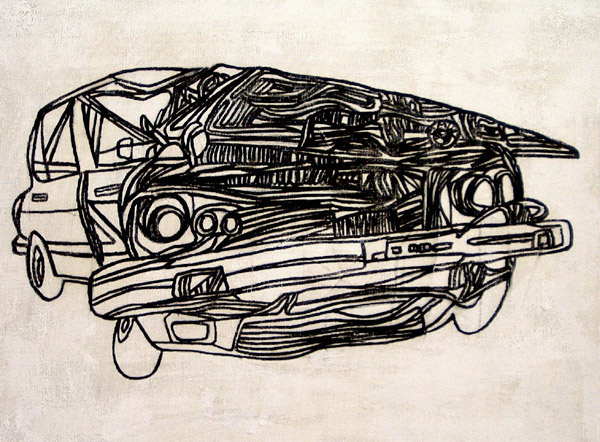
Federico Solmi Was a BMW oil marker on shaped gauze canvas 9.5″ x 12″
*
I’d never heard of him until I read about this show, even though IMDb lists 252 films under his name. It must be the plots.
[top two images from Federico Solmi, where they are described as drawings; bottom two from Boreas, where the first is described as a still from the video]
Joe Ovelman at Connor Contemporary in DC
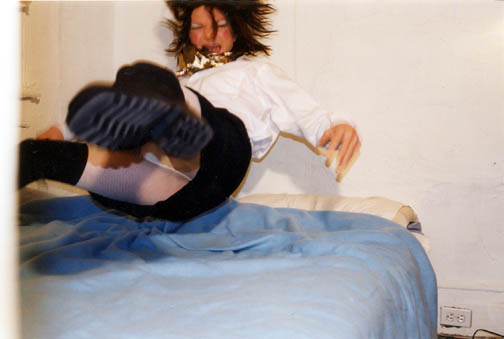
Joe Ovelman untitled (jump) 2002
Barry has a post which is a tribute to Joe Ovelman – and also to his D.C. gallery, Connor Contemporary, where his magnificent series, “Snow Queen” (or at least a large part of it) will be shown beginning this Friday.
The images above and below are earlier self-portraits, but Barry has included one of the Snow Queen images on his site. For five more, click onto the artist’s name on Connor’s site.
UPDATE:
Leigh Connor just sent me an email confirming that the entire series (18 works) will be shown in her gallery. She also refreshed my memory that Ovelman’s modest epic was shot in the Cental Park Rambles. This serves as a timely reminder, during the week which sees $21 million of “The Gates” dismantled and hauled away, that art has never been a stranger in New York’s noble greensward.
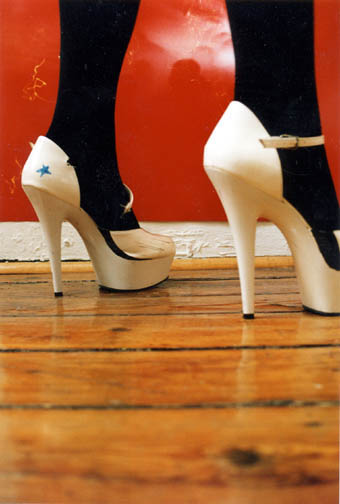
Joe Ovelman untitled (blue star) 2002
[images from Joe Ovelman]
snow tree
early this morning outside the north bedroom window.
I know I’ve snapped a picture of this little tree and uploaded an image before, and yes, even prior to that at least a couple more times, but it’s the only tree we have, and since I’m not sure it’s going to come back this spring I wanted to give it one more chance to shine.
Pretty little Shadblow.
now it’s St. James
Until this afternoon I was under the impression that you had to be dead before being addressed as a saint – unless you’re an American president of course.
Whatever. But this is indeed a RARE treat.
Monique Luchetti at The Phatory
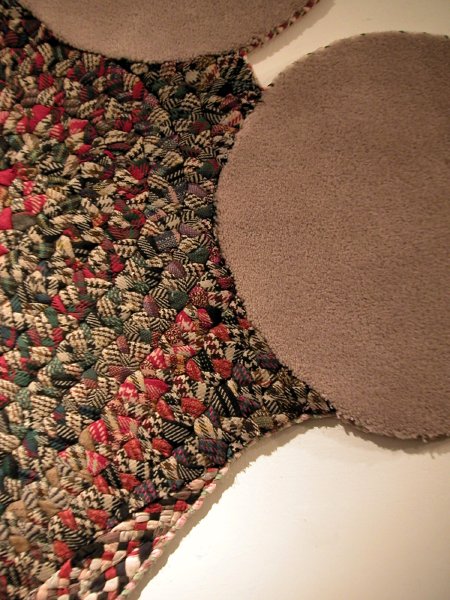
Monique Luchetti Thorn In My Side 2005 re-braided rugs and commercial carpet, detail
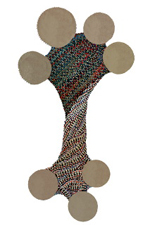
Thorn, full image
Like so many of her contemporaries, male and female, Monique Luchetti delights in bringing what has been conventionally regarded as “women’s work” to the sacred precincts of the art gallery. In her current show at The Phatory, “RNA,” a practical domestic tradition has become almost completely transformed, far beyond the (considerable) labor involved in her physical alteration of (mostly) found materials. These “canvases” evolve into economically-constructed, powerful, abstract and timeless worlds. Or, as the press release would have it,
For this show, Luchetti presents work using second-hand braided rugs and other floor coverings, which she pulls apart and reweaves into works of art. As in cellular regeneration, Luchetti’s work metaphorically decodes the aesthetic blueprints implicit in these formerly utilitarian objects, liberating them from their domestic duty. This transformative process extends the labor of the original weavers who, despite working within pragmatic and cultural confines, imbued their rugs with their own visual aesthetics.
There are now additional images, including some works on paper, uploaded onto Luchetti’s website. Many of these pieces are in the current show, but there’s much more.
[second image from The Phatory]
woods
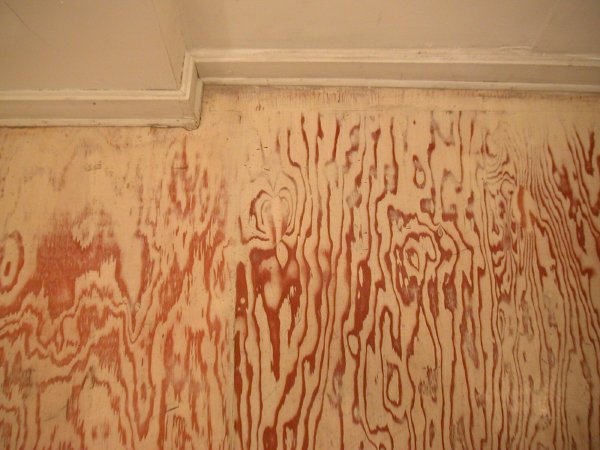
untitled (Phatory floor) 2005
Vincent Skeltis at 31 Grand
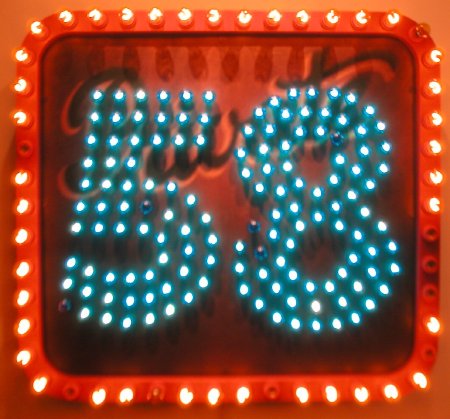
Vincent Skeltis Mel’s Corral #58 2004 metal, incandescent bulbs, photograph, plexi-glas 48″ x 48″ x 9″
31 Grand‘s press release says that Vincent Skeltis’s show, “Nowhere But Up,” among other things, “explores the death of the American nuclear family.” I suspect that the only thing which has really changed about that almost mythical societal arrangement is what photography can now do, in the hands of an artist, to tell us about it.
This particular family happens to be Skeltis’s own. He has installed a haunting show of photographs and artifacts describing the parallel lives of a father who disappeared into dissipation when his son was four, and the son who by his own admission was well on the way toward destroying himself when their paths crossed twenty-one years later, only ten months before Vincent Skeltis, Sr. died.
It’s a dizzying array of images, of men, women – and things – presented without sentimentality but also without any bitterness. Things happened, people remembered.
Art survives.
Barry and I were walking about Williamsburg with our friend Karen the evening the show opened, and had earlier run into two other friends visiting the same galeries we were. At 31 Grand I was still in something of a daze, struck by the honesty and the strength of what Skeltis had done, when Cory Arcangel and Noah Lyon came in with a mutual friend of their own, Alex Galloway. Cory really loved what he saw, and since I don’t think I’d heard it before, I took his own tribute to the show, “This is like real art!” for high praise indeed. There was no argument.
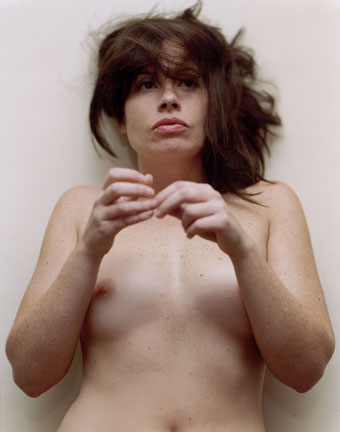
Vincent Skeltis Nude Portrait of Amy 2003 C-print 40″ x 30″
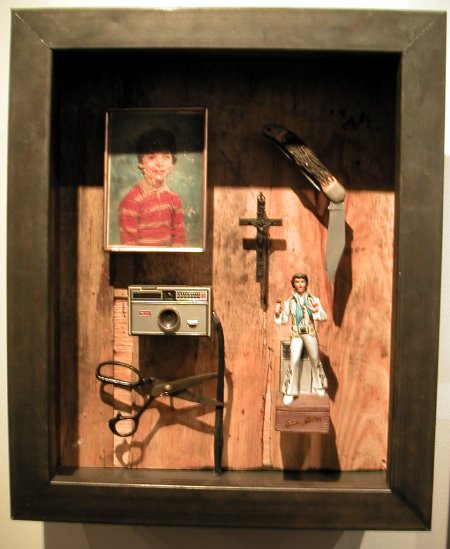
Vincent Skeltis All Things Considered 2003 framed photograph, pocket knife, cross, camera, music box/flask figurine, scissors, steel, plywood 23.75″ x 19.5″ x 6.75″
[image, “Nude Portrait of Amy,” from 31 Grand]