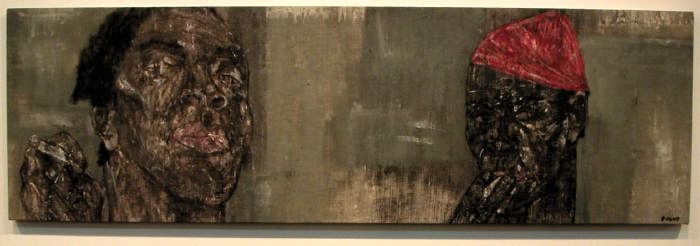
Leon Golub Two Heads (II) 1986 oil on canvas 21″ x 68″
It’s a terrific show, and don’t let thoughts like that expressed in the remark of the guy we passed on our way across 20th Street deter you. We heard him tell his companion, “If there’s one thing I don’t like it’s the politicization of art.”
Full disclosure: If you’ve been reading these pages for even a little while you already know that I have no problem with the “politicization” of art – any more than I have a problem with art which addresses any other subject. Man is both the creator and the subject of all art, and the root of the word, “politics” is the Greek word for “people.”
The Jack Shainman show was organized by Claude Simard and it will be up until March 12. The title is a mouthful to be sure: “The Whole World is Rotten: Free Radicals and the Gold Coast Slave Castles of Paa Joe,” and the content may be a headful, but there’s beauty and power in the images of the mid-twentieth-century activist reponse to centuries of racism, and the continuing engagement of contemporary artists, which are included in this exhibition.
And exhibition it is, at least so it is in the larger room, where the works are displayed almost as they might be in a museum of natural history. We were at the opening with our friend Karen who liked the work but complained that the show just wasn’t messy enough. Then she immediately added that her complaint “might just be the Group Material in me.” But I thought immediately when she said it that she was right about the room. The works were generally excellent, even at first sight (they will further reward a return), and the crowd was dynamic, but the walls were holding back.
Then we found the small gallery to the side, which was hung just right. There were posters, photographs and newspaper clippings hung imaginatively in something vaguely like salon style, and in the center one of Paa Joe’s large coffin replicas (there are two in this show) of slave castles from the Ghanian coast. Dynamite.
I’ve finally accepted the fact that I really do enjoy going to (some) openings, and the major lure, aside from the ties of friendship, must the be the kind of energy created by the crowd at the reception for this show.
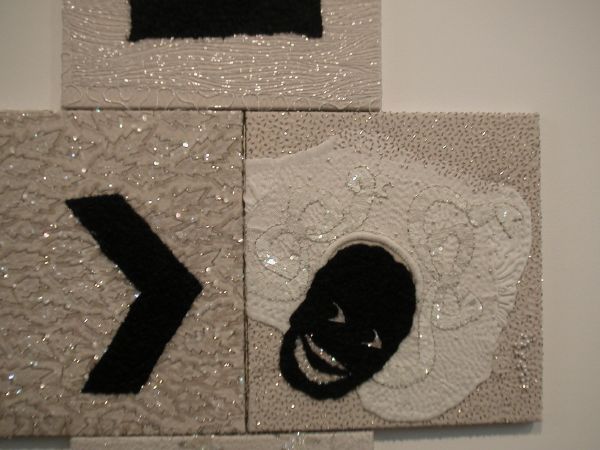
Nick Cave The Day after Yesterday 2005 human hair on found beaded and sequined garment fabric 43″ x 111″ x 1″ detail
AIDS hysteria II: incitement to violence?
The witch hunt has begun in earnest, and we won’t be the only ones hunting. The most insidious aspect of what is already taking on the appearance of a coordinated media campaign is the fact that it will be so difficult to fight back. The victims of ignorance and fear are put into a position where almost any response looks like it’s merely a defense of the right to use recreational drugs, fuck like rabbits and murder the innocent.
Obviously responding to the media’s recent hysterics over the first, sketchy report of a more virulent form of the AIDS virus, linked invariably with stories about promiscuous gays, Richard Cohen writes today in the Washington Post [I shouldn’t be too surprised, since this is a paper which also thought the Iraq war would be a good thing] that the buggerers must be condemned.
For too long now heterosexuals have kept out of this debate. Many of us have been protective of gays, seeing them primarily as victims of discrimination.
. . .
But while gays clearly have their enemies, that should not mean they are immune from criticism. The fact remains that a portion of the gay population — maybe 20 percent, [Charles] Kaiser estimates — conducts itself in ways that are not only reckless but just plain disgusting. Unprotected, promiscuous sex in bathhouses and at parties and using drugs such as crystal meth to prolong both desire and performance are practices that should be no more acceptable for gays than for heterosexuals. Gays don’t get some sort of pass just because they’re gay.
. . .
They are entitled to their own sexuality, but not to behavior that endangers others, costs us all plenty and, too often, entails a determined self-destruction that too many heterosexuals overlook.
. . .
Back in the 1970s William Ryan of Boston College popularized the term “blaming the victim.” It gave voice to a needed concept, but it also silenced critics who saw that sometimes the victim needed to be blamed. This is the case now with gays when their behavior is both stupid and reckless. When they’re victims of discrimination, they need to be defended. When they’re victims of their own behavior, they need to be condemned.
Why was this piece written? What’s his purpose, since he gives no helpful advice, offers no proposals? While I have no reason to think it’s not his intention, Cohen’s venomous piece sounds to me like an incitement to violence.
Finally, and this isn’t a rhetorical question at all: If the “carriers” are just gay men, why are he and his straight colleagues so worried about our health? I don’t have a good answer.
AIDS hysteria
AIDS and (recreational) drugs. It’s a dangerous mix, but the danger is not just that described by the media lately; the danger lies also in our media’s obsession with drugs and the impact that obsesssion has on all of our society.
The latest wave of hysteria over what is still presented as “the gays’ AIDS” was inspired by the tentative discovery in one person of what may be a drug-resistant strain of HIV. Regardless of whether fears of a new mutation turn out to be justified, we should be asking some questions about the report itself and the public’s reaction to it.
Today’s NYTimes features a very frightening (although for reasons other than the paper intended) story in the center of the front page with the headline: “Gays Debate Radical Steps to Curb Unsafe Sex; Fear of a Severe AIDS Strain stirs talk of Intervention”
[Gay activists and AIDS prevention workers say] They want to track down those who knowingly engage in risky behavior and try to stop them before they can infect others.
It is a radical idea, born of desperation, that has been gaining ground in recent months as a growing number of gay men become infected despite warnings about unsafe sex.
Although gay advocates and health care workers are just beginning to talk about how this might be done, it could involve showing up at places where impromptu sex parties happen and confronting the participants. Or it might mean infiltrating Web sites that promote gay hookups and thwarting liaisons involving crystal meth.
Other ideas include collaborating with health officials in tracking down the partners of those newly infected with H.I.V. At the very least, these advocates say, gay men must start taking responsibility for their own, before a resurgent epidemic draws government officials who could use even more aggressive tactics.
Scared yet? That’s the agenda. But actually, in addition to the weakness of its basic premises, there’s a problem with most of the documentation used by the Times writer, Andrew Jacobs.
The piece discusses AIDS as if it were identified solely with the (American, male) gay “community,” and every measure discussed for fighting its spread is directed to those “others” who supposedly comprise that community. Moreover, as usual this paper enlists the support of some of gaydom’s more conservative “spokespersons.” The result is some pretty scary stuff for the eyes of an activist who has survived the first 25 years of the epidemic (every one of them as a person with HIV disease) without succumbing to the hysteria of our “drug” laws.
Historian Charles Kaiser: “A person who is H.I.V.-positive has no more right to unprotected intercourse than he has the right to put a bullet through another person’s head.”
GMHC‘s executive director, Ana Oliveira: “It makes a community stronger when we take care of ourselves, and if that means that we have to be much more present and intervene [my italics] with people who are doing this to themselves and others, then so be it.”
Treatment advocate David Evans: [who thinks gays are safe today] “You have to remember that was the era when Jesse Helms and others were saying that gay people got what they deserved, and that the government shouldn’t spend any money to help them. There was a time when people thought, ‘Oh my god, they’re going to put us in camps.’ ”
POZ editor Walter Armstrong: [playing much less loose with our rights and with common sense, would leave the policing to gay organizations, but he thinks they should use widespread screening and a partner-notification effort to track users of crystal meth who have been infected] “I think there are ways to do interventions [again, my italics] ethically, sensitively and compassionately. There’s a huge window of opportunity between criminalization and empty prevention messages.” recently
BUT IT’S STILL A WITCH HUNT IF WE ARE THE HUNTERS
The most reasonable voice included is that of author and clinical psychologist Walt Odets:
He and others said it would be more effective to try to identify the underlying causes of drug abuse and self-destructive behavior, including the difficulty of living in a society that rejects committed gay relationships while condemning homosexuals for having sex outside those relationships. Gay men, he said, are using methamphetamines as an anti-depressant.
Finally, at the bottom of the article we hear a reassuringly calm announcement from New York City’s Department of Health and Mental Hygiene about plans for
a more vigorous return to conventional H.I.V. prevention. Deputy commissioner Isaac Weisfuse says that his agency is planning to place information banners on gay Web sites and devote more money to hard-hitting ads about methamphetamine use.
And, he noted, the free condom has largely disappeared from public places. “Unfortunately, condom use has fallen off the radar screen,” he said. “We need to do something we did well 20 years ago, which is to get condoms in every place people socialize or have sex.”
In the end it’s still about knowledge and condoms – for everyone, not the totally discriminate use of “screening” procedures, prohibitions against sex, drugs (always the drugs the establishment doesn’t admit to), on line hookups, medical records or whatever they may come up with tomorrow.
Chris Tanner
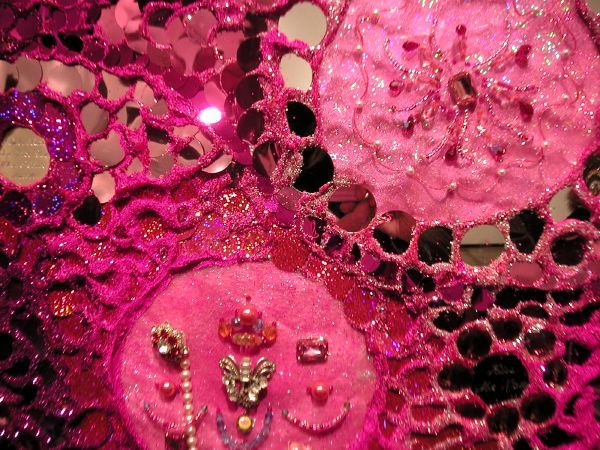
Chris Tanner Marcella 2005 mixed media on canvas 48″ x 110″ detail
Although perhaps not quite so excited as he himself should be with his latest success, we’re still really delighted with Chris Tanner’s spectacular show, “Ravaged by Romance,” at Pavel Zoubok, an uptown gallery which recently moved to West 23rd Street.
Barry and I have been enthusiastic about Tanner’s work (the paintings, the performances and Chris himself) for some time, but we’ve never seen so much of it at once, outside the walls of his dazzling apartment (yup, you already knew it’s in the middle of the East Village).
It may be hard to believe, but what you see in this show are actually some of his more low-key creations. We have one brilliant, large-ish piece ourselves (always wishing we could have more) and, given a chance, it would probably upstage this show on its own. It should also upstage our entire apartment, but we haven’t yet given it a chance. It still hasn’t been framed, partly because it really needs something more like a box with a plexi cover: The problem isn’t the paillettes; it’s those fabulous feathers.
Okay, now I’ve talked myself into uncovering it again and just letting the magic breathe.
For more images, see the artist’s page on the Pavel Zoubok site.
Chris Tanner Flowers for my Mother 2004 mixed media on wallpaper 17.75″ x 17.75″
[second image from Pavel Zoubek]
7th Avenue in the rain: blue

untitled (blue mattress set) 2005
“on the subject of WAR”

Nina Berman Cpl. Tyson Johnson III, 22, a mechanic with Military Intelligence
The caption next to the photograph of Corporal Tyson reads:
Cpl. Tyson Johnson
22 years old, 205th Military Intelligence Brigade, was
wounded September 20, 2003 in a mortar attack on
Abu Graib Prison. He suffered masssive internal
injuries and is 100 percent disabled.
Photographed May 6, 2004 at his home in Pritchard, Alabama.
“Most of my friends they were losing it out there.
They would do anything to get out of there, do anything.
I had one of my guys, he used to tell me, ‘My wife just
had my son. I can’t wait to get home and see him.” And
you know, he died out there. He sure did, and I have to
think about that everyday.
“I got a bonus in the National Guards for joining the
Army. Now I’ve got to pay the bonus back and its
$2999. The Guard wants it back. It’s on my credit
that I owe them that. I’m burning on the inside.
I’m burning.”
We went to the opening last night mostly because a friend was part of Smack Mellon‘s latest group show (the site’s not updated as I’m writing this, so check ArtCal for details), so it was supposed to be largely a social thing. Sure we knew the title of the show, “on the subject of WAR,” ahead of time, but I can speak for both of us when I say that we were still caught a bit off guard by the power of the imagery. We didn’t leave with any springs in our steps.
Susan Sontag, in whose memory the show is dedicated, would have been pretty pleased: The curator, Smack Mellon-ite and visual artist Kathleen Gilrain, wants to show how other artists continue to deal with the dilemma of representing in images the atrocities and absurdities of war.

Eve Sussman Solace 2001 video still
Twelve of the horrible, and infuriating, photographs and texts from Nina Berman’s project, Purple Hearts, Back from Iraq, shared a room with Eve Sussman‘s very beautiful and melancholy video, Solace, from which the strains of Purcell’s “Music for a While” were heard repeated over and over again, threatening to destroy any composure remaining to the viewer. The video is worked from homey Brooklyn footage assembled by Sussman on September 11 and the days following.
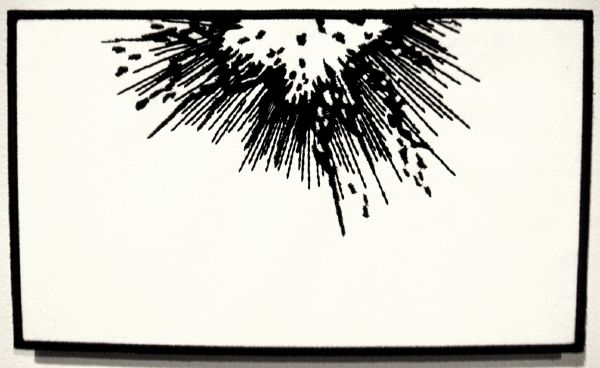
Mike Asente Aerial and Ground Explosions 2004-2005 mechanical embroidery, dimensions variable (detail of installation which included five pieces)
Mike Asente‘s delicate white needlepoint “canvases” explode near the entrance of the huge DUMBO space, which itself looks much like a survivor of urban war.
Barry and I have two of Asente’s pieces, and we like them both a lot. One is a large soft sculpture, Baby Disney Asshole, and the other is a tiny framed embroidery suggesting a distant galaxy, which somehow, and quite oddly, links the earlier asshole with the current work with explosions.
There’s much, much more in the exhibiton on Water Street, including a room of early 40’s photographs from the “good” war by anonymous photographers (from the collection of Edward C. Graves), but crowds and the lateness of the hour made it difficult for us to see all of the work properly last night.
The other participating artists are Bobby Neel Adams, Barnstormers, Melissa Dubbin and Aaron S. Davidson, Ron Haviv, Susan Meiselas, Patricia Thornley, Sarah Trigg. While photography and video dominate, a number of other media are represented in this powerful show.
We should really go back ourselves, but it won’t be easy. No one walks out whistling.
[image at the very top from Purple Hearts; Sussman video still from artnet]
The Gates

actually, this was the only gate we found whose curtain was wrapped about its architrave
I just didn’t get it. Barry and I went to see Christo and Jeanne-Claude’s project for Central Park, The Gates, this afternoon, well, first because it was there and also because we expected there would be a great deal of excitement on the first day of its display. We also thought we’d run into a lot of friends.
It was there, and apparently it was opened this morning in the minutes around 8:30 as scheduled. But I think I was surprised that I didn’t find it at least a little exciting, rather only very mildly diverting. Nor did it seem to inspire the kind of holiday cheer I had expected within the huge crowds which had turned out to see it, crowds found walking through and about [thousands?] of saffron-colored “gates” which lined almost every pedestrian path in the park (the Rambles and other “wild” areas were left alone). And there were no friends in sight, as if they all knew better.
The Reichstag thing I liked a lot, even if I didn’t get to see it.
Anyway, I guess $20 million just doesn’t buy what it used to.
Perhaps striking the right note for the day, we overheard one young woman, as we passed her and her friend on our way up to Belvedere castle, talking about the miles of saffron nylon on display: “Yeah, I’d make a skirt out of the stuff.”
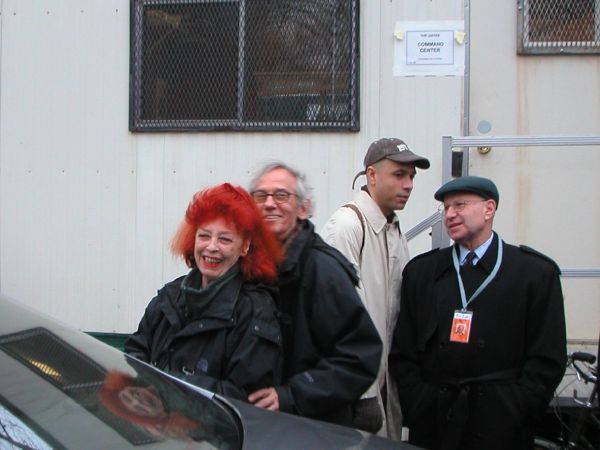
at the “Command Center,” while our small crowd gathered on the other side of the vehicle, and as their intense conversation with a bunch of male authority figures in suits wound down, the pair kept pointing to the car; did they want to get rid of it or keep it?
Halfway through our trek today we were passing the Loeb Boat House and the parking lot across the path from its door when I spotted a very large limousine being escorted into the lot. I’m a car fanatic, so identifying a $350,000 long-wheelbase Maybach 62 in a blessedly-car-free (temporarily) Central Park was no problem. We stood around until we could spot the back-seat occupants and, not surprisingly, they turned out to be Christo and Jeanne-Claude. I have to assume that their use of the car was a condition of a patron’s generosity to the project.
Oh yes, a final touch of another local color: Barry spotted a Duane Reade bag inside on the floor in the rear.
“Defenders of the Unpopular Feel Less Popular”
This is not a good thing for America, regardless of the court arguments.
Lynne Stewart, whom the NYTimes accurately describes as “an outspoken lawyer known for representing a long list of unpopular defendants,” has been found guilty of all charges levelled against her by Justice Department prosecutors. The headline on the Times site for a story dealing with reaction within the legal defense community to her conviction is shown above. It’s a little cute, but the reality is definitely not.
“I don’t think that there’s a political lawyer in this country who doesn’t believe that the government has a plan to target the lawyers who do what we do and to silence us,” said Stanley L. Cohen, one of the country’s best-known defenders of militants, terror suspects and other unpopular clients.
. . .
Roger L. Stavis, who worked alongside Ms. Stewart representing another defendant in the case that led to Mr. Abdel Rahman’s conviction [it was the lawyer/client relationship of Stewart and Rahman which was the subject of the government’s ire – Ed.], said it was regrettable that a lawyer could be convicted of a crime “for her zealous representation of a particularly odious client.”
But wait, good people, maybe this isn’t such a big problem after all. This regime just sweeps up any number of folks around the earth whom it brands as terrorists, throws them into concentration camps, again anywhere in this Pax America world, and possibly for life, by the admission of its own spokespersons. There they are never charged with any crime, yet they are routinely tortured and denied access to legal counsel. We don’t even know who they are or where they are; no list is ever furnished; and the gang in Washington may itself not know about the existence of most of them or the nature of their alleged wrongdoing. The victims’ friends and family are normally no better informed about their disappearance than the rest of us.
In the current scheme of things, concerns about legal representation for an accused terrorist may have become irrelevant. Sheik Omar Abdel Rahman was seized and tried long before 9/11, when we are told “everything changed.” There have been virtually no trials for real terrorism since, and zero convictions. This government doesn’t believe in trials when they can get away with avoiding public airings of its incompetence and evil purposes.
Lynne F. Stewart’s trial mave have been the exception which proves the rule.
just a thought

untitled (Whitney) 2005
Claudia Weber and Jennifer Karady

Claudia Weber The Return 2005 mixed media, dimensions variable, installation view

Claudia Weber Untitled 2005 mixed media, dimensions variable, large detail of installation view
Claudia Weber is represented by one photograph and two sculptural installations at Momenta Art this month. I like them all a lot. The installations both excite and scare me for their fugaciousness [I worked on that noun a bit]. For more, see bloggy and go to the gallery in Williamsburg before March 7.
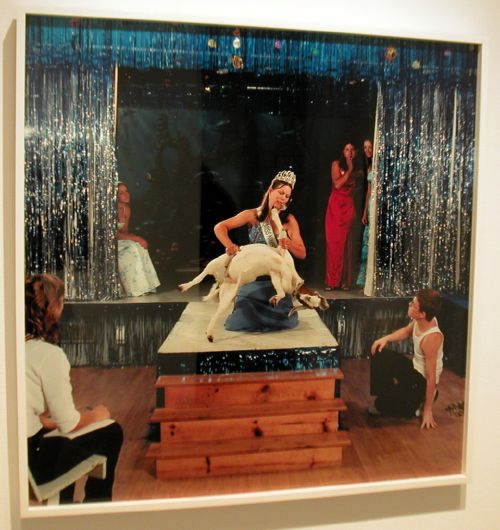
Jennifer Karady Pageant Talent: Katrina Johnson, Miss Nimrod 2003, Nimrod, MN 2004 Chromogenic color print on Fujiflex, mounted on Plexiglas 30″ x 30″ installation view
In the second gallery space Jennifer Karady shows photographs which engage, and disturb, with their sensitive examinations of some very special [dependent but apparently quite fulfilling] relationships between people and the animals closest to them.
While looking around unsuccessfully for larger images from the show, on a day on which the people at Momenta are not around to help with a jpeg, I discovered that Karady has herself collaborated with a friend from a neigboring species, Tillamook Cheddar, a diminutive and very charming abstract expressionist with a solid c.v. of her own.