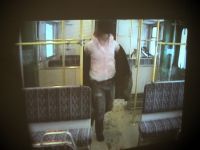

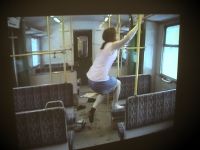

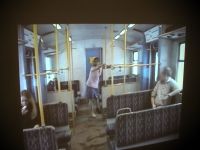
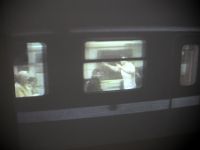
Klara Leiden Paralyzed 2003 video, 3 minutes, stills taken from installation
This is what keeps some of us going. The wonderful energy of a new gallery located where none have gone before, and the first exposure to an exciting new artist.
I left Reena Spaulings Fine Art this afternoon with a grin from here to there, and a bounce in a pair of feet which had been complaining about mistreatment until just before Barry and I entered the rough storefront space on the east end of Grand Street.
The centerpiece of the gallery installation was a site-specific installation which seems to define a sub-genre. Klara Liden builds imaginative natural habitats in the midst of hard urban realities, and here on the Lower East Side she has collected corrugated cardboard from both the immediate neighborhood and the basement of this old building in order to assemble a treehouse-like room on stilts within which she has mounted photographs documenting her scavenging for its construction.
Two videos make up the remainder of the exhibition, and I have uploaded stills from one of them above. The young Swedish artist is shown madly and athletically dancing through a Stockholm subway car at night, shocking a number of other passengers, all of whom it seems would prefer to be able to ignore her. The soundtrack is by the Legendary Stardust Cowboy.
We are told that Liden has studied formally as an architect. We can see that she is a subversive architect. She is described in the press release as “a genius,” and I wouldn’t argue with that. “Before this show she invented a free postal system in Stockholm, made books with ‘appropriated’ outdoor advertising, and built an underground house on the banks of the River Spree.” Each of these enterprises is beautifully recorded in simple books available in the gallery.
The show continues until January 31. Unfortunately there is no web site yet, but there is always ArtCal. Go talk to the nice people we found on Grand Street today.
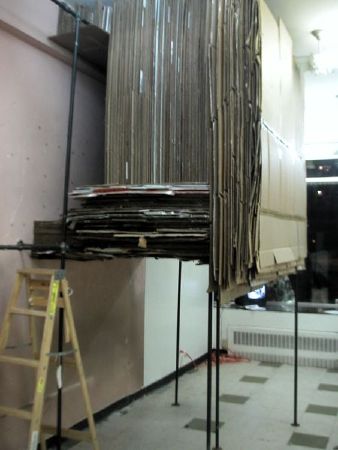
Klara Liden Benign 2004 cardboard, wood, steel, photographs, installation view of the structure, with ladder entrance
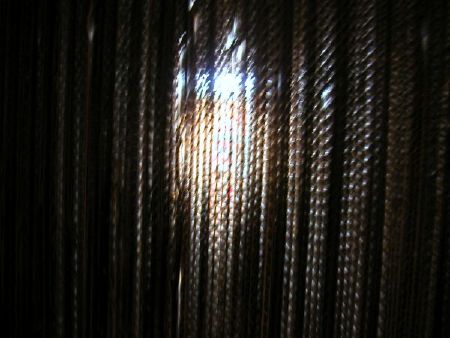
Klara Liden Benign 2004 cardboard, wood, steel, photographs, installation view from within the structure, through the corrugations
one-stop shopping in Brooklyn

untitled (Metropolitan Avenue marketing) 2005
Alberto Gonzales

I AM NOT A TORTURER!
Contact your senator now! We deserve a top law enforcement officer with a better resume.
For those who have a senator on the Judiciary Committee itself, which began hearings on the nomination this morning, here’s a link to the roster, with access links within it. To email the committee leaders, and for a message form, see this “Action Alert” site from The Nation.
[image from AP by Susan Walsh]]
more at Caren Golden
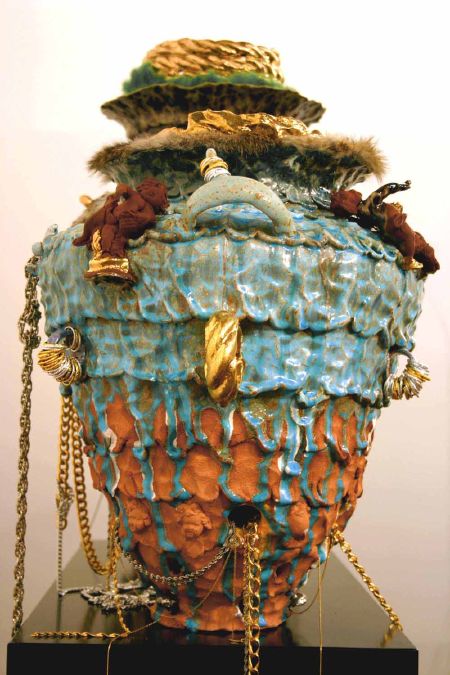
Nicole Cherubini G-Pot with a Rose 2004 stoneware, fake gold and silver silver jewelry, red rabbit fur, enamel 41″ x 15.5″ x 15.5″
I now have a jpeg of one of the Nicole Cherubini pieces which really is in the Caren Golden show, so I am showing it above, together with images below of work by two other artists seen in the same space.
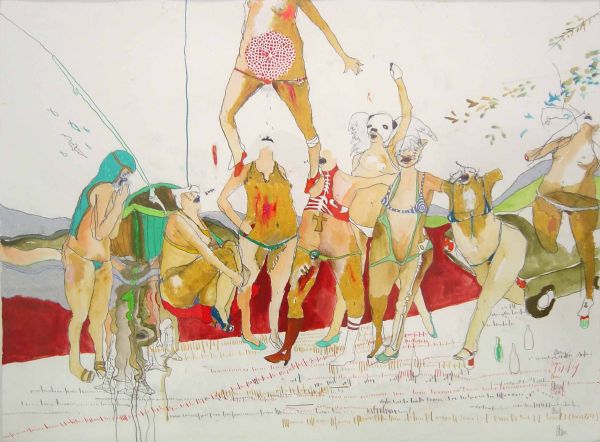
Amy Morken Untitled 2004 graphite, colored pencil, pastel, oil stick 22″ x 30″
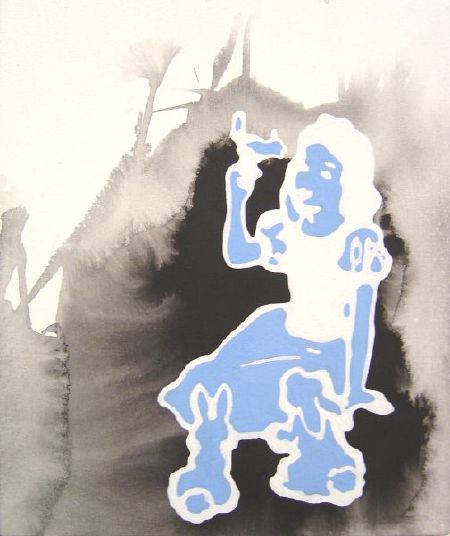
Ryan Humphrey In the Woods 2004 acrylic on canvas 12″ x 10″
The remaining artists shining in “The Twilife” are Emily Keegin, Emily Joyce, Dan Kopp, Evan Lintemans, Julie Nord, Elizabeth Olbert, Luis Coig Reyes and Andrew Sendor.
[images from Caren Golden Fine art]
the Austrian Cultural Forum
GÃŒnther Domenig, on the architect’s imagination.
I love visiting the Austrian Cultural Forum building. Once you’ve greeted the very-New York concierge guy behind the desk inside the door of the narrow 24-story tower on 52nd Street, you could actually be in Wien. The two-year-old building designed by Raimund Abraham is that modern. And, yes, I really mean that about the city. The former capital of the Austro-Hungarian empire is no longer just old. Go see for yourself.
Anyway, back in New York, yesterday I stopped by the Forum’s current exhibition, âGÃŒnther Domenig: Structures that Fit My Nature,â which unfortunately offers only a tantalizing and impressionistic glimpse of the work of the interesting Styrian architect GÃŒnther Domenig. The modest spaces which occupy four levels of the building are mostly devoted to just two projects, the Steinhaus in Steindorf, KÀrnten (Carinthia) and the Dokumentationszentrum (Documentation Center) in Nuremberg, and there is precious little guidance to those (the supply of the show’s brochure had been exhausted long before I arrived).
The first structure is Domenig’s own still-evolving dwelling and offices on the shores of a vacation lake, and the second is his striking deconsecration of the notorious Nazi Party Rally Grounds.
One of the most useful (and stylish) elements of the installation was the wall-size video screen interview with the architect (edited as a monolog spliced with photographs of his work) which occupied one of the rooms. I think it should be recommended viewing for anyone who wishes to understand where truly new architecture should start. I wish I had taken notes, but Domenig says something profound about the relationship between the architecture in the architect’s head and the architecture which has to be constructed in the messy real world.
I loved the little wooden dock shown in the video; it seems to have made the transition.
The causes for his repeated exasperation, and his extraordinary perseverance in the face of enormous obstacles, helps to explain why we get almost no truly exciting buildings in New York these days. We have to insist on great patrons as well as great architects.
the dream
[GÃŒnther Domenig STONEHAUS, Relations PPP 1987 pencil and color pencil, installation view]
ADDITIONAL PROGRAMS
The Cultural Forum has some more wonderful programming lined up over the next two months. First there will be an exhibition of figurative works by Austrian artists and others called “Slices of Life: Blueprints of the Self in Painting.” It opens with a public reception on Tuesday, January 18, from 6 to 8pm. The artists include Amy Cutler, Plamen Dejanoff, Nicole Eisenman, Johanna Kandl, Elke Krystufek, Muntean/Rosenblum, Katrin Plavcak, Lisa Ruyter, Markus Schinwald, Ena Swansea, Nicola Tyson and Gregor Zivic. (I’m having fun trying to imagine which of these artists has a connection with Austria, especially if I imagine connections something other than that of birth.)
Beginning the next day there will be a number of chamber music, lieder concerts and film programs in the building’s small, two-level jewel-box theatre. Somewhat exceptionally for this institution whose expressed mission (encouraging and describing the impact of the digital world on the arts and culture at large) has meant that it has hosted some very exciting new stuff, the January and February programs are limited to composed “classical” music, although they range, almost all somehow Austrian, from Haydn and Schubert through Mahler, Berg, Schulhoff and Krenek, to PÀrt and Kurtag.
I’ll be there January 18, but I’m also going back for the music and the films. There’s always the building too, and maybe I’ll get further upstairs some day. I still haven’t seen almost 20 of those tantalizing 24 stories.
Nicole Cherubini at Caren Golden
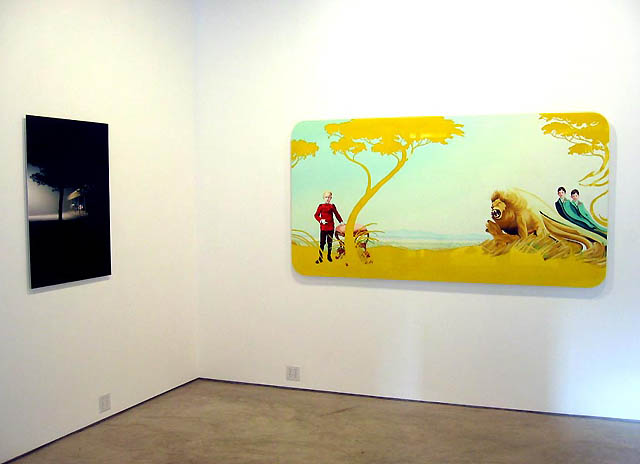
installation view of works by Emily Keegin and Andrew Sendor at Caren Golden Gallery
Caren Golden has assembled a fascinating group show, “The Twilife,” curated by Brit Shapiro. I’m not sure I understand the conceit which brought the work of these eleven artists together, but somehow it works.
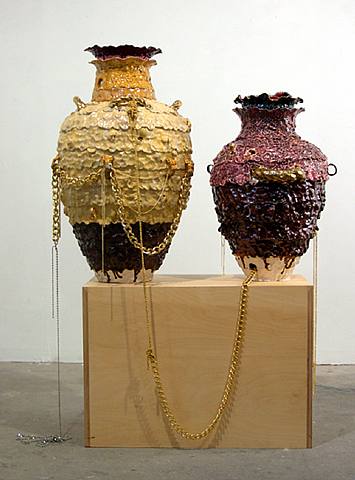
Nicole Cherubini A Pair of G-Pots with Cherubs, Fur and Rope 2004 mixed media [work not in the current Caren Golden show]
There are no weak spots in the roster, but one of these artists really stands out, both for what I saw on West 23rd Street and for my personal history with the work.
Barry and I had first seen smart conceptual work by Nicole Cherubini when it was photo-based, but for a while she has been creating some pretty outrageous stoneware sculptures. I don’t know for sure why it has taken me so long to “get” her fabulous ceramics, but they really took my breath away when I saw what she had contributed to this show.
I’m afraid my blindness had something to do with the stubborn native reserve I had thought I had overcome long ago, after years of embracing the exuberant expression of less retiring friends and strangers and especially after embracing the often extravagant art of my own times.
This surprises and embarasses the me I thought I had become.
Cherubini’s art mocks the posturing of wealth characteristic of all civilizations, even if her pots could only have been created today. Every age displays its extravagance, but this one has not only rejected absolutely all restraint, it absolutely glories in the rejection.
I don’t think this gorgeous, exuberant sculpture could have been done in the 80’s, even in the East Village. In the few years since the dispersion of the world evoked in the current New Museum retrospective of a special time and place, our everyday world has gone so much farther than Arch Connelly or Rodney Alan Greenblat. Cherubini is simply claiming this current outrageous age for her art.
[first image from ArtNet, second image from Samson Projects LLC via ArtNet]
the United States, tsunami relief no-show
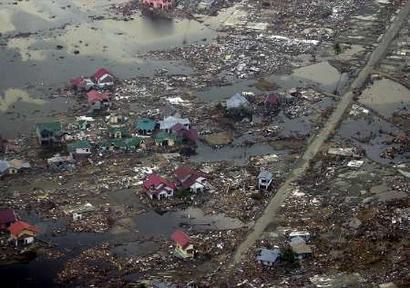
Meulaboh, Sumatra, Indonesia, today
I have no status in and no experience of emergency relief operations, planning or administration, but anyone could have foreseen that the immediate challenge in responding to the tsunami disaster would be the logistics of accessing the people who need help.
Yet almost everything I’ve seen written about the scale and kind of the world’s response is being expressed in monetary terms. Meanwhile, beginning already several days ago there have been alarming stories about large stocks of water, food, fuel and other matierials assembled at airports or elsewhere which cannot be transported to those who need them most. Speed is incredibly important after disasters and this one is already almost a week old.
The U.S. used to offer to send elements of the Air Force, the Navy, the Marines or the Coast Guard when disaster struck and transportation and communications were disrupted anywhere in the world. I haven’t heard anything about our volunteering to any nation the men and women or the planes, ships, landing craft, helicopters (no equipment could be more important in southern Asia right now) or even trucks (they don’t have to be armored, so we should have a good supply already) which could best deliver help to remote villages and islands around the Indian Ocean basin. No one is better equipped to do this than the United States.
But sorry, world. Our people and equipment are just not available. Our resources are otherwise (and fully) engaged in wars, and if those engagements didn’t look good before, they certainly are not going to make us look any better now.
I think the world will find the money for relief and reconstruction, perhaps to a great extent because of the generosity of people more than the largesse of their governments, but lives are being lost right now because we’re not there. War has become such an addiction for the U.S. that I’m not sure we’re ever going to show up again.
UPDATE: Maybe there’s still hope for all earthlings. Immediately after finishing the post above I found this AP story. But it’s still too little and too late for too many.
[image from REUTERS/Dudi Anung-State Secretariat]

must be the rural part of the South Bronx
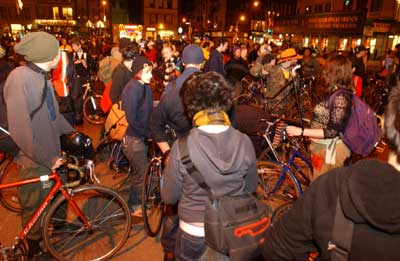
including at least one farmer and feed dealer
There’s a fairly happy story in Newsday this morning, reporting the relatively unaggressive approach of NYC police to last night’s local Critical Mass.
The monthly event promoting pollution-free transportation went off almost without incident, marking the first time since the Republican Convention in August that police did not harass the participants.*
The numbers were down from those recorded on recent Fridays, perhaps because of winter and the holiday, but more likely because many enthusiasts would have feared a repeat of unprovoked police violence, indiscriminate incarceration and illegal confiscation of bicycles. News of last night’s peace should produce larger turnouts in the [warmer] future.
After the news of the success of the ride, my favorite part of Wil Cruz’s article is the attribution of a quote near the end which criticizes ambiguous police direction. The speaker is described as “Jack Horowitz, 57, a farmer and feed dealer from the South Bronx.”
I read this to Barry and he immediately added to my own glee: “That’s why I love New York!”
*for recent history, see this September link and this one from late October.
[image by Joel Cairo from Newsday]
the New Year

Until this afternoon around 3:30 I still had no image for a New Year’s post. Then I spotted Allie helping the harried (actually, sometimes pretty intense, witness the cell phones), last-minute shoppers waiting in the checkout line at the Whole Foods market down the block.
She’s very beautiful, and the funny Louise Brooks hat/wig makes her very much a part of the frivolity of the holiday. Still, although I’m probably transferring too much here, especially since she was working and I was shopping on this New Year’s Eve, her reluctant smile seems to register a sadness about certain appalling events of 2004 as much as a hope for a far happier 2005.
By midnight tonight may we all be thinking only the good thoughts.
Happy New Year to all!
the tsunami, how can we help?

a boy drinks a bag of clean water in Chennai, capital of the tsunami-stricken state of Tamil Nadu, south India Tuesday, Dec. 28, 2004 [excerpt of caption from AP]
Of course we want to do something, but how?
Along with surely at least scores of his other friends, relatives or colleagues, this morning I received this email from our good friend Sumit, who fortunately lives safely in Bangalore with his wife Seema, miles from the violence on the southeast coast of India.
Hi,
Let us wish your family and you a very happy and healthy New Year.
By now you would have all heard about the terrible natural disaster that struck Southern coastal India, Southeast Asia and Sri Lanka. The devastation is immense. The loss of life and damage to property is shocking. The thousands who have been affected by this tragedy need any help they can get. There are many ways in which one can help.
Seema and I are collecting the following items in Bangalore to send it to Chennai tomorrow to the Banyan (an NGO) in Chennai, which is arranging distribution at the affected areas. The items are:
1. Blankets and Sheet
2. Face Masks
3. Provisions: Daal (Lentils), Rice, Sugar
4. Electral, Glucose
5. Biscuits
6. Clothes: Children and Adult. Old and New.
We are collecting at the basement in our house:
[here he gives their address and telphone number in Bangalore]
Those interested in helping may also contact the following people in Chennai (Madras).
Ashok from The Banyan: 91-44-26530504 ashok@thebanyan.org
Sulek and Pravin from DBA: 91-44-26630063 spravin@dba-corp.com
Exnora is another organization that has helped with relief measures in the past. Details about their organization can be found at:
http://www.chennaibest.com/discoverchennai/ngowatch/feature05.asp
For those outside of Tamilnadu and India, the Prime Minister’s relief fund is a reliable (relatively free of bureaucratic hassles) organization that has appealed for funds. Here are 2 websites, one about the Fund and the other with a form through which you can make donations.
Please donate whatever you can. Every bit counts.
http://pmindia.nic.in/relief.htm
http://pmindia.nic.in/formpmnrf.htm
Please forward this request to anyone you know. We need to do whatever we can.
God Bless
Seema & Sumit
The list of emergency items is painful to read, but I think his words tell us even more about how we should all think of our responsibilities when disasters strike, or at least all of us who are not able to offer skilled help on the scene.
Realistically however most people outside of the countries immediately affected by this one will have to be satisfied with the less dramatic gesture of contributions in money rather than kind.
Since Sumit’s suggestions only include agencies able to offer help on the sub-continent, here is a list of relief agencies assembled by the NYTimes.
My own preference will probably be Doctors Without Borders, because of my faith in and admiration for their extraordinary importance, commitment and effectiveness. Alright, I’m also totally dazzled by their heroism.
I’ve just checked their normal website, where I was given the very happy message, “Doctors Without Borders web site is experiencing very heavy traffic.” The page then gives a secure link where donations can be made and a separate link where people can secure information about volunteering services.
Their traffic volume seems to suggest that enormous numbers of people are being very generous and perhaps also that the other NGO’s offering tsunami relief are being deluged with contributions as well.
I will end this long post with an large excerpt from one of several emails I’ve received from a New York friend who had been on holiday in Phuket with a mutual friend of ours until that fateful morning. They were having breakfast on the beach at 8:30 when Donald felt something he only later realized was the earthquake itself. They both left for the airport at 9:30 when the sea was quite calm. Minutes later the wave hit. Only when they ran into the first survivors at the airport a little later did they learn what had happened.
Donald wrote this note from Thailand, and I received it late last night:
James, the post-wave problems will be severe, as you can imagine. Fortunately, Thailand has extremely good infrastructure for addressing things like this, government corruption notwithstanding. Communications here are good, lots of airports, roads, etc. So getting things down to the South where they are needed will be fairly easy, although once down there, there are a zillion little islands.
The impact of this is most easily described to Americans this way. “These people were poor TO BEGIN WITH”. If they lost family members, then they lost everything, because for most people in this region, family is all they have. (Americans tend to exoticize things like the intensity of Asian kin relations, but the reality is that intense kinship is a good way to sustain a network that mitigates the dire poverty.)
The impact is also horrible in terms of employment and living. Whether you are a tourist or a local, if you were in Phuket, you were there because of tourism. If you weren’t a tourist, then working for tourists was your job. So with the tourism trashed by a tidal wave, probably more than a million Thai survivors have just lost their employment, and are now job less, and possibly homeless, grieving for dead relatives and a dashed future.
Now, add to that the imminent public health disaster created by the loss of sanitation, piles of corpses etc. It is like you already were in hell, and now it’s going to get worse right before your eyes.
In terms of public consciousness, Thai people everywhere are mortified. And since one of the kings grandchildren died, it gives a personal context that everyone can connect with. (The royal family is very revered here). The press here is talking about nothing but the tidal wave, and that probably won’t change for a while. It has totally eclipsed coverage of the national election! Even the very arrogant and dictatorial prime minister knows better than to shame himself by appearing to capitalize on this.
I am actually more concerned about Sri Lanka. Though I’ve never been there, I know it is a much poorer country than Thailand. Like I said, Thailand has some very decent infrastructure.
I am rambling, but I appreciate the opportunity to talk about this.
Now we all have to try to save the survivors.
Above all, perhaps for a change, I’m thinking of Americans, as an American, not a New Yorker. If the Red Cross estimate of at least 100,000 deaths proves correct, more than 33 times as many people died this past Sunday as did on September 11. Unlike the aftermath of September 11, in Asia today millions of children and adults remain in serious danger because of disease, or from loss of food, shelter or livelihood. We have to rise to this challenge or lose our self-respect as a people.
[image from AP Photo/Xinhua, by An Zhiping]