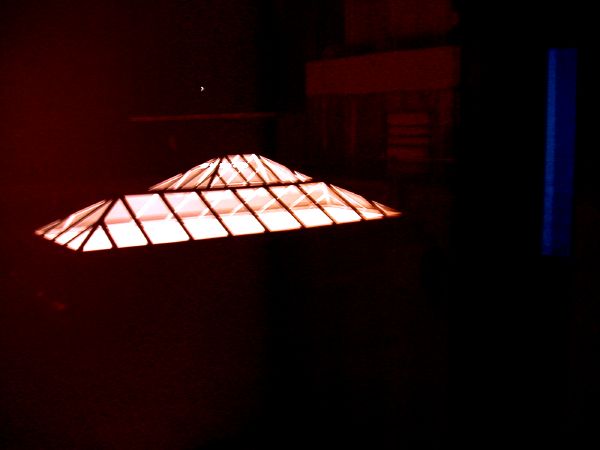
untitled (West 26th Street skylight) 2004
Jenny Laden
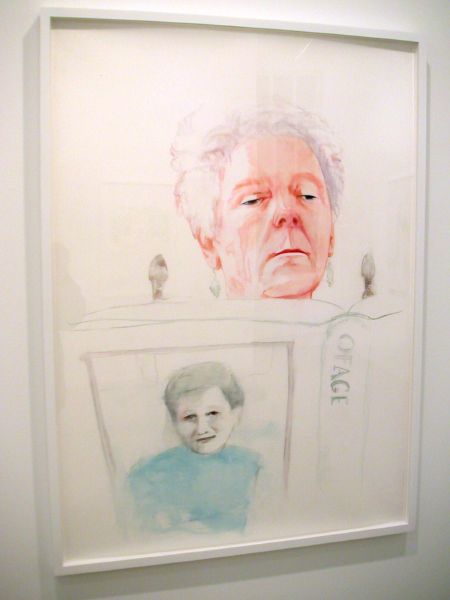
Jenny Laden Adina (armchair) 2004 watercolor on Mylar 42″ x 32″
I’ve been looking at Jenny Laden’s work for a few years, and it’s never looked as good as it does now. Gorgeous. She has a show right now at Jeff Bailey and it runs until December 23. These images and those on the gallery site itself only hint at the beauty of her paintings. They have to be seen directly. Her beautiful subjects are described with great delicacy and clearly with much love, and her medium leaves the still-liquid colors of their features floating without any ground whatsoever.
The color shown below in the photo representing a detail of “Ann (sweater)” comes closest to that in the work itself.
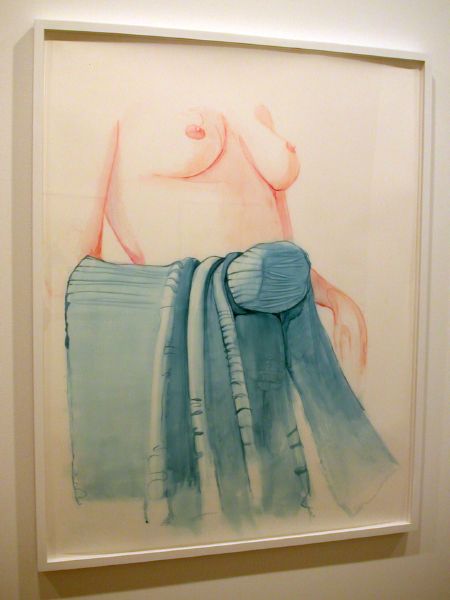
Jenny Laden Ann (sweater) 2004 watercolor on Mylar 42″ x 30″
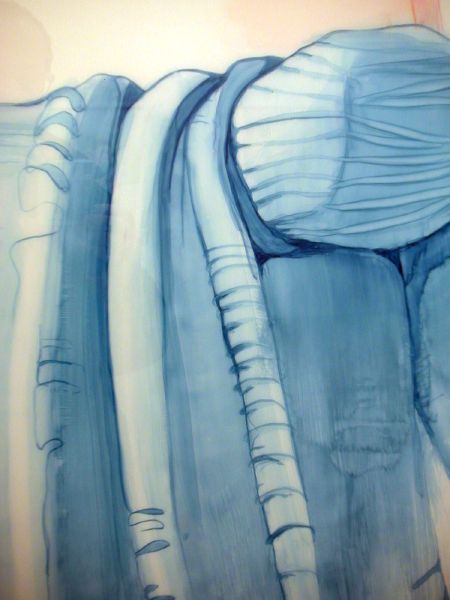
Jenny Laden Ann (sweater) 2004 watercolor on mylar, detail
Chelsea window
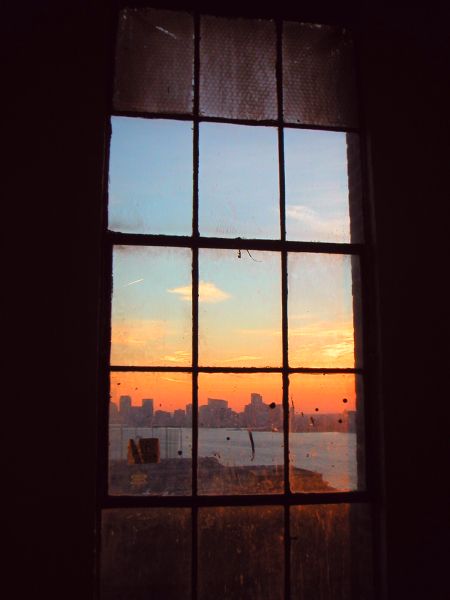
untitled (dirty Chelsea window, December 4) 2004
Nelson Leirner
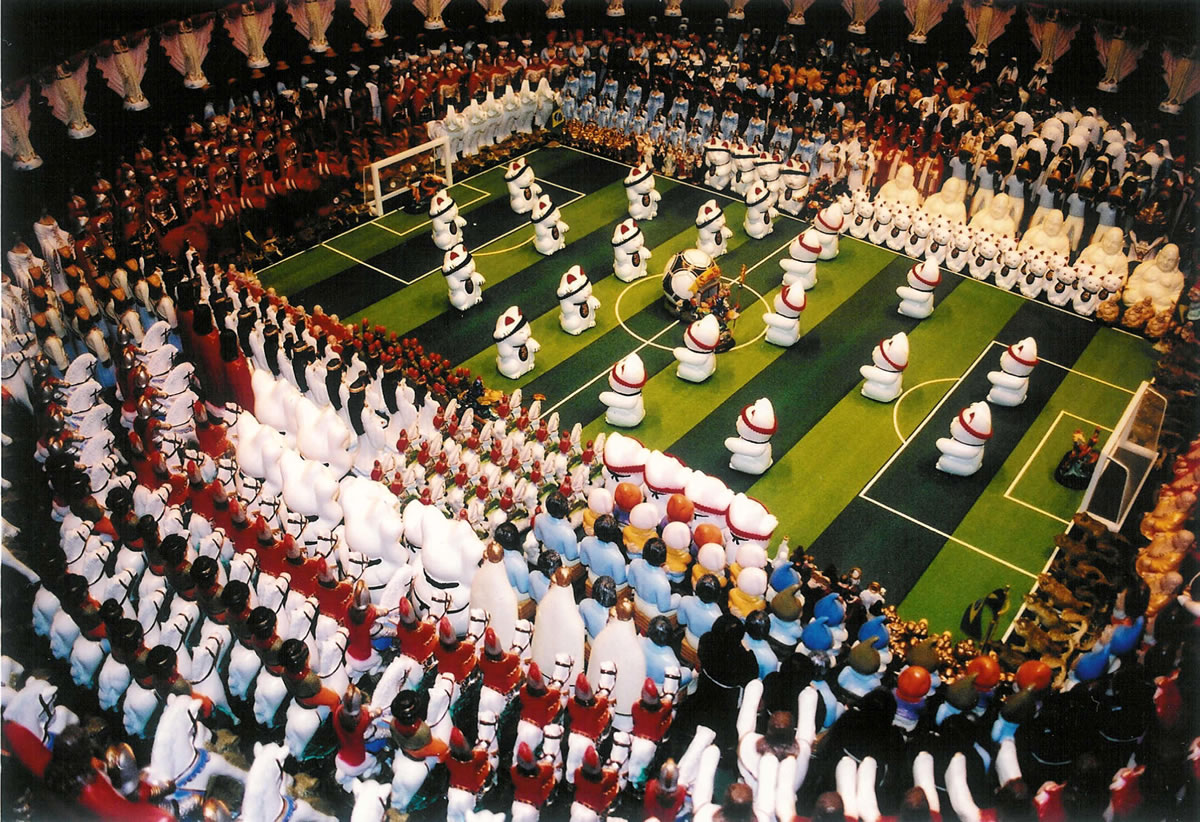
Nelson Leirner Maracan� (2003) plaster, ceramic and plastic, 120″ x 130″ x 9.5″
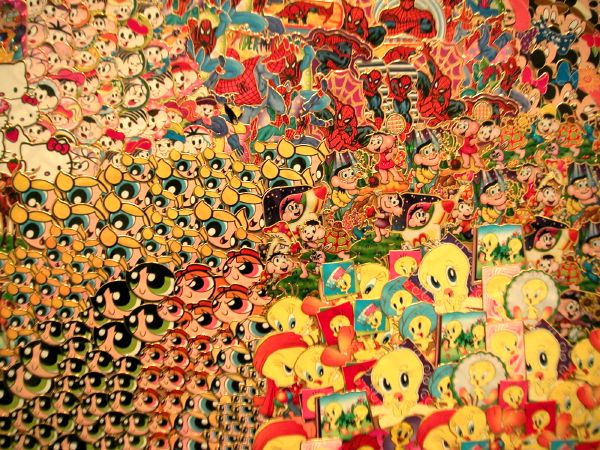
Nelson Leirner Figurativismo Abstrato (2004) sticker on wood, 67″ x 86.5″, detail
Ooops. Tardy again. Nelson Leirner’s show at Roebling Hall‘s new space in Chelsea closes tomorrow, and since it was alrady extended a few weeks I have absolutely no excuse for posting so late.
The gallery describes the show as the Brazilian artist’s North American gallery debut, so maybe I can be excused for thinking I was looking at the work of a very young man. Leirner was born in 1932, so I suppose I was a little off.
“. . . socially conscious conceptualism,” reads part of the press release, but there’s great fun in a visit to the world he has created to skewer economic imperialism.
[first image at the top from the Roebling Hall site]
Richard Jackson
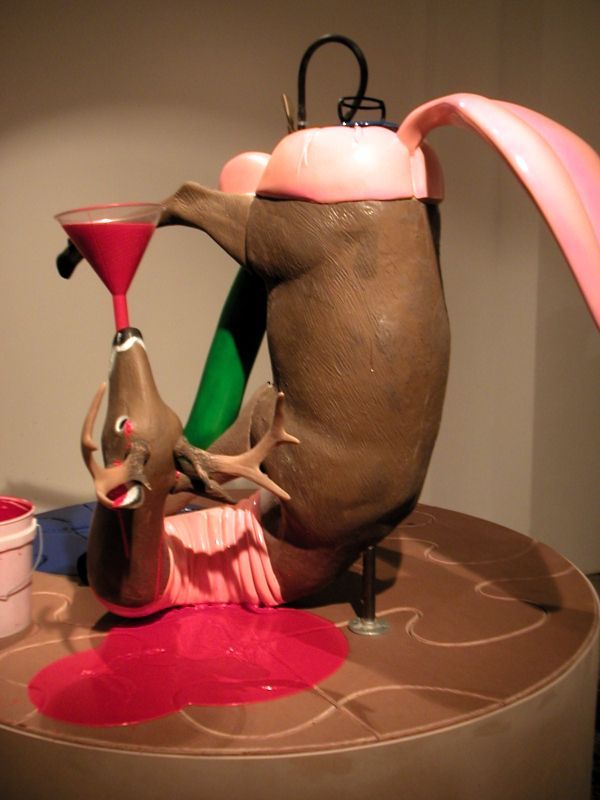
Richard Jackson Dick’s Deer (2004) large detail of installation
Umm. I’m somewhat without words here. And I’m not even going to alude to the full-size, spinning structure, “Living Room,” in the front of the gallery.
So go look for yourself.
Haswellediger is a gallery which really shouldn’t be ignored, but it looks like it’s never going to be easy paying attention. I like that.
Just to make it easier – or more difficult – this time there’s a concurrent exhibition at Foundation 20 21. Haven’t been there yet, but the heritage and the location alone is a draw. It’s an “outgrowth” of Thread Waxing Space and it’s inside the National Arts Club.
“Democracy Was Fun”
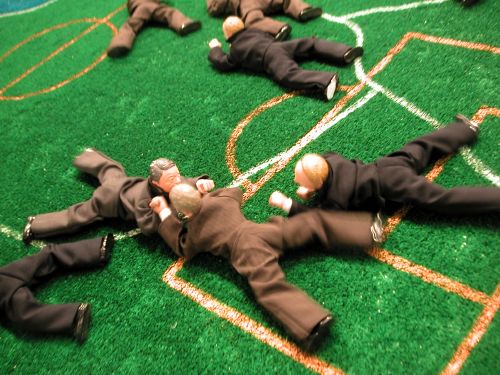
Momoyo Torimitsu Horizons (2004) mixed media, detail of installation
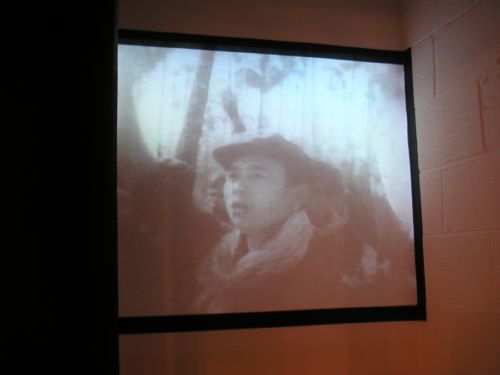
Robert Boyd, Patriot Act (Xanadu: A Place Where Dreams Come True) (2004) DVD, still from video
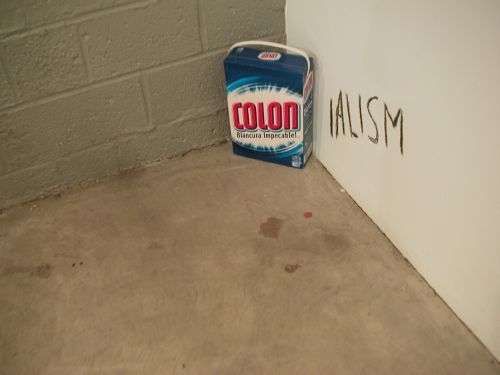
Riiko Sakkinen Colonialism (2004) mixed media, installation view
UPDATE (December 11): The show has been extended for another week, until December 18. And tonight, saturday, at 6 o’clock, the gallery will host New York Political Artists Town Hall Meeting #1 (NYPATHM1).
Only one more day to see how “Democracy Was Fun.” The White Box show closes tomorrow, but the hangover will continue. This group exhibition, curated by Juan Puntes and Raul Zamudio, packs the kind of political wallop we’ve come to expect from this fearless little non-profit space on West 26th Street. But there are some outstanding pieces of art here as well.
I’m sure I’m missing a lot, but right now I’m thinking of the riveting and accelerative video by Robert Boyd, which manages to stop all traffic entering the gallery space; Jane Benson’s camouflage garlands over the ramp running from the door; Tim Hawkinson’s flattened rubber pachyderm “Seal”; Rainer Ganahl’s outrage, in paper and ceramic, over the corruption of language and the death of dialogue; Riiko Sakkinen’s inspired adaptation of the simplest found materials; Momoyo Torimitsu’s field of tiny competing salarymen; and Conrad Atkinson’s horrendously-exquisite porcelain land mines on the gallery’s front windowsill.
East Village USA
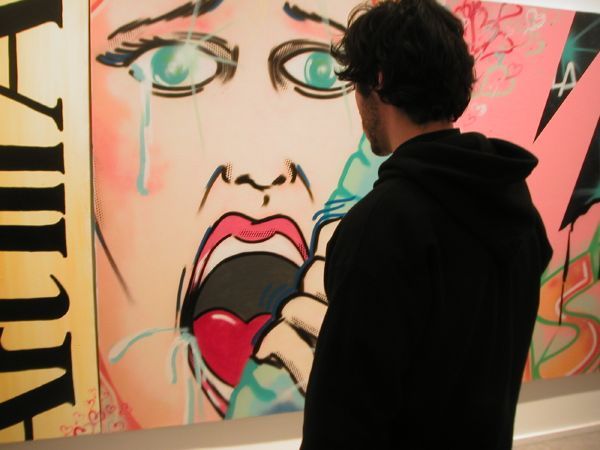
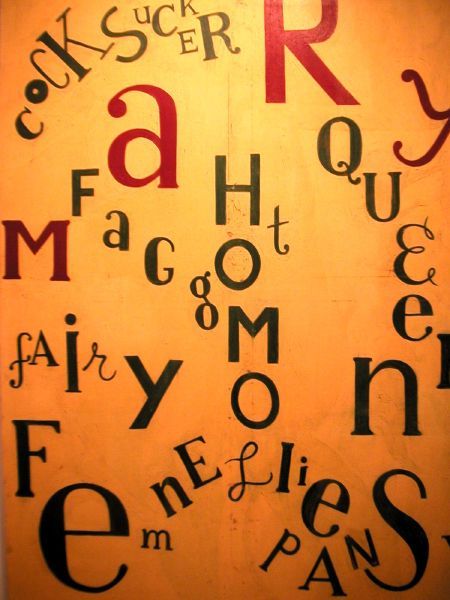
Crash (John Matos) Mass Media (1983) acrylic and spray paint on canvas, detail with admirer
McDermott & McGough A Friend of Dorothy (1986) oil on canvas, large detail
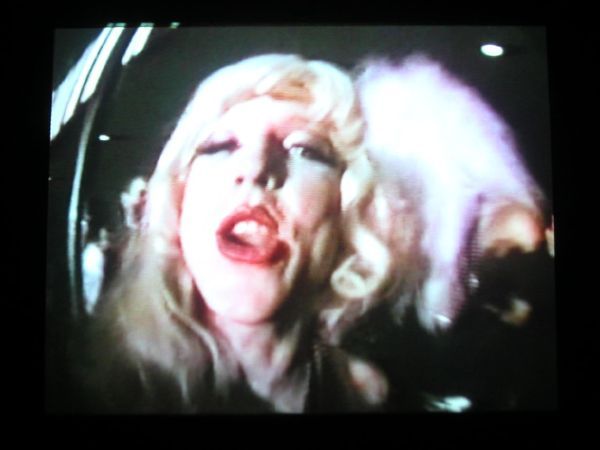
Nelson Sullivan My Life in Video (1982-1989) still from the video (Lahoma Van Zant)
“Imagine a village where everybody is an artist, nobody has or needs a steady job, and anyone can be the art world’s Next Big Thing.” The New Museum of Contemporary Art calls it “East Village USA.” The real show closed years ago, but tomorrow the museum is giving us all another chance to go there, and for some of us it’s a little like going home – once again without the complications of mom and dad.
This welcome retrospective of an entire exotic little world describes why I had to leave a very comfortable life in Rhode Island (no, mom and dad were not there). I just had to be in New York, even if it was going to be uncomfortable.
It doesn’t just look like a museum, and it’s not so very new or contemporary, but the show is a delight. I say it’s not so museum-like because it’s not just about the painters, sculptors and photographers who shocked and seduced Uptown spectators for a few years before success, or extraordinary wear and tear, erased the energy of a small age: A good part of the exhibition is devoted to the brilliant performance and club scene which was the environment in which the visual arts flourished – then as in every great creative era. Lots of video monitors are spread around the rooms, but this time they don’t really screen video art or art documentaries. Even if so many of the little giants on those screens aren’t around today, last night I preferred to imagine I was in a room next door watching their live performances remotely.
Some of my favorite things from the whole show (many of them real surprises) after only a preview peek: The work of Crash, Nelson Sullivan, Paul Thek, Arch Connelly, Peter Halley, Rodney Alan Greenblat, Sue Coe, Jimmy De Sana, Tseng Kwong Chi, Ethyl Eichelberger, Frank Moore and Jim Self, and Klaus Nomi.
ADDENDUM: Oh yes, there’s at least one perfect installation, of a perfect Nan Goldin. I lay awake last night and again this morning, thinking about it. It’s by itself on the wall of an almost totally darkened landing above a staircase heading down to the club-like installation of most of the performance videos. The photograph is lit from above like an old master in a wealthy collector’s study. Worshipful.
CORRECTION: I had originally identified the lady in the video still as Christina, but Sullivan’s archivist and editor, Robert Coddington, set me, well, straight.
[Nan Goldin link thanks to Charles T. Downey, via Bloggy]
Darrel Morris
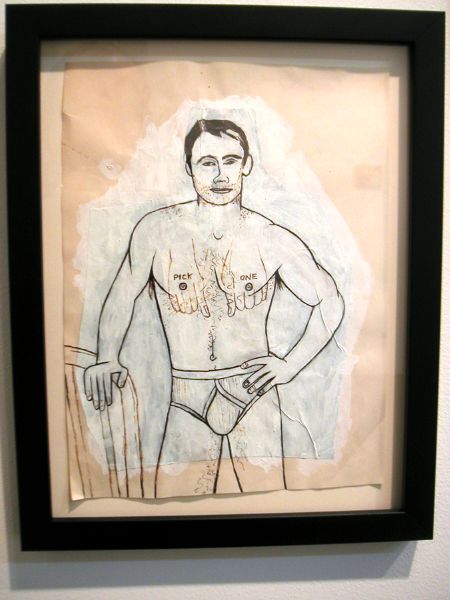
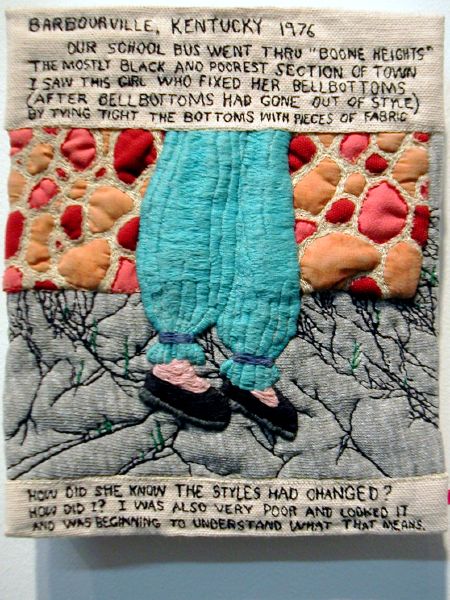
Darrel Morris has been extended at lyonsweirgallery until December 18th, even though (not surprising) most of the work on view may already be sold.
Much of the exhibition consists of small works on paper, some with heartbreakingly-sensitive short texts, and many of these same images are duplicated in works whose medium is embroidery and fiber applique.
The gallery site has a short description of the artist’s background.
Morris, who teaches at the School of the Art Institute of Chicago, was raised in rural Kentucky amongst people who made quilts and braided rugs out of necessity. This work served as an introduction to the use of sewing as an expressive and artistic medium.
In a series of small-scale works (generally no more than five by seven inches), Morris embroiders scenes from his boyhood and others. He then appliqués the embroidery onto fabric cut from clothing, most often his own. This choice of materials and approach places the work itself within a social structure while generating an edgy awkwardness.
Often utilizing a raw but self-deprecating sense of humor, Morris creates complex commentaries on social inequities and lopsided power struggles. Despite the somber topics, however, Morris elaborately and colorfully embroidered images of men and boys rendered like characters in comic strips result in narratives which are powerful and humorous, if often forlorn.
There was no list available when we visited the gallery, so the images shown above cannot be identified further. Their dimensions are very modest, approximately 8.5 x 7 inches.
fight the proposed MTA photo ban!
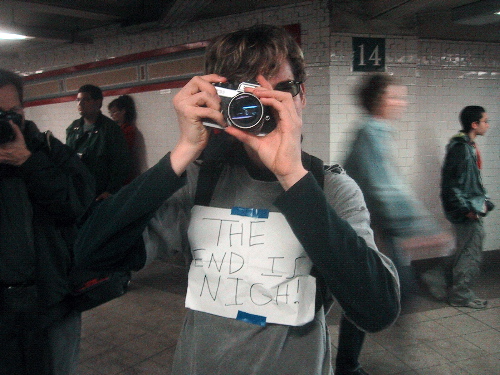
They’re still trying!
Trying, that is, to outlaw photography in the New York transit system. Last June I wrote about a fantastic zap I had participated in called by “The Photographers Rights campaign.” That same group has called another zap for December 18th in response to the MTA’s continued ill-conceived intention to remove cameras from users of the system in the name of security.
Remember that token clerks have already been removed from many stations altogether, and more will eliminated in the future, ultimately abandoning the platforms to Metrocard machines and the public’s own devices for ensuring their safety. There are also plans to ultimately remove conductors, and eventually drivers as well, from every train, removing all MTA employee presence from the public areas where millions of New Yorkers find themselves confined every day.
The removal of cameras will have precisely the opposite effect of security from terrorism. Anywhere else they call them “security cameras,” for Pete’s sake!
From the group’s site:
Many of us are determined to not let this go by unnoticed and without protest; Join us, plan on taking your camera out for a day of photography that won’t ever be forgotten, with a flash mob photo session that will even make the MTA board want to be there with cameras. It’ll be one of those Only in New York things you’ve been hearing about…
Meet December 18th on the main concourse of Grand Central Terminal, and bring your photo apparatus of course. It shouldn’t be hard to spot all the other people with cameras, especially with the even larger crowds expected this time.
Oh, yes, and this time let’s wear signs. People should be able to see the point.
On a related note, the same officials who want a photo ban also want to make it impossible to move from one subway car to another. Think about that one the next time you read about someone going berserk inside a moving train.
Talk to or write your Councilmember about both these issues.
[image from my June 6, 2004, post]
Gloria Steinem
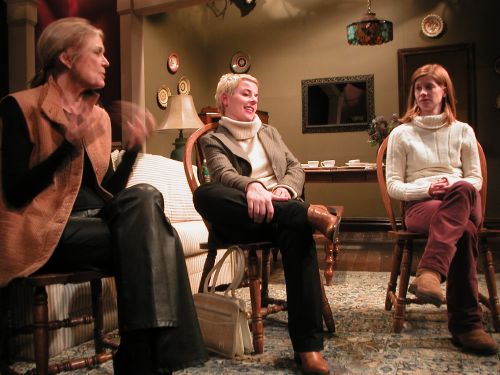
Gloria Steinem, Winter Miller and Mandy Siegfried on the set of “The Penetration Play” in the Mint Theater space last night
It was supposed to be an evening of theatre. It was, but it ended with much more.
Winter Miller’s “The Penetration Play,” was the second play produced by the new collective, 13P (Thirteen Playwrights). Last night there was the promise of a “conversation” following the play, which was something like a feminist/queer drawing-room comedy. It was a promise very much fulfilled when Gloria Steinem, who had been sitting behind me for an hour and a half, walked onto the set and sat down with the producer, the young playwright and the three women actors. In a big change from the usual routine of these events, the audience was not solicited for input; as it turned out, the conversation was sufficiently animated without us.
I adore Steinem (incidently, at 70, she’s still one of the most beautiful women alive). Last night she totally dominated a stage which had been created and made real by five other people sitting with her (in one sense of course without her pioneering feminism its scenario might have been unimaginable today).
In just the few minutes reserved for discussion the author of “Outrageous Acts and Everyday Rebellions” captivated her audience with half a dozen observations seemingly as original as they were sensible.
Everything she said was related to Miller’s play, and my favorite thought, regardless of how hoary its history might be, seemed to leave her lips as the inspiration of the moment. She was speaking about the decisions women (I would include men as well) make about the conflicting claims of independence and family. She lamented that so many women still err in giving birth to children before giving birth to themselves. The results can be disastrous for everybody.
[ref. the scale of the photo image, hey, it’s a small theatre; I was in the front row with my feet touching a stage raised only six inches above the floor]