a very small Thanksgiving story

celery-sticks2.jpg
store-bought cut celery

Overheard from the loudspeakers at our neighborhood Whole Foods this afternoon, clearly audible above the sounds of colliding shopping carts being pushed by harried people with long shopping lists, [almost] all prepared for elaborate home-cooked feasts tomorrow:

“. . . calling the lady who wanted the cut celery, . . . calling the lady who wanted the cut celery; your cut celery is ready at customer service . . . .”

I looked around and caught the attention of the store’s excellent produce department’s wise sage. He rolled his eyes upward. I smiled at this discreet admission of his dismay, and I shrugged my shoulders in an acknowledgment of its source.
For the sake of the other guests at the Thanksgiving meal she certainly will be sharing, I hope she doesn’t have any more complicated assignments.
When I told Barry about the announcement he had an immediate explanation for the woman’s strange request. “Maybe she didn’t have time to cut it and still put the Cheez Wiz in it.”

[image from ClubChef]

Louise Lawler

lawlerlouiseunk.JPG
Louise Lawler, detail view of installation

A visit today to the Metro Pictures show, “Looking Forward,” was an excellent tonic after the somewhat over-the-top week which saw the opening of the new MoMA.
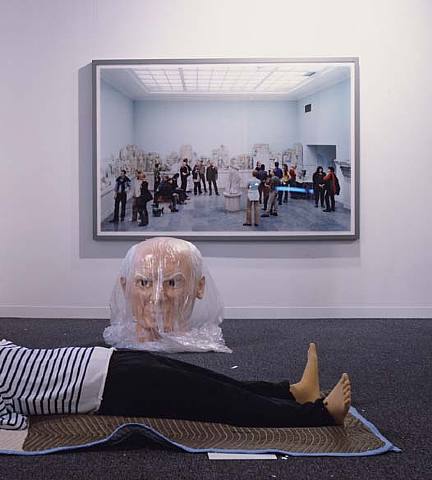
Lawler’s subject, and obsession, remains the ordinariness of the awesome, specifically, the low materials of the high mysteries which end up in our great shrines and temples of art. On 24th Street today her installation described works of art, mostly iconic, as they appear while in the process of some kind of transition – images the unannointed acolyte never sees. But she is not a mere documentarian. Her art leaves us with an understanding of both the processes and the products of the institutions which elevate these works, and which their formal display could never provide.
Besides, her own processes and products are themselves as beautiful as they are smart.

lawlerlouise.jpg
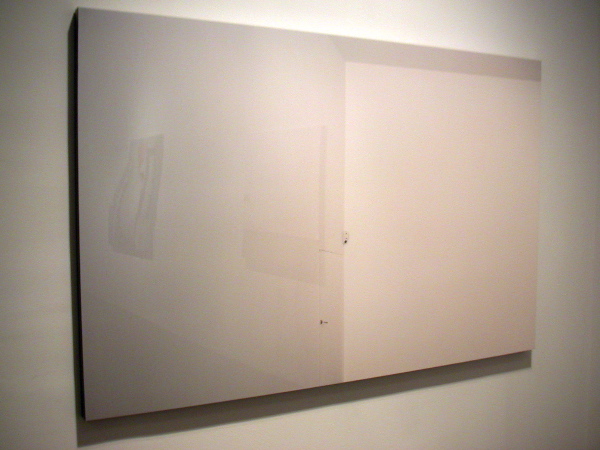
Louise Lawler Big (2002-2003) cibachrome mounted on museum box 52.8″ x 46.5″

[image at the top undocumented for now; second image from Metro Pictures]

ArtCal steps up

tresricheNovember.jpg
Limborg brothers Les tr�s riches heures du Duc de Berry: Novembre (1412-16)

Barry has now set up ArtCal, a way-cool art openings/events calendar, and it’s linked on the left side of both his site and mine, where it’s easily downloaded and printed.
It is a very subjective list of gallery shows up in New York at any given moment, and right now it includes, also subjectively, information about shows which open in the next few days. Still to follow will be the iCal and RSS feeds, offering even more convenience to art fans who want to plan ahead.

[image from The Web Gallery of Art]

new MoMA, a clean well-lighted space, and maybe no more

[EDITING CONTINUED, WITH AN ADDENDUM, MID-DAY NOVEMBER 17]
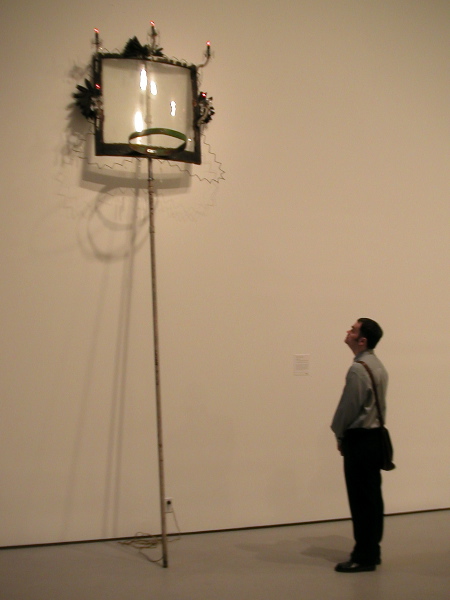
Hammons.JPG
one of my favorite “discoveries” today: David Hammons’s High Falutin’ (1990) in the Contemporary galleries, with Barry contemplating its delights

We were there about two and a half hours, had a few croissants, a sip of coffee and a bit of mineral water (there were a number of white linen-covered catering stations, and even small tables and chairs, always within easy reach throughout the six floors of galleries) on our Members visit to the “new” Museum of Modern Art this afternoon.
I liked the easy access to refreshments and the contemplative moments which went along with enjoying them while we could hang out in the gallery spaces, but all of that will disappear after this week. What will remain are the new museum spaces and yes, a few restaurants (not yet opened) which will be assigned their own rooms.
There’s more space.
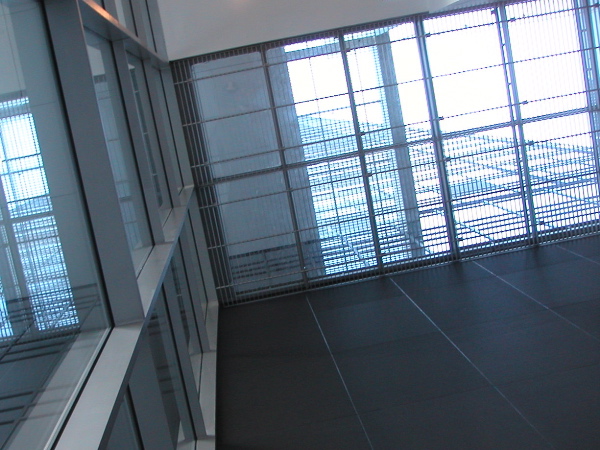
MoMAskylight.JPG
skylight, with lots of lines

There’s also more natural light, more views, of the stuff both inside and outside. The building is still sandwiched between 53rd and 54th Street west of 5th Avenue, but it’s now spread out on a much wider footprint. The facade of the original 1939 building has been uncovered/restored and at least one of its interior spaces is still recognizable in the S-curve of a stair landing and its black terrazzo staircase. The old main entrance however, with its curved stainless steel marquee, will now serve an elegant restaurant, “The Modern,” and not happy pilgrims entering New York’s oldest major shrine to modernism.
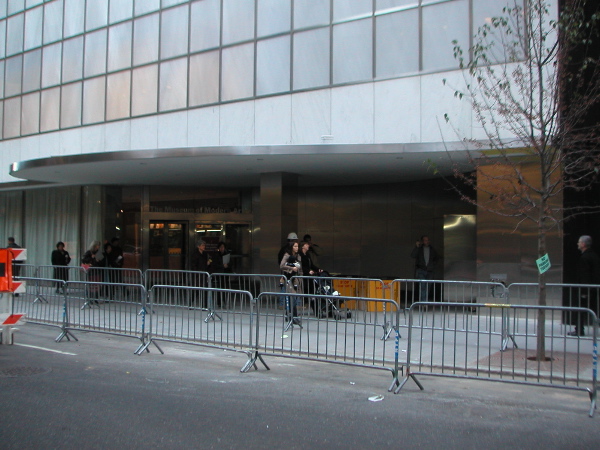
MoMA1939entrance.JPG
the 1939 entrance, soon to be a restaurant

There are lots of neat lines (all of them very crisp indeed) including a few very good sightlines. But no, contrary to the hype, neither the lines nor the idea of the architecture itself really disappears, even in those rooms where the art is hung comfortably cheek by jowl.
That architecture looks, well, old-fashioned. Eeegads!
Why do we have to spend half a billion dollars to construct a new building which nobody is supposed to notice? Why should it cost $425,000,000 in order to seem not of our own time, not too contemporary, just because we need more room to display more modern art, some of which as I understand it, is still supposed to be contemporary art, art of our own time? Actually, maybe the trustees wanted to build something which could be identified with the chronological mid-point of the collection as it now exists, the art and architecture of the “median era,” but if that is the case, why not acquire a real mid-twentieth-century building and refit its interior to display the magnificent collection of the Modern in a context with real integrity?
This evening Barry recalled the extraordinary success of the conversions for modern museum spaces we had seen in Vienna. We have the equivalent of the Austrian Imperial stables right here; there are buildings all over New York begging to be brought back to life. I’m afraid this new architectural mediocrity, no matter how much its details are described as exquisite, will turn out to be at least a little embarassing for a city which used to know how to do these things so well.
The building we got is awfully Park Avenue – 50’s and 60’s Park Avenue – and so it is without the integrity which is the minimum which we should expect of a building which reflects its own time. I went to the new MoMA today after reading the previews written by those who are supposed to have the educated and aesthetic judgement which can critique as complicated a project as that just completed in Midtown. I told a number of people that I expected to be delighted, okay, at least clearly pleased, even if I did not expect to be overwhelmed.
But after experiencing the architecture first hand, doing for the Museum what it is supposed to do, I simply don’t have any strong feelings at all. I’m not used to being without any aesthetic sentiments, perhaps most of all when it comes to architecture, so I’m not certain, but right now I think I’m just indifferent to this building.
I really don’t know what to say. I feel post-coital without ever having enjoyed a coital.
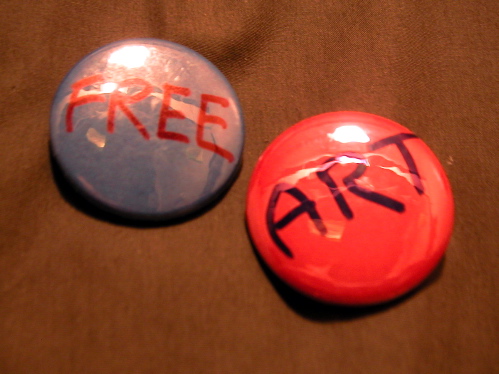
freeart.JPG
my own little protest buttons went virtually unnoticed, except by one of the caterers, who agreed with their message enthusiastically and spoke movingly of the burden the price presented for “working class” families

If I’m indifferent about the building at the moment, I’m left with one at least one strong impression, even if it’s one which I brought with me when I left for the Museum today. The $20 admission fee is appalling, if not just plain immoral. All of the arguments about the price have been raised better and more dramatically elsewhere than I can here, but the fact remains that the exclusivity represented by the decision to raise the fee to a level which makes regular access to modern art almost inaccessible to just about anyone not already more or less in the club is simply unconscionable.
In the end I did leave with one negative impression I hadn’t brought into the building with me, and I don’t think it’s a criticism which should shake the Olympians in the trustees room. In fact, accomodating it would please just about everyone: There just aren’t enough benches in the middle of those huge rooms. If it’s worth looking at, it’s worth looking at for a while, and that sometimes means sitting with it for a bit, especially after spending that twenty dollars.
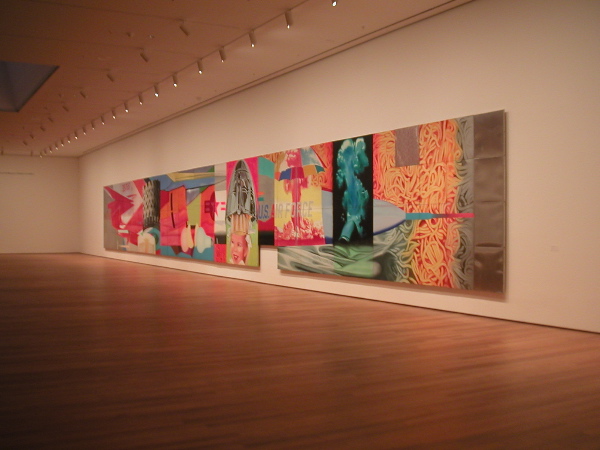
Rosenquist.JPG
On the sixth floor only the James Rosenquist gets to rest

But go look for yourself, and when you’ve saved up some more money, go back again. It’s a clean, well-lighted space. They haven’t wrecked the art; in fact most of it looks better than ever, so some people will be happy enough. I’ll be back too, especially since Members don’t pay per visit, but yesterday’s experience mostly makes me just want to go back to visiting the often-struggling little private and public gallery spaces I’ve been haunting all along. I hope to see you there too.
M26 justice – developments

Sentencing of the four remaining M26 defendents, until now scheduled for November 18, this Thursday, has been stayed pending the New York State Court of Appeals decision on whether or not it will review the unsealing of their older dismissed cases. This means that unless there is a last minute change there will not be any significant activity in court this week other than an announcement of the rescheduled date.
The defendents will know in four to eight weeks whether the Appeals Court will consider their petition. If the Court of Appeals agrees to review the petition, the defendents expect that sentencing will continue to be stayed in the interim. The review decision itself would not come until next string at the earliest.
If it decides not to review the petition, there will be no higher recourse and the D.A.’s sentencing memorandum will stand. They will be sentenced as Judge Stolz sees fit, which could mean anywhere from zero to 365 days in jail. If it decides in their favor, it will be, as Steve Quester writes, a great victory for the entire civil rights community in New York, and these defendents could be sentenced only with jail time effectively off the table altogether.
I will post more developments as they happen, including of course any and all future court dates.
Ah, how the sledge of justice does plod on.

Colin Powell, may he not enjoy this retirement

He’s gone. Colin Powell’s finally gone, and under the most cowardly of circumstances, just slipping out the back door quietly to no good purpose, and not three years ago, not two years ago and ultimately not at any time before November 2, but instead only days after the apparently successful election campaign of the man for whose stupidity and insane belligerance he destroyed whatever reputation he may* have assembled years ago.
That same cowardice, in the line of his duty as Secretary of State, is responsible for the deaths of perhaps over a hundred thousand Americans and Iraqis.
Powell’s legacy will, and not incidently, include his argument that the U.S. armed services couldn’t (shouldn’t?) be integrated – for homosexuals, that is. I’m sure however that he would have made the usual exception for times of war like the present, when they are needed for cannon fodder.
A very small man indeed.

*I’ll leave it to others, who know much more than I do, to comment on Powell’s early, very problematic career in the Viet Nam war (a Mai Lai cover-up is apparently only part of it) and in the Iran-Contra affair (coordinating the sale of missiles to Iran), and I’m sure they will.
[thanks to Elise Engler for the reminder about Powell’s early days]

David Wojnarowicz eventually got to China

Woj:stonesweep2.JPG
David Wojnarowicz untitled (1988-89) collage on masonite 39″ x 32″ detail

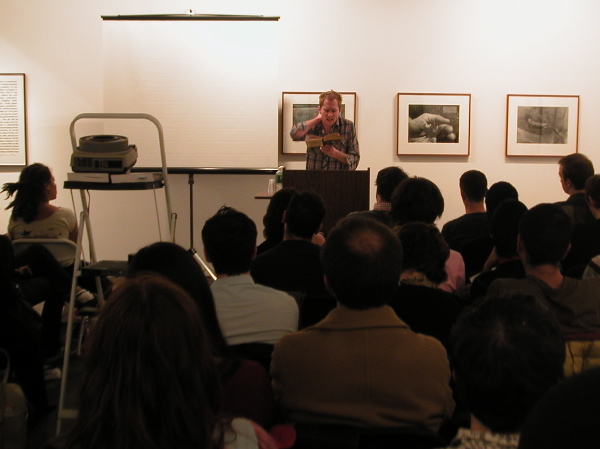
David could make the stones weep, but he could also make them scream. Last night we were welcomed by PPOW and Poets House to a tribute to the artist and writer David Wojnarowicz, who died of AIDS complications in 1992. The evening was scheduled for one of the last days of the gallery’s current show, “Out of Silence: Artworks with Original Text by David Wojnarowicz.” Five writers, artists and activists read from his texts or delivered original work inspired by his art and his rage.
For someone who had met David and who had been familiar with and in awe of his power for twenty years, the most surprising thing about the evening was the description and engagement of the overflow crowd; most of the people in the room were too young to have known the man whose memory brought them together last night.
The young novelist and poet Douglas A. Martin read an excerpt from Wojnarowicz’s powerful memoir, “Close to the Knives,” the scene where the artist/poet describes an erotic encounter with a stranger inside his “salesman station wagon” parked off a deserted road somewhere in Arizona. This was more of a performance than a reading. David was in the room.

Woj:DouglasAMartin.JPG
Douglas A. Martin inside David Wojnarowicz

His former lover, Tom Rauffenbart, reminded many in the room that David was not just an angry man. A child who loved life of all kinds, he never shut down an extraordinary curiosity which began very early. One of the works on display in the room was a black and white photographic print showing an obviously homemade biological specimen (certainly not dead from David’s hand) in a jar on a windowsill. There was a text within the image, small white print in the lower right corner:

When I was a kid I went into the backyard and tried to
dig a hole to China with a shovel and a bucket. After an
entire afternoon I hadn’t even left New Jersey

For more on David and the evening, see Bloggy.

flu shots, Minnesota nice

MinnesotaNice.jpg

“In Minnesota,” this morning’s NYTimes headline reads, “Flu Vaccines Go Waiting.”
Setting aside the question of how we got into a situation where throughout the country this year there are only a fraction of the flu shots which should be available, how can we get a bigger supply of this kind of people?

In most places, people are clamoring for flu shots – waiting in lines, calling every clinic in town, even going to Canada. But in Minnesota, the opposite problem has emerged: even people considered most vulnerable are forgoing the shots so there will be enough left for others.
This puzzling reaction has left state health officials charmed, but also urging an estimated 1.6 million high-risk residents to be vaccinated.
Concerns about quality control at a vaccine plant in Britain led to a shortage of flu vaccine in the United States and led health officials to ask that shots be limited to those most susceptible to complications from the flu, including children younger than 2, adults older than 65 and the chronically ill.
But in Minnesota, officials said, more high-risk people are passing on the shots than in years past.
Ann Thiel, 88, of Inver Grove Heights, said she had gotten a flu shot every year for the past decade after a case of the flu caused her esophagus to rupture. But after hearing about the shortage, she decided not to get her annual shot.
“I think an awful lot of money is spent on people my age at the expense of younger people,” Mrs. Thiel said. “I think I’ve had more than my share of good luck.”

[image from Northwestern Health Sciences University]