Capogiro: head-spinning gelato

I don’t know much about it. For some reason there doesn’t seem to be a website (even when those are now so ubiquitous we shouldn’t be surprised to find a website for the lemonade stand the neighbor’s kid set up last July). I do know that the makers of Capogiro gelato are in Philadelphia and I believe it’s a pretty small family business.
The fact that I’m writing about this food product should surprise me even more than it does my regular readers. I’m not even much of an ice cream fan; a pint has been know to for languish weeks in our freezer compartment, and I rarely think of going for a cone or a cup when I’m outside, even on the hottest summer day.
I do like to cook, but I have no patience for putting together a sweet when I’m doing savory stuff. Instead, if I’m planning a meal for friends, I usually go looking for some kind of simple, cool palate-cleansing finish, and that’s what started this rave.
Months ago I first came across Capogiro in our local Garden of Eden food market. The container had almost no identifying markings, and certainly nothing about calories, vitamins or dates of manufacture. Of course I was really intrigued, so I bought one. I even imagined that perhaps some local slow-food entrepreneur working out of an apartment kitchen might have placed the product in that freezer cabinet surrepticiously in order to create a market and a demand. When I tasted it at home and I realized how good it was, that story actually sounded even less preposterous.
I have never, ever before tasted any frozen dessert as wonderful as this one, at least on this side of the Tyrrhenian Sea. I hesitated to write about it for fear that my almost-secret supply might dry up, but I also thought that the best way to ensure its availability might be to do some word-of-blog marketing.
If the recommendation of someone who has just admitted he’s severely challenged as an ice cream fanatic isn’t enough to whet your appetite, let me tell you about just a few of the incredibly inventive flavors Capogiro has made available to its fortunate acolytes (meaning especially the people of Philadelphia). Here’s a short sample courtesy of Philadelphia Weekly:

How about prune armagnac, full of prunes swollen with fine French brandy? Or Mexican chocolate, powerfully flavored with canella (pungent Mexican cinnamon), bitter almonds and dried ancho chilies that make the back of the throat tingle. The La Colombe cappuccino is as frothily delicious as its namesake. Blood orange sorbetto tastes as though it were just picked from a tree, while cactus pear sorbetto, a shockingly pink confection, somehow manages to replicate the exact taste sensation of eating a cactus pear, minus the gritty seeds. Flavors change almost daily, depending on what’s seasonally appropriate.

My own favorite so far was called, I think, rosemary goat’s milk, but with Capogiro’s (head-spinning) inventiveness and taste, I doubt the competition will ever be finally judged.

children outside a “real world”

McCallumJames.jpg
Bradley McCallum & Jacqueline Tarry James August 6th, 2002 1 :01 – 2:00 PM
color photograph, 50″ x 40″
McCallumFrost.jpg
Bradley McCallum & Jacqueline Tarry Frost August 6th, 2002 5 :01 – 6:00 PM
color photograph, 50″ x 40″

They share a medium and a subject. Both of the shows currently installed in Chelsea’s Marvelli Gallery are the product of an artist’s camera and both are about young people (sometimes very young people) who have rejected (or been ejected from) a society which will now accept their images filtered as art.
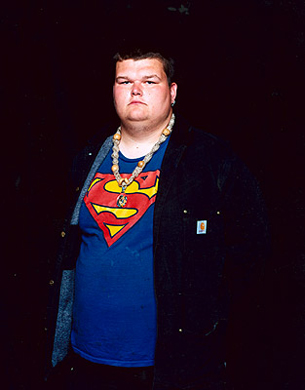
Bradley McCallum and Jacqueline Tarry show large, sensitive almost-full-length color portraits of homeless Seattle teenagers (and young adults who became homeless as teenagers). Their subjects’ costumes seemed incredibly stylized to me at first, perhaps almost unbelievable, and the life-sized photographs exhibit such technical beauty that you are likely to be very surprised, as I was the other night, should you hang out in the room a little while longer. The people on those walls will soon begin to seem less picturesque and much more familiar, but there will be little comfort in that development.
Two flat-screen monitors showing the same two-hour video are mounted on opposite walls of the same gallery space, with their starting moments deliberately out of sync. The moving images document 26 people (including among them the few shown in the room’s still photographs) as they step up in succession to replace from behind the figure a viewer has been watching standing facing the camera and who now disappears. This takes place on a very ordinary-looking Seattle neighborhood corner, one which may be a central part of these people’s world. The central figures are almost motionless, but the pedestrians and vehicles within the camera’s frame speed by at a literally regardless pace ten times faster than real life, since the filming was done over a period of 26 hours and the video has been accelerated to occupy only two. The soundtrack consists of excerpts from each of the subjects’ individual conversations with Tarry, layered with the low ambient energy of traffic noises.

Krausstwoboys.jpg
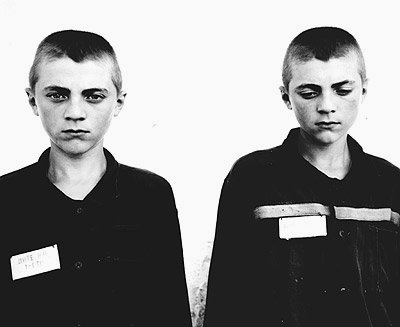
Ingar Krauss Untitled (2003) gelatin silver print, 33.5″ x 41″

In a smaller room at the rear of the gallery Ingar Krauss shows a number of black and white photographs of children and young teenagers who are a part of the Russian penal system today. The subjects alone would guarantee interest, but Krauss’s gift manages to raise tragedy to the level of a powerful art which will not be denied here. Unfortunately we can’t know whether or how this may help these small victims of society’s incompetence.

[images from Marvelli Gallery]

Joe Ovelman in the streetscape

joewithguy.JPG
joewitholderguy.JPG

He called around noon today. “James, I’ve just posted something.” For a second I was thinking of the the internet, but then I realized that Joe Ovelman is currently not even connected, and it dawned on me that he was talking about posting in the traditional sense.
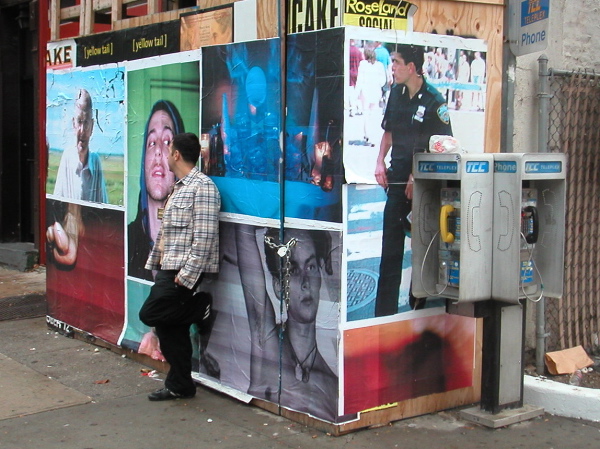
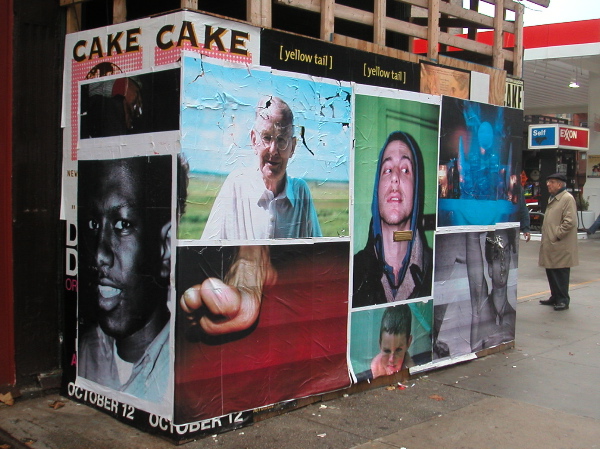
Actually, Joe doesn’t do many things in the traditional way. If he’s not showing his art in a formal gallery space he finds a way to get it out where all kinds of people are going to see it anyway. Today he wheat-pasted a contractor’s temporary wall on 11th Avenue just below 23rd Street with photocopies of some of his images, and if the area he covers is smaller than his previous outside “canvases,” the individual images themselves are much larger.
There’s also the wonderful effect he has produced by extending the work to the smaller sides of the fence structure which projects along the plane facing the avenue. It becomes a box. The carefully-balanced colors and patterns combine in a jewel-like three-dimensional installation. Joe’s latest post is sculpture.
And the serendipitous pleasures of the interaction the work inspires: When I mentioned to Joe that I really liked the mail slot touch, he said that he had watched from the corner as at least one passer-by lifted its door and peered inside. Also, just as we arrived there late this afternoon the young man in the picture above was arranging the pose in which he is seen here while [his girlfriend?] snapped his picture.
For more, see Barry’s post.

New York stopped in its tracks

traffic9thavenue.JPG
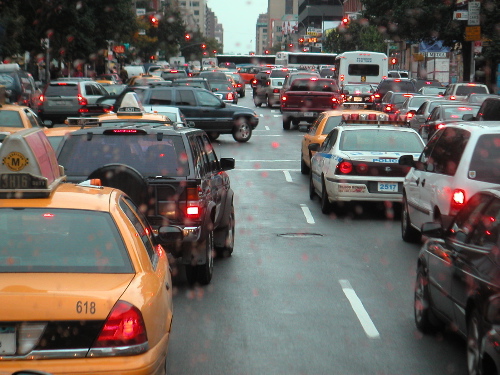
from the front of the bus, 9th Avenue in the forties, on a Saturday afternoon (these vehicles aren’t moving)

We live in Manhattan. We’re supposed to be able to get around the city without each of us piloting two or three tons of private metal, but it’s getting harder and harder to assume the availability of the public transportation which makes this city possible.
Barry and I had decided early this afternoon that we should have no trouble running up to 57th Street to see two gallery shows which close today and then heading back in time to look into a number of Chelsea locations before their doors were locked at 6 pm. But we hadn’t bargained on the virtual disappearance of both subway and bus service, and in the end we were reminded that Manhattan’s transportation failings are far greater scale than that represented by a badly-organized and underfunded MTA.
When we discovered (only after descending the stairs into the station) that there were no uptown trains running from our corner, 23rd Street and 8th Avenue, all weekend, we decided to risk a cab and potential Midtown congestion. There were no complications once we settled into our roomy Toyota van, but less than an hour later the transportation mishaps started to pile on top of each other.
We made the mistake of trying to rely on the subway in order to get back to Chelsea. Our train ground to a halt in the staition just one stop south of 59th Street, where we had boarded it. The repeated announcements about a short delay were eventually replaced by one saying that there was a train broken down ahead of us and there was no way of knowing how long we would be held in the station. We abandoned our car and walked a long block to the 9th Avenue bus, thinking that passing only a couple of dozen numbered streets would be a quick hop, since there was so little traffic in sight. Traffic suddenly appeared out of nowhere and we ended up frozen virtually immobile by the SUV’s heading back to New Jersey through the Lincoln Tubes (see the picture above).
Well over an hour after leaving 57th Street we finally emerged back on 23rd Street. We had made the trip (a total of about a mile and three quarters) at the dizzying pace of 1.5 miles per hour. I have to remind myself that all this was happening on a quiet Saturday afternoon.
The subway had failed us once again (this is not uncommon); surface transportation was ridiculous (even in the best of circumstances we have to live with primitive bus designs, passengers exiting through the front, or entry, doors, clumsy fare-collection machinery and the total absence of dedicated bus lanes). In addition, every intersection box was blocked by cross traffic, meaning that the bus had to wait through two signal changes even after it reached the stripe at the cross street (there were no traffic police in place anywhere along our route).
I saw one fire truck in the middle of the almost chaotic scene; fortunately those guys were not on an emergency call this time, but had the circumstance been otherwise . . . .
All forms of transportation on at least the west side of Manhattan, with theoretically the most mobile population in the nation, had been rendered impossible. And still our elected and appointed officials persist in believing that the job of municipal transportation oversight is to get more cars to move still faster into and through the streets of a city already suffering from an impossible burden of private car ownership.
Oh yeah, I just reminded myself that all of this traffic was created even without the impact of the insane proposal for a West Side stadium.
This week the MTA announced liklihood of really major cutbacks in service, which will leave room for still more cars. Great planning.

Facing years of spiraling deficits, the MTA is proposing to eliminate 14 percent of its bus lines as part of a severe cost-saving package that would come on top of a fare hike and more than 160 subway token booth closings.
The bus route closures, slated for 2006, would hit all five boroughs and include some lines that follow major arteries in Manhattan.

Stockhausen

StockhausenMontag.jpg
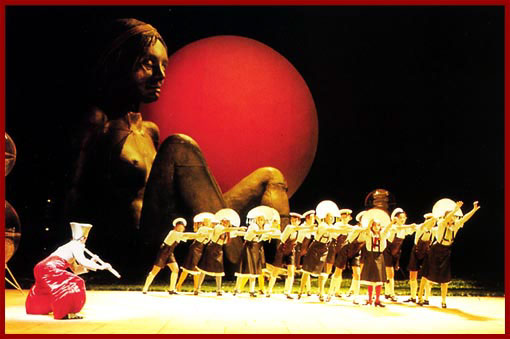
Der Kinderfänger (the Pied Piper), from “Montag aus Licht,” Act III, scene 2

Yay! It sounds like he’s finished it! Karlheinz Stockhausen has announced that the premier of his life’s work, the 29-hour “Licht” (“Light”) cycle, will be performed in Dresden in 2008.
I think I’ve been waiting as long as he has. I’ve hungrily collected recordings of each of the seven sections, named for the days of the week, as they have gradually become available (I’m only aware of the existence of four at this time), but I’ve been excited by his music since first hearing it through the CBC/BBC/NDR broadcasts transmitted across the Detroit River in the 1950’s. Thank you, Canada.
I actually don’t know any of the things about music that could be acquired from formal study; I’ve had none. But I’ve been listening to things all my life, most of the time attracted to the less obvious arrangements of sounds. Maybe I’m just a romantic, but I think of Richard Wagner wherever I confront Stockhausen’s great project (no, seriously), and I’m not making the association just because of the obvious similarities in the ambitions of these two geniuses.
For a small taste of Stockhausen’s storybook, through a short synopsis of the opera’s first section, “Montag Aus Licht,” see this text from “An Unofficial Website about Stockhausen“:

The theatre foyer seems to be underwater, bathed in green rays of light. The inverted Eve formula can be heard from many basset-horns.
In the first act a huge statue of Eve is on the sea shore, and is tended to by many woman with perfume and water. (Later this image was adapted for use in a famous television advertisment for the painkiller Nurofen®). The statue, which has three soprano soloists singing down from the larynx, gives birth to seven boys with animal heads who are followed into the world by seven little men from Cologne folk-lore: the Heinzelmånnchen. 3 sailors arrive from the sea to witness an elaborate pram dance with all the nurses and newborns racing geometrically about the beach. All the while surreal events are portrayed through the use of sound samples (e.g. baby animals, steam trains, the Marseillaise sung by a budgerigar), and the children involve themselves in all manner of clamour, mischief and bodily functions. At the height of the chaos an icecream seller arrives on an upside-down bicycle and moments after that Lucifer arrives joined by a web to his grotesque double. He is buried in the sand by the three sopranos. The women’s weeping is soon accompanied by falling rain , and the act ends with Lucifer emerging from the sea and ordering the boys back into the womb of the statue.
“Everyone back in!! The whole thing again from the start !!!”
The second act starts with a procession of candle-bearing maidens, and a very long concert grand piano approaches the statue. A short complicated piano piece is played by the boy budgerigar, and the womb of the statue begins to glow. Seven boys of the week are born, and each is taught his own song for his day. The boys are seduced by three female musicians who emerge from the Eve Statue.
In the final act Eve appears playing basset-horn, and performs for her reflection. Soon a musician arrives as an alto-flute player, and joins Eve in a duet. Children come and listen, and eventually the flute player is distracted by them and leads them away into the clouds.
As the public leaves the theatre they find the foyer bathed in clouds, and can hear the children climbing higher and higher, like birds.

For more information, see the composer’s own site.

Stockhausenoriginal_instuments.jpg

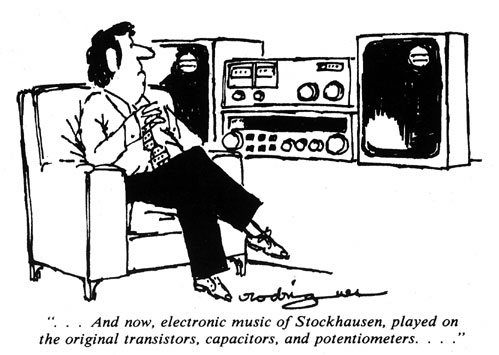
[photo image by Henning Lohner from swipnet; cartoon from a 1980 edition of “Stereo Review,” via Stockhausen’s site today]

something personal

gahanwilson.gif

Riiiiing! Riiiiing!
It was our phone sounding at 7:30 in the morning last June 10th. [those of you who are familiar with Barry’s and my sleeping schedule will understand just how much that call violated all reasonable decorum in this household] When I picked up the receiver the short message I heard was, “Would you mind if we cancelled your radiation lab appointment for 2 o’clock today?” After answering that it would be no problem, I managed to ask my oncologist’s office, “why?” [not why call at 7:30 am, which is what I should have asked first, but why cancel]
[A LITTLE BIT OF BACKGROUND: I was scheduled to begin radiation treatments that afternoon to combat a serious prostate cancer diagnosed early in April. I had already managed to make my peace with the prescribed regimen, but the message nevertheless registered as something of a last-minute reprieve, even better than hearing that classes had been cancelled for the next day when you had not done the assigned homework.]
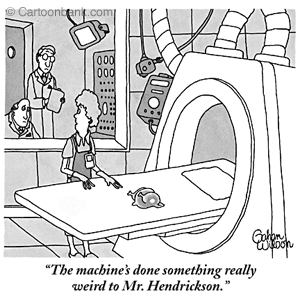
The nurse’s answer to my question was, under the special, very high-tech and critical circumstances of the procedure involved, and one which has to be precisely directed at an extremely important part of the body’s plumbing apparatus, not a little disturbing. Her explanation: “We’re having mechanical problems with the machine.”
Umm, maybe it was actually a good thing that I wasn’t fully awake.
In any event, later that day I was given the all clear signal, and I eventually went off to go under the big zapper – on the following day. I was in and out in under a half hour, and I didn’t feel a thing. I went back every weekday for a total of five weeks and then took a break for three more (squeezing in a trip to the West Coast) before going into the hospital for an outpatient procedure during which radiated “seeds” were implanted in my prostate.
I’ll spare the details, but mine is a serious case, because of the growth’s size, and beyond serious consideration of a cancer removal operation. There are major, not easily measured, risks in the radiation treatments, and no one knows at this point what are my chances of escaping from the ultimate capital sentence. But from the evidence available this thing sounds pretty pokey to me. I believe most men die of something else before this cancer gets them, and I still expect, as I have for years, that I’m more likely to be shot by a road-raging driver than I am to die in bed.
I feel fine, and my head seems to be alright. I’m a wee bit distracted, but I don’t think I’m really depressed. Actually the worst seemed to be over once I had decided on the treatment regimen.
Barry’s been great, of course. His welfare will always be my biggest concern.
I was initially reluctant to tell many people about this thing. I wanted to wait until I knew more about what was going on, and at first it barely went beyond my immediate family. At this point however (9 weeks after the implant procedure and 7 months after a diagnosis) although there are already probably too many friends who have had to listen to my all-too-complete response when they ask, “so how was your summer?,” I’m now ready to visit it upon the blog world.
Those who regularly look at the site know that I’ve generally kept most of myself out of it until now. It’s always been about other stuff, and it’s definitely not a journal. I decided to make at least one exception and to write this post months ago because I thought it might help some people (and incidently give me an opportunity to mention the success story of my long-term seropositive status at the same time). I’ve regularly put it off since, mostly because I thought it would be such a chore to get it right, that is, to not sound too self-indulgent and to avoid any morbidity.
I don’t understand morbid.
If I had not been really blown away by the original cancer diagnosis last spring, it was largely because I’d had to deal with virtual or almost-death sentences several times before, and I’d managed to get past each one. I see no reason to imagine this thing going any differently.
There’s this history.
When I was 17 I was in a car accident which two of my best friends did not survive; rescuers didn’t find me in the burning car at first, and once I was deposited in the emergency room hallway I was given “last rites.” Thanks to the excellence of a great little hospital I was able to leave its care a month later, even if encumbered by a full body brace and crutches.
Years passed and in 1989, at my regular doctor’s casual suggestion, I decided to take a blood test for HIV disease. He called me at the office a week later and quite matter-of-factly told me it came up positive. At that moment the only thing shielding an uptight corporation from seeing my pretty dramatic response to a short phone message were the opaque walls of my private office; I left for the day soon after in order to share the news with a very wonderful friend. Today, 20 or 25 years after being infected, I remain asymptomatic; I know I’m one of the very fortunate ones. My doctor himself didn’t make it.
Five years ago just outside my front door I was assaulted from behind by an irate SUV driver. After he had nearly run over myself and an elderly blind neighbor crossing with the light, I had slapped his truck’s rear end with the palm of my hand. I went to the emergency room for immediate care and an x-ray – just in case; the diagnosis for serious injury was an all clear, but I was shocked to be told that, by the way, there was a mysterious growth in my right lung. Months later, after a major operation and a couple of extraordinarily painful complications, I had learned that the tumor was benign but that they weren’t going to replace the damn rib.
I think I’m very likely to shake this latest threat to my plans for a slightly cranky old age, just as I have all of the others so far.
Since I now have a few more years under my belt than I did in 1989, I’ll admit that I’m now a little more comfortable when I think about my mother’s immediate and unsentimental response that year after I told her I had the AIDS virus: “Well, you’ve had a good life.”* Okay, I can go along with the “good” part, but I’m still not ready to call it a complete life.
Still just a little too cranky.

* Eighty-two at the time and with almost 8 more years to live, she had instantly changed the direction, if not the subject, of our converstion; maybe that’s what she was hoping to do, maybe she thought that would be a good thing and maybe it was.

[image by Gahan Wilson from the New Yorker]
“Arna’s Children”

The powerful documentary, “Arna’s Children,” is now at the Quad Cinema here in Manhattan. I’d be much more excited if it were playing in every town in the U.S., but unfortunately it’s not going to happen. If you want to know why, see what I wrote last May.

I just noticed that of the four films currently being shown at the Quad, Barry and I have actually seen three. This is pretty amazing, since the two of us rarely get around to slipping into a movie theatre in the crush of so many seductive live (therefore more time-sensitive) performance offerings. Like “Arna’s Children,” the other two films would not be described as directed toward mainstream audiences (whatever that means), but I can recommend both “The Child I Never Was” and, most enthusiastically, Bruce LaBruce’s “Raspberry Reich.”
If these films have anything in common, it’s the ability of each to re-arrange minds which might have thought everything was already nicely in place.

ACT UP Saturday night

ACT UP’s on a roll lately! Members have been working very hard – and very cleverly. The media has had to salute their brilliant zaps, even describing the issues for a change, but this time the attention came without a single clenched fist being raised in anger. Well, yes, documentation of AIDS issues wasn’t actually part of the coverage this time, but the unexpected homage still represented great exposure.
Saturday Night Live returned for the Fall season three nights ago* introducing the show with a skit which satirized the first presidential debate and its format. Chris Parnell, impersonating the moderator Jim Lehrer, after explaining the order of the candidates’ exchange, continued his instruction:

Following Senator Kerry’s rebuttal, there will be a brief demonstration by members of ACT UP.

The studio audience roared, and Barry and I almost fell off the couch.

* I haven’t tried to post anything until now because, while we had watched the recorded program on Sunday night, we’ve been without a decent internet connection since Monday morning. Time Warner came for a repair of our TV cable service yesterday. They failed to fix the problem, but did manage to knock out the cable modem. If we’re lucky it will be fixed later today.
Working with a wireless network borrowed from a friend at some remove in our building, I was fortunate to be able to put up this story, but I won’t attempt anything right now which has an image.