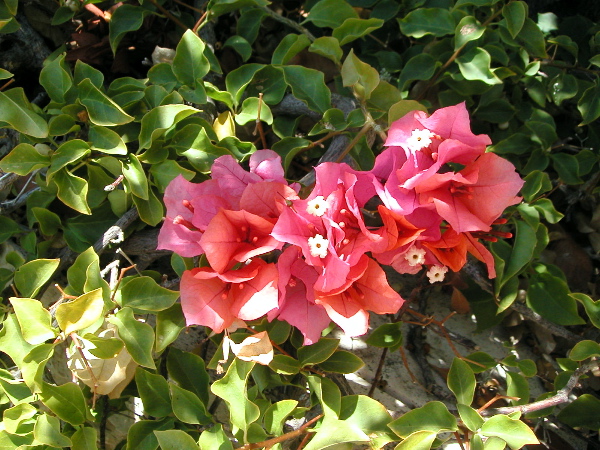
More than 25 years ago a friend in Boston brought me a present she had carried all the way back from a visit to El Paso, where she had grown up. It was a peach-colored discovered (for Europeans), in 1768.
[The image was captured last Wednesday afternoon, near the Central Garden of the Getty]
Schindler’s Studio-Residence
“AS IF THERE HAD NEVER BEEN HOUSES BEFORE”
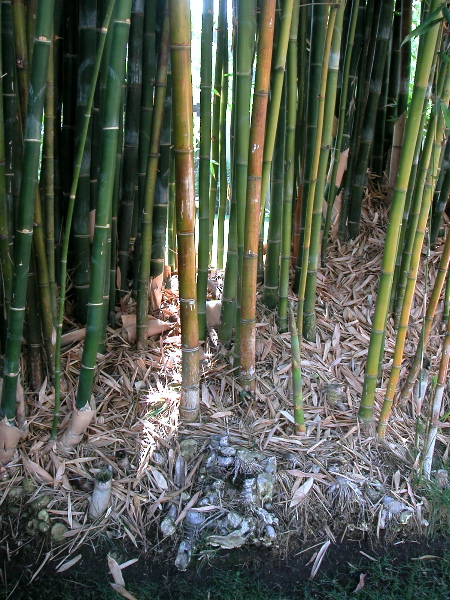
Schindler House, view at the driveway entrance of part of a very tall and dense copse of bamboo which runs along the front sidewalk (the pleasant sounds of a large, creaking wooden ship are heard when the wind blows)
Utopia. The house was built in 1922, and the grounds followed. The compound was an incredibly original creation and it almost totally baffled contemporaries. The people who built it and made it a happy place for themselves and their friends are long gone, and while no one has succeeded them in their residency, the Schindler Studio-Residence in West Hollywood has never failed to attract admirers, visitors and guests.
The original furniture is in storage, so as I tried to evoke the functions of the interior and exterior spaces in my reverential self-guided tour of this beautifully quirky place I had the odd impression I was walking through the remains of the palace of a sage or nobleman in a culture not yet discovered by the West. Actually that wouldn’t be far from the truth.
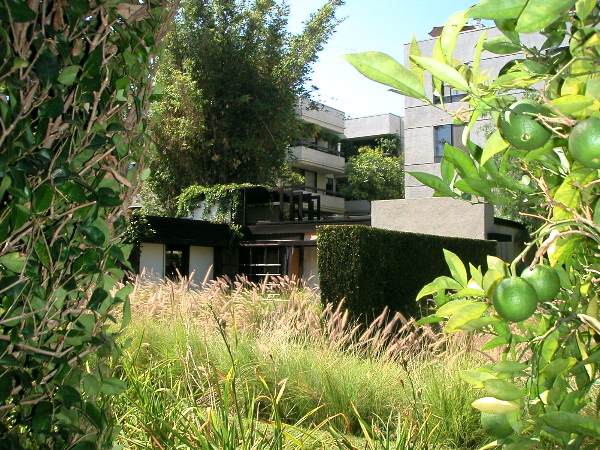
Schindler House, view of the north wing from the walk leading to the architect’s studio (the taller, white building is a neighboring apartment house)
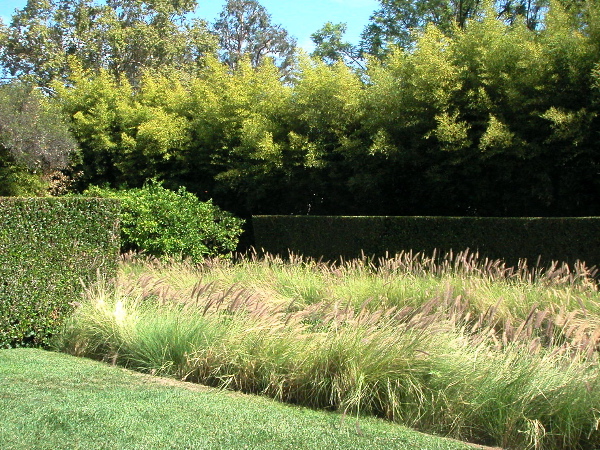
Schindler House, view from the north wing of its private terrace and the plantings beyond, including the tall hedge shielding the walk to the architect’s studio
Last year the NYTimes published an article about an important fight in which the foundation maintaining the house is currently involved, and it included this homage to Schindler’s art on Kings Road:
Schindler was born in Vienna in 1887 and came of age amid the intellectual ferment that produced Sigmund Freud, Gustav Klimt and Arnold Schoenberg. He emigrated to the United States in 1914 and soon was working for Frank Lloyd Wright.
Several years later, Wright sent him to Los Angeles to supervise a project, the Hollyhock House, built for Aline Barndsall, an oil heiress. He decided to stay and open his own architectural practice.
In 1922, Schindler built his famous home, designing it, in the words of the British historian and critic Reyner Banham, ”as if there had never been houses before.”
Even today it is striking in its simplicity and originality. Glass, concrete and redwood are the principal materials. There are few doors, just sliding panels inspired by Japanese houses. Rather than bedrooms, there are canvas ”sleeping porches” on the roof. Furniture is sleek and angular, and the boundary between indoors and outdoors is blurred.
What went on inside the house while Schindler and his wife lived there was at least as remarkable as the house itself.
Both were social and political radicals, and they turned their home into a salon for artists and all manner of utopians, from Communists to theosophists to vegetarians. Guests and tenants included the photographer Edward Weston, the composer John Cage and the novelist Theodore Dreiser.
Schindler died in 1953, and his wife continued to occupy the house until her death in 1977.
She established Friends of the Schindler House to preserve the property, and in 1994 the group received an injection of cash after arranging a partnership with the Museum of Applied and Contemporary Art in Vienna, of which [Peter] Noever is the director. Since then, the house has been used for concerts, exhibitions and cultural events.
(Because of structural deterioration at the Schindler House, the World Monuments Fund placed it on its list of 100 most endangered sites in 2002.)
See also this earlier post and the link there.
Los Angeles precision landscaping
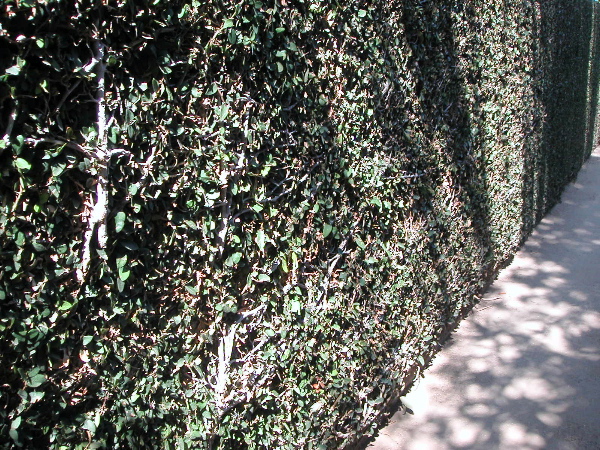
Schindler House, high, tight-foliage “hedge” bordering the entrance drive
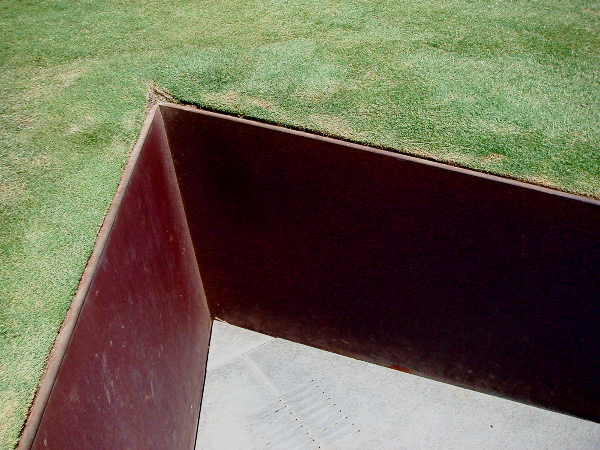 Getty Center, corner of zigzag pedestrian path through Central Garden
Los Angeles doesn’t disappoint a visitor from the North, and for this pilgrim its charms always begin with the flora, even if much of what has become identified with the region is imported or artificially maintained. In fact, the boldness of both its humblest and most fabled gardeners must regularly surprise even Angelenos themselves. The “hedge” shown above is little over an inch deep, and is actually a vine attached to a cement wall. The 30-inch metal retaining wall in the image below it allows delighted visitors to literally walk through a large hillside lawn.
The most striking aspect of these two disciplined geometric creations may be that they are found in a hybrid environment. In both cases the larger gardens are a delicious combination of minimalism and wild abandon. For some of the gardens attached to Rudolf M. Schindler’s Studio-House, see the next post; for flowers in Robert Irwin‘s inventions at the Getty, see the images which will go up over the next week or so.
Green Hummer Project
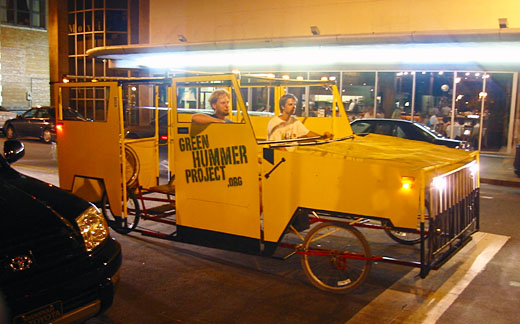
political art, cruising Savannah streets
Crazy about bikes, but just can’t get those Hummers out of your mind? Check out these guys and their wonderful full-size Green Hummer.
This bicycle is an attempt to make large numbers of people reconsider the ways that they move around their cites. Our SUV is the opposite of modern consumer culture, an anti-commercial. We want people to think independently of the corporations who program their televisions. We want people to see our pedal-powered, life-size Green Hummer cruise around a real city, and think about the contrast between advertising and the real world.
In advertising, cities are lifeless, cars are safe, drivers are happy, gas is clean, and you are not responsible whatsoever for traffic, pollution, your weight, the marring of our landscapes, or war.
Our SUV is for the real world.
Don’t miss the wonderful short video clips!
[thanks to Derick Melander and his brother for the link]
Richard Meier and Robert Irwin, in detail
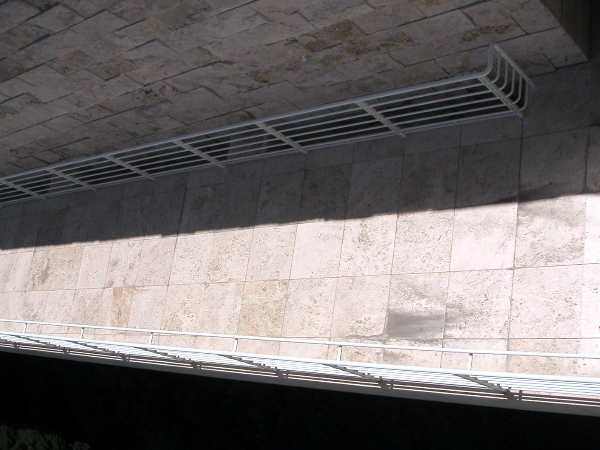
Meier’s ramp
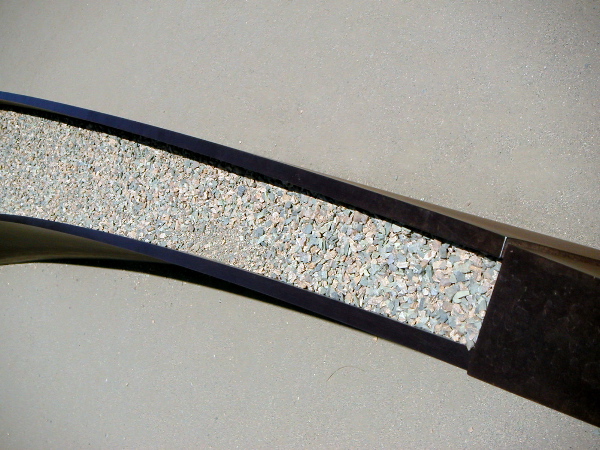
Irwin’s ramp
The overall design of the Getty Center is that of Richard Meier, but Robert Irwin was commissioned to create its Central Garden. Both jobs cried out for gently-sloping walking ramps, but each man arrived at an elegant solution appropriate to his own creation. Together they approach or surround a cultural temple atop a beautiful sun-drenched acropolis.
Terence Koh at Peres Projects
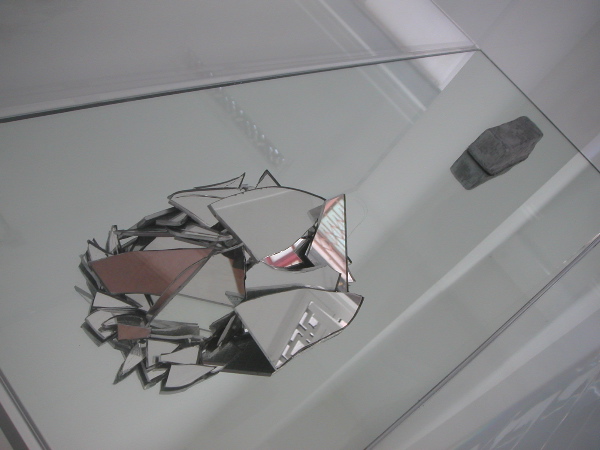
Terence Koh detail of Do not doubt the dangerousness of my butterfly song (Silver) (2004) Custom metal vitrine, speakers, ipod with unique song sung by artist, paint, male argyrophorus argenteus butterfly, broken mirror, star dust, 45 ” long, 18″ wide, 61″ tall. Unique
This work is part of the artist’s two great current shows, but they close today; my apologies to many people for posting this so late, especially since I’ve been so impressed with both the work of Koh and, at our remove, that of his gallery, Peres Projects. We visited the space in Chung King Road for the first time just one week ago.
“Sam Shepard ghost town”
We’re home!
Since we only had a dial-up connection in the hotel room, I didn’t try to post everything I wanted to while we were in Los Angeles. This item, and perhaps a few others to follow, will make up for some of this blog’s relative “silence” of the past week.
We wanted to get out of the man-made environment for a day and get into the desert, so we left Wilshire Boulevard and drove northeast, eventually passing through the current greater-L.A. frontier around its fabled Victorville, soon after making a pit stop in the newly-created settlement of Summit Heights (where the mall was complete even if the tract homes were not). Beyond this new asphalt camp the (unpeopled) wilderness began. Going through open country baking in 105-degree heat (convertible top up, AC cranked), we turned back after Barstow, but well before approaching Needles, and drove back across the top of Edwards Air Force Base.
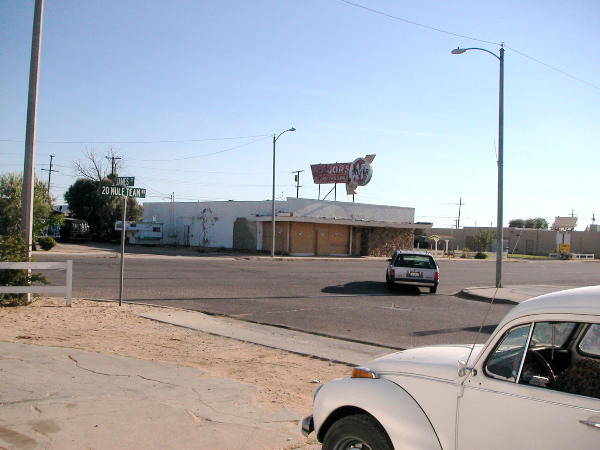
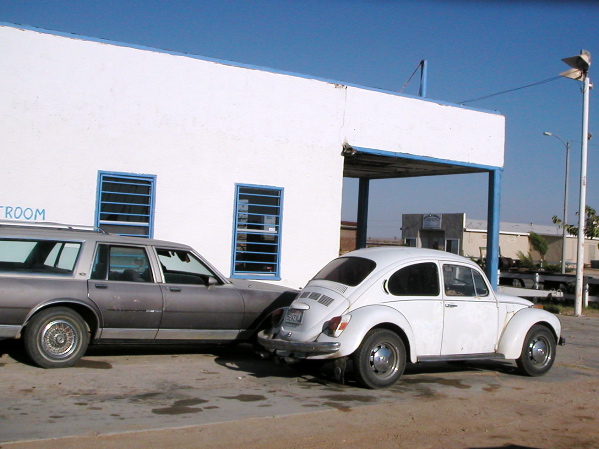
We had seen real and re-created ghost towns, but the two images below are descriptions of a special case, the community of Boron, which Barry called a “Sam Shepard town.” We both thought it was pretty cool, if a bit of a commute from Manhattan. A special touch was provided by the excellent 80’s rock coming from the white-painted repair garage with the “…troom” sign (the chamber indicated was of course the reason we had ended up there for this serendipity).
Historical note: The 20 Mule Team Rd. marker refers to the fact that this street was once the route, established in the 1880’s, of the 20 mule teams which hauled borax from the borax Works in Death Valley and Amargosa to the railhead at Mojave (30 miles west of Boron).
Robert Irwin plants the Getty Museum
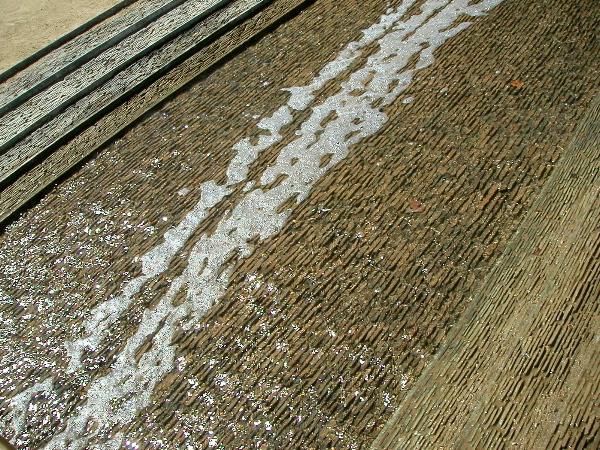
The collection is spotty in its quality, but it shows beautifully. The architecture is a great pleasure, yet not revolutionary or breathtaking. Ah, but the gardens are an absolute, unqualified delight, all thanks to Robert Irwin and the uncredited gardeners who work their wizardry on the grounds of the Getty Museum.
Lots more garden images (including real flowers!) will follow over the next week or so.
Moon furnished N. Korea missile with subs a threat to U.S.
Yowza! That’s showing some really faith-based initiative!
It would seem that, a few years ago, the Rev. Sun Myung Moon purchased a small fleet of Russian ballistic missile submarines with the missile-launching hardware intact, then handed the subs over to North Korea. Now, according to Jane’s Defense Weekly, the North Koreans have used that hardware to develop missiles that can threaten the United States.
Your tax-free cult’s dollars at work.
Thanks to The American Prospect, linked above, Atrios and Jane’s Defense Weekly.
I’m a tree hugger
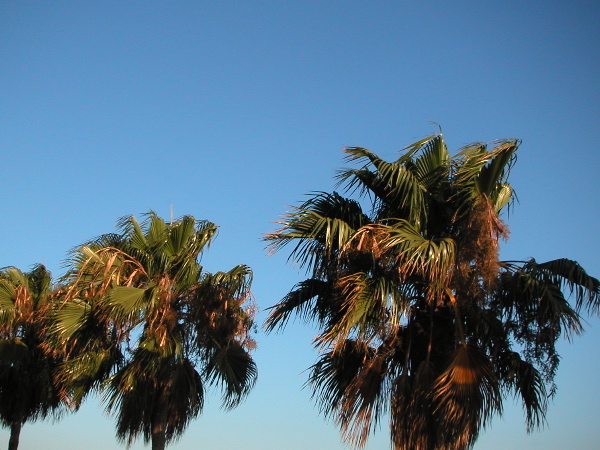
untitled (palms in the blue)
These wonderful creatures could easily turn me into an animist. These palms were waving above the high terrace of the Los Angeles County Museum of Art this afternoon.
But, at least on the surface, the current featured exhibition, “Beyond Geometry: Experiments in Form 1940s−70s,” could hardly be more removed from these beautiful sentinals outside. It’s a stunning show, even if I somehow missed the argument of its curatorial premise.