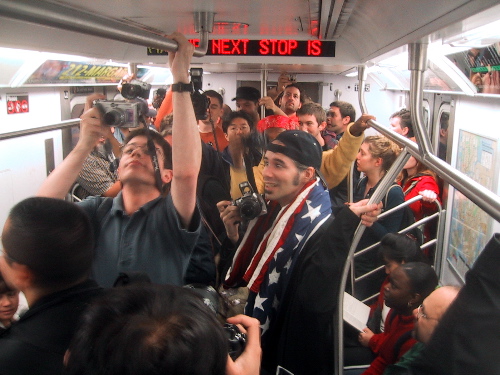
way cool photo-in captures New York MTA

MTAcameras1.JPG
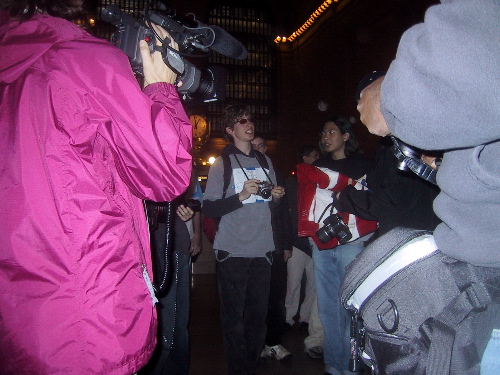
Grand Central Station
MTAcameras2.JPG
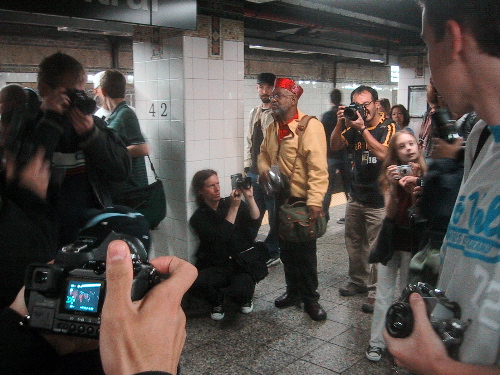
waiting for the Lex express
MTAcameras3.JPG
on board, somewhere above Union Square, er . . . actually, below
MTAcameras4.JPG
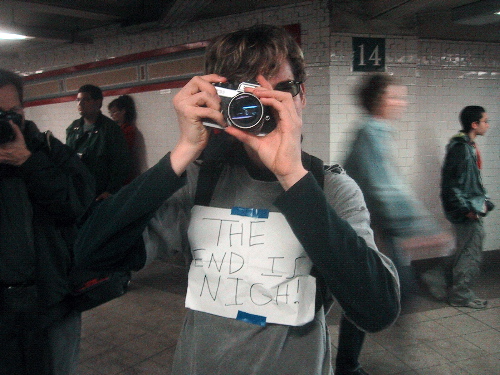
transferring to the L

I saw the message captioned, “Photographer’s Rights Protest,” and I told myself, “I’m in!”
The issue is the New York MTA’s recently-announced proposal that photography be banned throughout the system. Of course it would be for our protection, from camera-hefting researcher/terrorists. I was attracted to the issue (how could its lack of merit even be arguable?), but the fact that a demonstration was announced through the internet, the modest panache of its text appeal, and finally my own recent experience with MTA security incompetence, and its photographic documentation, made it a must.
An excerpt from the organizers’ webpage:

This will be a peaceful demonstration against the MTA’s proposed Photography Ban, conducted in the spirit of Rosa Parks. We will simply ride through Manhattan with our cameras, taking as many photographs as we please, of whatever we please. This is a completely legal protest, as photography within the subway system has not yet been banned (even though the police seem to have been told otherwise).

Participants were asked to bring cameras and, if they wished, “a witty sign.” I have to admit that while I had good intentions, I didn’t manage to fabricate the cool sandwich-board I had created in my head; I went shamefully textless. So did all but one of the hundred or so people who gathered in the central hall of Grand Central Station early this afternoon. That singular body sign, “the end is nigh,” was suitably wry but undoubtedly arcane for all passers- and sitters-by.
But maybe in this action it really was appropriate to just take pictures, especially if the press was already interested, as it seemed this afternoon it was.
The weirdest thing for someone who’s been in perhaps hundreds of other zaps and demonstrations was to be in the midst of all these people taking pictures of each other. Right now there must be thousands of shots out there somewhere showing people snapping people snapping people snapping people, and perhaps beyond.
Not incidently, our progress through the system today must represented the safest time and place in the history of the MTA – at least as far as any threat originating with camera-wielding terrorists is concerned. Don’t leave those cameras home, good folks; it’s for your own security.

For some early-posted, great images go to the dart board]
stopthephotoban.jpg
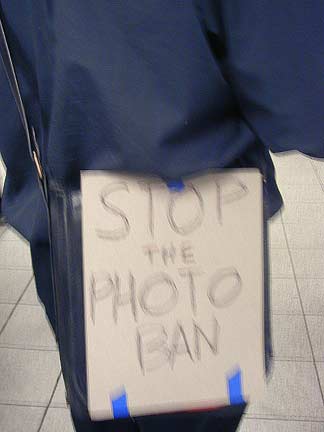
In the end, I broke down and made this crummy impromptu sign on the site, hoping it might raise us above the “flashmob”-type thing.

[bottom image from Forgotten NY]
New York Times erases AIDS

The NYTimes begins its obituary of Ronald Reagan today with a three-column headline on the front page and it continues inside for a total of four more full-page sheets uninterrrupted by advertising. The size of this death notice may be unprecedented, but the most newsworthy item is what’s missing.
The words AIDS or HIV do not appear once.
This is beyond politics; it’s criminal neglect, if not part of a deliberate agenda, from the newspaper which was itself so guilty in ignoring or mishandling accounts of the plague during the Reagan years. Now that same newspaper would have us regard as serious journalism its account of the life of our second-most-disastrous president, the man whose administration, in surviving its general malfeasance and treasons, marked the final disintegration of American democracy.
We won’t buy it.

Reagan, more dead[ly] as president than now

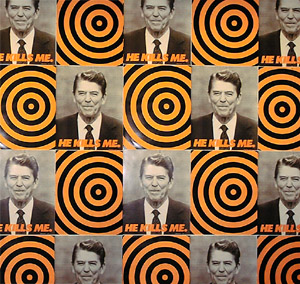
Reaganhekillsme.jpg
Donald Moffett He Kills Me (installation detail), 1987

He’s dead, but as the encomiums pile up he’s not going to look dead enough.
Reagan virtually spat on people with AIDS throughout his presidency. The epidemic began under his watch, and he ensured that it would ultimately kill millions. For that responsibility alone, he didn’t deserve the relief alzheimers must have brought to his memory.
Ah, wait, Barry just turned on Sylvester’s “You Make Me Feel Mighty Real.” The magical musical legend Sylvester died of AIDS in 1988, so that ecstatic, triumphant shout of delight seems very real around here today. We’re dancing on his grave tonight. Maybe me especially. I’m still talking, and now that monster/fool is not. I’m one of the lucky ones. I’ve been HIV+ for decades, and I’m not leaving yet.
Oh yes, and my memory’s just fine.

[image from Richard F. Brush Gallery, St. Lawrence University]

Eyton Fox gets even better

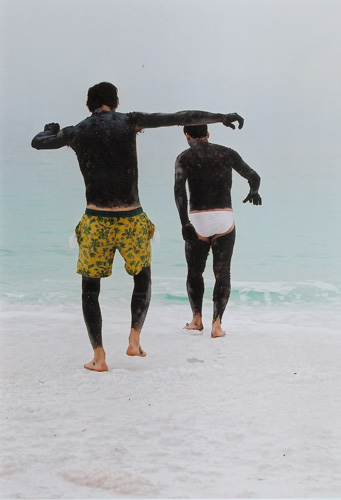
walkonwater.jpg
German visitor and Israeli tour guide meet the Dead sea

I’d say that Eyton Fox has now redeemed himself in the eyes of anyone who might have thought his last film, “Yossi and Jagger,” operated in too much of a bell jar. The story of a love affair between two young Israeli officers in a remote army base on the Israeli-Lebanese border, “Y&J” does not really address the elephant in the barracks – the moral questions of occupation and violence.
The American-born Israeli fimmaker’s third film, “Walk On Water,” which premiered last night at New York’s NEW FEST, is a much more mature film than the very well-received feature shown by the director last year, and it covers far more ethical ground without stretching the moralizing. The film’s most profound voiced statement is brief. It’s delivery is given to an Israeli Arab and it’s directed at a Jewish Israeli who represents absolute power in their shared world. The young Arab, his family and his nation have just been deeply insulted in front of two visiting young Germans. His reply, painfully gentle under the circumstances, is directed into an open car window. It was something close to this: Maybe if you people could get over what happened to you a long time ago, you’d be able to see what you yourselves are doing now.
It’s a wonderful, nuanced film. It’s about all kinds of people doing both very bad and very good things, representing the relationships between one generation of Palestinians, two generations of Jewish Israelis and three generations of Germans. No one gets off easily.
Now what some of you will appreciate knowing before you decide to go: The actor playing the lead Israeli character, Lior Ashkenazi, is one of the most beautiful men ever touched by a camera.

[image from the film’s website]

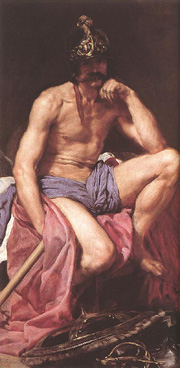
the most warlike nation

Mars_EUR.jpg
Mars, God of War Velázquez

Over the last 200 years the United States has “used its armed forces abroad in situations of conflict or potential conflict or for other than normal peacetime purposes” 241 times, according to research done at the Library of Congress. I have added the number of conflicts since 1993, when the data was collected by the Department of the Navy. The report cautions:

The instances differ greatly in number of forces, purpose, extent of hostilities, and legal authorization. Five of the instances are declared wars: the War of 1812, the Mexican War of 1846, the Spanish American War of 1898, World War I declared in 1917, and World War II declared in 1941.

The fact that only five of these actions were legally-authorized wars is hardly reassuring.
Even if we choose to deny our warlike character, the rest of the world cannot. This nation, which even now numbers less than 5% of the world’s population, feels it necessary and justified to regularly attack people around the world in the name of its own security. Even when we are not at war or in attack mode, we’re right out there. The United States “owns or rents 702 overseas bases in about 130 countries and has another 6,000 bases in the United States and its territories.”
On Memorial Day just ended, our de facto Commander in Chief declared, apparently with a straight face, “Through our history, America has gone to war reluctantly because we have known the costs of war.”
Gone to war reluctantly? We go to war at the drop of a hat. Known the costs of war? Unlike the war experience of virtually every other nation on earth, that of these United States has only been in other peoples’ backyards.
Ours is the most warlike nation on earth, and perhaps in all of history.

[image from Art Renewal Center]

no more avoidable memorials, please

I heard part of a broadcast on public radio yesterday, reporting that a small American town was memorializing, for the first time since the Viet Nam War, a combat death of one of its young citizens. As earlier wars fade from our memory, these are the ones which remain – to haunt us.
On a day when we are remembering the casualties of so many American wars, the loss of hundreds of thousands who made the ultimate sacrifice for the values we believe our society represents, it is beyond tragic to think about these last two major conflicts. They were both huge follies. The Iraq War is increasingly recognized as perhaps more crime than folly. But our leaders say it must still continue.
If we were wrong in putting them out there in the first place, how can we tell them to stay there now?
Twenty-three years after he first asked it, Senator Kerry’s question is still not being answered. How do you ask someone to be the last to die for a mistake? Unfortunately Kerry himself is no more forthcoming than the administration whose wars he voted for, and his position sounds something like this: Keep going, but crank it up harder, and get everyone in the world to just go along with it.
While we can talk about the failings of those who sent Americans to Viet Nam or Iraq, nothing can diminish the nobility of those who fell there. And nothing must compromise the support we owe to those currently in danger in the Middle East. Cheer them, give them what they need to survive, but bring them home. Finally, we must ensure that they are honored.
We have failed them. We must not compound the error, regardless of our excuses.
Like all great hearts, they are more dear to us all when they aren’t dead.
Let’s just bring the heroes home upright this time.

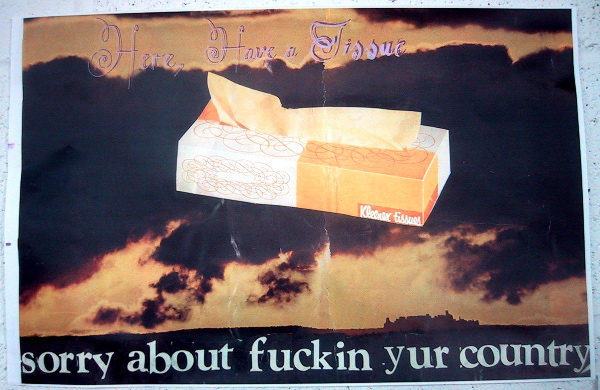
will a tissue make it better?

fuckinyurcountry.JPG

This is one of a group of works by Brian Belott [who shows at Canada] lining the gallery’s entrance ramp of the White Box show, “Majority Whip,” which closed yesterday. Closed, but not to be forgotten, since we can expect to see its children throughout this New York summer, and far beyond.

On Wednesday night, a clutch of Billionaires for Bush managed to crash an enthusiastic gathering of somewhat less-monied and decidedly un-Bush artists and activists in the gallery:
billionairesWhiteBox.JPG

Washington Square Marbles

washington arch.JPG
not a pigeon in sight this past Thursday

Stanford White’s elegant Washington Square Arch has been restored, but virtually every square inch of its carved surfaces is now covered in an almost invisible high-tech screening material designed to keep out the New York pigeon. Only the flat and molded surfaces (including the base, a section of which is shown above) and the two pier sculptures of George Washinton manage to avoid the veiling.
I suppose Ancient Athens didn’t have much of a pigeon problem. This is just a thought, but if it had, without sophisticated modern plastic netting the Parthenon frieze would have been hidden under guano for over 2000 years and Lord Elgin would never have known his “Marbles” were even there.