Susan Wanklyn moves off the grid

wanklynAtlay.jpg
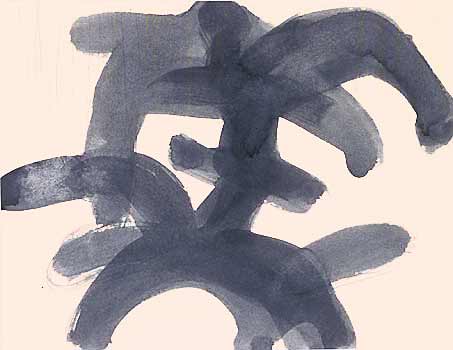
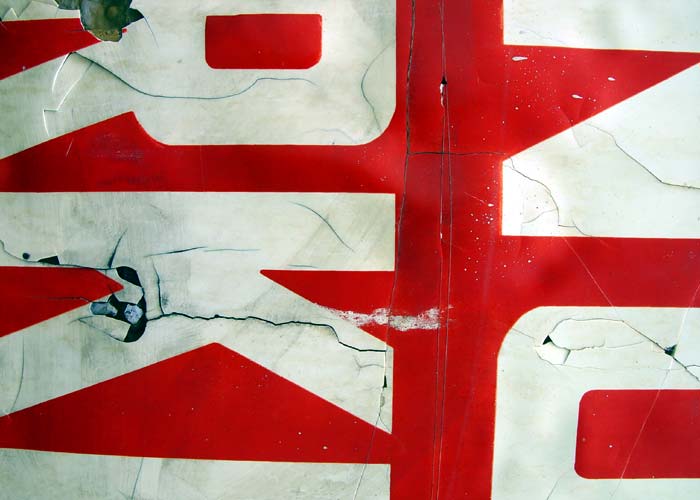
Susan Wanklyn Atlay (2004) 24 x 26 inches, Casein on Wood

The art is very smart, very beautiful, but that only begins to describe the artist, for whom we have to add warm and nice. Ok, we know Susan Wanklyn just a bit, but it’s because for some time we’ve very much enjoyed living with both one of her earlier paintings and two iris prints.
Guests invariably ask about the strong, uncharacteristically almost-colorless grid hanging in our dining room. We can’t offer much of an answer. We like the fact that we haven’t stopped asking about it ourselves.
Barry and I won’t be able to make the opening tomorrow of her show at Cheryl Pelavin Fine Art in Tribeca, but I’ve seen emailed jpegs and the images on the gallery site. They show that she’s certainly not standing still and that the work has never been more beautiful – or sensual.
Always loved the casein paint!*
From the artist’s statement on her gallery’s site:

My work shares with classical minimalism the focus on the viewer and the act of seeing. In addition, however, the challenge has been to set up a room of paintings that have the feel of cohesive narrative, seamlessly giving thematic cover to formal concerns. I have introduced shapes that are abstract and figurative at once (I want to have my cake and eat it too.) As Alfred Hitchcock said in reference to his movies, I am not trying to create a slice of life but rather a “slice of cake.”

wanklynactionfigure.jpg
Susan Wanklyn Action Figure #7 (2004) 9 x 11.5 inches, Casein on Paper

*
Because of living twenty years in a modest 18th-century house in Rhode Island I once thought it could only be associated with beautiful country furniture.

[images from the Cheryl Pelavin site]

“Keep Off The Grass” appears nowhere in the First Amendment

popeincentralpark.jpg
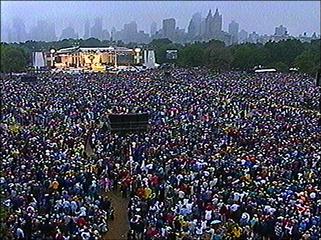
holy turf: 250,000 attend a papal mass in Central Park in 1995

The title above the image is a direct quote from the editors of the New York Post, supporting the application of United for Peace and Justice (UFPJ) for a permit to rally in Central Park on the eve of the Republican Convention.
I can’t remember ever getting excited (in a good way) by an editorial in the sad sheet which I no longer think of as a newspaper but rather a political and economic screed for its owner, Rupert Murdoch. Maybe it’s an aberration, but today the old thing published a real editorial again. Could it be that the son, Lachlan, isn’t just a pretty face?
The editorial appeared April 30 and while it is no longer available on their site, this is the complete text:

LEFTIES ON THE LAWN
A gaggle of lefty agitators wants to convene in Central Park this summer to
give President Bush a little grief. But the Parks Department says no,
because they might bend the grass.
Well, too bad about that. “Keep Off The Grass” appears nowhere in the First
Amendment.
United for Peace and Justice applied for a rally permit for the park’s Great
Lawn for Aug. 29, the opening day of the Republican National Convention.
The Parks folks said no on Wednesday, citing possible damage to the lawn.
And, sure – it is a great lawn.
But it happens to belong to the people of New York City.
If it were in Boston, it would be called the Common – a space set aside by
law and tradition for the vigorous expression of political opinion.
And if the lawn is harshly used, the solution seems clear enough: Plant a
new lawn. Grass seed is cheap.
We hold no brief for the views of United for Peace and Justice; indeed, the
War on Terror is meant precisely to secure peace and justice for Iraqis – as
well as guarantee for Americans the right to demonstrate peacefully in
public.
No matter what some groundskeeper-cum-bureaucrat in City Hall thinks.

In lead editorials today both the NYTimes and El Diario joined the Post in coming out strongly in support of the Central Park permit, and the Times cautions the Mayor about any attempt “to declare Manhattan to be a no-free-speech zone during convention week.”

Mayor Michael Bloomberg lobbied hard to attract the Republican convention to New York this summer. Now it’s coming, and with it swarms of protesters. The city is obliged to offer hospitality to both the conventioneers and the demonstrators.
. . . .
In this era of highly scripted conventions, the protests outside the convention hall may offer the most authentic political discourse of the week. When the nation watches what happens in New York during the convention, we want everyone to fully appreciate the glories of the city, and the way it has come back from the disaster of 9/11. But viewers also need to see a New York that is and always has been a place in which political expression is valued and protected.

The march and rally organizers themselves are broadcasting the widest possible invitation for what will be a massive, extraordinarily important expression of dissent. Part of an email from UFPJ’s Bill Dobbs, where I first learned about the Post editorial:

August 29! Mark your calendars and come on down to NYC, say NO to George W.
Bush’s empire-building and war-making. United for Peace and Justice (UFPJ)
is organizing a not-to-be-missed protest for Sunday, August 29th, a
curtainraiser for the Republican National Convention which begins the
following day. There will be lots more protest during the convention, from
Monday, August 30 through Thursday, September 2.

New York needs your bodies, your voices and your creativity that week, but it’s for the sake of the entire world.

[image from CNN]

lynch parties in Iraq revive American tradition

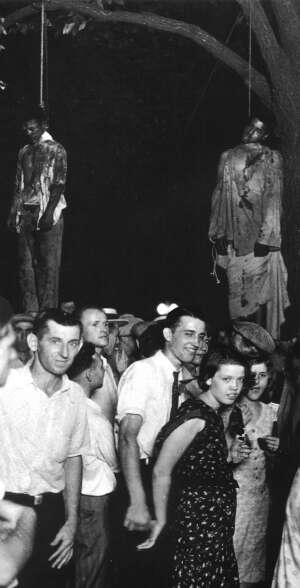
lynching.jpg
“race” trumps all once again

Luc Sante writes in the NYTimes today that he had trouble recalling any American precedent for the prison photos we have seen come out of Iraq this month, until he remembered similar triumphal faces and gestures in photographs taken in the first half of the last century.

The pictures from Abu Ghraib are trophy shots. The American soldiers included in them look exactly as if they were standing next to a gutted buck or a 10-foot marlin. That incongruity is not the least striking aspect of the pictures. The first shot I saw, of Specialist Charles A. Graner and Pfc. Lynndie R. England flashing thumbs up behind a pile of their naked victims, was so jarring that for a few seconds I took it for a montage. When I registered what I was seeing, I was reminded of something. There was something familiar about that jaunty insouciance, that unabashed triumph at having inflicted misery upon other humans. And then I remembered: the last time I had seen that conjunction of elements was in photographs of lynchings.

Note: Up to 90 percent of Iraqi detainees were arrested “by mistake,” according to coalition intelligence officers cited in a Red Cross report.

[late 1930’s Indiana image from Do or Die]

warning signs

dodo.jpg
as in “dead as a ____”

In a real parliamentary democracy the fact that at this moment the first five headlines* of the normally comfortably-establishment news service, Reuters, are about the “abuse” scandal and the plumeting public support for both the war and for Bush would be a signal that the collapse of the government is imminent.
But here it’s not so exciting. Here we are apparently all just helpless spectators.
Sigh.
*
1.) U.S., Britain, Seek to Contain Iraq Abuse Scandal
2.) Poll: Bush Job Rating Dips, Support for War Down
3.) Bush’s Backing of Rumsfeld Shocks and Angers Arabs
4.) Bush Shown Iraq Abuse Photos, Again Backs Rumsfeld
5.) Red Cross Was Told Iraq Abuse ‘Part of the Process’

[image from Global Change 2]

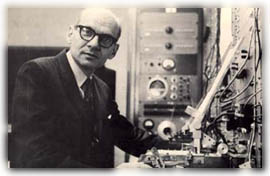
Milton Babbitt

babbitt.jpg
Babbitt, at system

Happy Birthday Milton!
Just found out while streaming David Garland during dinner that today [for another half hour at least] is Milton Babbitt’s 88th birthday.
Hope you’re still up and maybe Googling, guy!
What a treasure, and what a delight to have him around us.

A composer who asserts something such as: “I don’t compose by system, but by ear” thereby convicts himself of … equating ignorance with freedom, that is, by equating ignorance of the constraints under which he creates with freedom from constraints. …A musical theory must provide… a model for determinate and testable statements about musical compositions.
– Milton Babbitt, “The Structure and Function of Musical Theory”

Okay, It still bothers me to know how much he loves American musicals, but nobody’s perfect.

[both image and quote from Camille Goudeseune]

Bush knows he didn’t apologize, even if the press doesn’t

Of course he’s not accepting personal responsibility, but he’s also not even apologizing for his occupying army, the country (or anything or anyone else); he’s merely saying vaguely, he’s sorry about it. But wait, read the full context of the word “sorry,” which he uses twice in his own report of what he told King Abdullah:

“I told him I was sorry for the humiliation suffered by the Iraqi prisoners and the humiliation suffered by their families,” the Republican president said during a Rose Garden appearance with the Jordanian monarch.
“I told him I was equally sorry that people who have been seeing those pictures didn’t understand the true nature and heart of America.”

If Bush is “apologizing” for American misdeeds here, he’s also “apologizing” for the ignorance of all who aren’t Americans. The latter is both an insult and an impossibility, and it makes the first statement meaningless.
He’s too stupid too realize it, but he’s just effectively shouted out once again, and this time not just to Iraqis, but to everyone in the world who is already unhappy with what our monstrous political, military and economic establishment has come to represent for them, “Bring them on!” We have no defenses for what will follow.

“Where Do We Live”

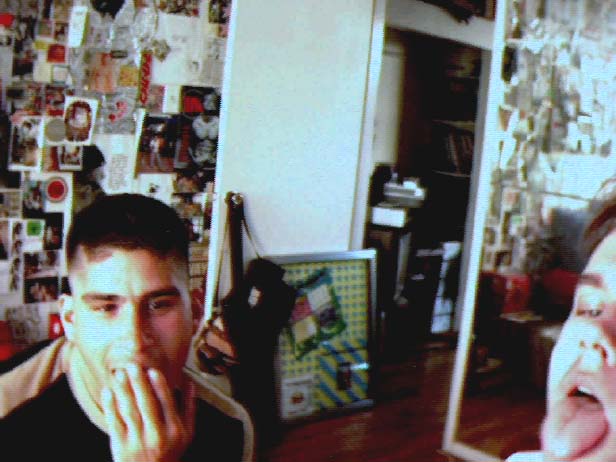
my exciting nyc apartment.jpg
Lower East Side relativity

Half the theatre had emptied out when we returned after intermission last night. I did recall hearing, as the lights went up, one matron in the row in front of us repeating to her partner over and over again, “no content; the play has no content.”
She was wrong. In fact I think she may have been covering for her embarassment in being shocked by what was happening on stage. I cannot account for the reasons why so many others, like those two, failed to come back for the last 50 minutes of Christopher Shinn’s “Where Do We Live.” but the play making its U.S. premier at New York Theatre Workshop this month is definitely a serious container – of the relationships we all have with family, friends, lovers neighbors, strangers and, finally, the entire world.
He’s good. He’s very good.
Disclaimer: We stayed after the play for an audience discussion with the young playwright, so I may be a little ahead of the game. Here [the remaining] New Yorkers really redeemed themselves. I was blown away both by their theatre sophistication and by their obvious comfort in talking about some of the scenes and issues which had apparently caused our more prudish seatmates to flee the house, some only minutes after the play had begun. While there we were reminded that Shinn has been very fortunate in his teachers, who have included Maria Irena Fornes, Tony Kushner and Michael Cunningham. Whew.
September 11 plays a subtle, almost mute role in Shinn’s drama, written in the months after the destruction of the towers which had stood in sight of his apartment on the Lower East Side. Don’t concentrate too much on the dates projected on the back wall. The story which unfolds inside two neighboring apartments in a tenement abandoned by Giuliani’s Republican idea of New York is that of nine barely-related people struggling with all human connections, even those they would prefer to ignore.
The energetic young cast, some doubling, tripling or even quadrupling roles, was magnificent. Shinn is directing a play for the first time here, and he seems to know what he’s doing. The set and the costumes were a perfect match with the lighting, which peformed small miracles reinventing rooms and scenes. The great sound design was an integral part of the characters’ story, but it was just one of the many stimulants in which they indulged, just like real.
“Where Do We Live” opened in London at the Royal Court in 2002 and opens here officially this Sunday, May 9. Performances run only through May 30. If you’re not bored with youth, New York, sex, drugs or rock and roll, or indeed with relationships, you’re more than welcome to do something about changing the audience demographic responsible for the empty seats we saw later last night.

[image is not from the play, but rather from Mark Allen’s site, where it is described as “the confines of my super-exciting NYC Lower East Side apartment”]

we must all be Arna’s Children

Ashraf.jpg
Ashraf Abu-elhaje, shown here in the childrens’ theatre of the Jenin refugee camp in 1996, was its most impressive student. At the time he dreamed of a future as the �Palestinian Romeo.� Six years later Ashraf led a large group of fighters in the battle of Jenin. He was killed by a rocket fired from a helicopter.

We went to see “Arna’s Children” at the Tribeca Film Festival yesterday afternoon. It is the only TFF program we expect to see, so it’s clear we had already thought it was important before we knew a great deal about it. We had heard of it through an email sent by the generous Israeli artist, filmmaker and activist Udi Aloni, who had extended an invitation to gather with others for a reception in his studio after the screening.

ARNA’S CHILDREN tells the story of a theatre group that was established by Arna Mer Khamis. Arna comes from a Zionist family and in the 1950s married a Palestinian Arab, Saliba Khamis. On the West Bank, she opened an alternative education system for children whose regular life was disrupted by the Israeli occupation. The theatre group that she started engaged children from Jenin, helping them to express their everyday frustrations, anger, bitterness and fear. Arna’s son Juliano, director of this film, was also one of the directors of Jenin’s theatre. With his camera, he filmed the children during rehearsal periods from 1989 to 1996. Now, he goes back to see what happened to them. Yussef committed a suicide attack in Hadera in 2001, Ashraf was killed in the battle of Jenin, Alla leads a resistance group. Juliano, who today is one of the leading actors in the region, looks back in time in Jenin, trying to understand the choices made by the children he loved and worked with. Eight years ago, the theatre was closed and life became static and paralysed. Shifting back and forth in time, the film reveals the tragedy and horror of lives trapped by the circumstances of the Israeli occupation.

We stayed in the theatre for the generous Q&A which immediately followed the film. Only when the lights went up did we notice that Jeffrey Wright and Glenn Close were also in the audience. We were impressed with their commitment, whether professional or human, but not more than we were with the fact that the festival director was there. Peter Scarlet is responsible for this very large operation showing a number of films simultaneously in widely-spread venues, but he was there to announce the picture and stayed with the filmmakers throughout the discussion after, eventually participating in it.
Even for people who think of themselves as pretty familiar with the issues and the reality of the subject of this magnificent documentary, the film was shattering, and the emotional experience was only made more distressing by a number of things we heard from the director and producers after. One of the revelations was that of all the little boys who had grown up working with Arna in her theatre group, only one survives today.
We were both made physically sick by the emotions tapped that afternoon, and we agreed together that we were unable to imagine going anywhere at that moment, even to be among people who would understand what we were feeling.
There is almost certainly no reason to think that the insanity and horror being visited upon “the other” in the Middle East will end in our time. Films like this may occasionally awaken hope that, were enough people able to see it, the revelation of the humanity and misery of our victims would be sufficient to make us all intelligent peacemakers. This film could change the world, but, except for the incredibly small number already pretty much aware of what’s going on, people will not see it. If we survive our times, “Arna’s Children” may some day be seen in the same way we see the evidence of other monstrosities, like “The Diary of Anne Frank” – after the fact, but with great reverence.
I’m very sorry, but I see no reason to be optimistic about the possibility that the people of this country or of its client Israel will regain consciousness and reason in time to avoid even the destruction of their own societies, to say nothing of the mortal damage being done to those of others.
Ok, maybe I’m just depressed today. Ask me how I feel about it tomorrow.

[image from the Arna site]

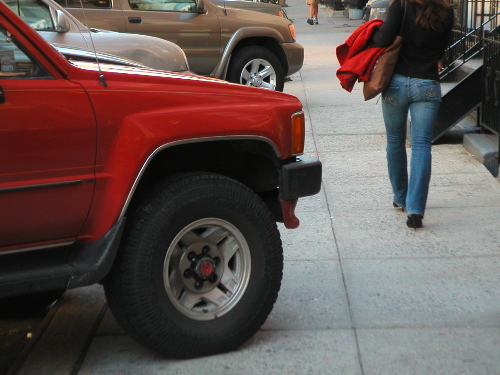
suburban police SUVs occupy Manhattan sidewalk

policeparking2.JPG
19th Street, east of 8th Avenue this afternoon: the signs read: “NO PARKING 8am to 6pm”

In 1962, at the peak of urban flight, New York City law was changed to permit police officers to live outside the city for the first time in its history. New York hasn’t been the same since. Although there have been many more frightening consequences, here we see one of the most visible.
Each of the vehicles shown above, almost all privately-owned and almost all SUVs, had large police permits lying on their dashboards. The 10th Precinct headquarters is located mid-block. So while they’re already getting free parking, apparently the street itself isn’t big enough for these commuters’ monsters. The narrow sidewalk of this quiet, tree-shaded residential block has to be commandeered for their convenience.
This is a scene reproduced all over the city, wherever there are police (or fire) stations. It’s no wonder that police routinely ignore threats to the safety and convenience of millions of New York pedestrians; the officers we pay for are essentially part of an occupying army, and they don’t know how to use their feet. I won’t even bring up large squad cars regularly double parked outside Krispy Kreme, or routinely blocking busy pedestrian crosswalks.

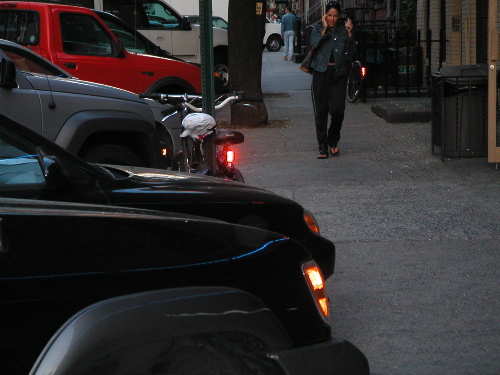
Incidently, the continued presence of these angle-parked precinct officers’ private tanks even at night makes the street signs somewhat disingenuous:
policeparking 1.JPG
the same block at 7:30pm last Friday

street storage: street parking

signNoParking.jpg

Let us suppose you have a chest of drawers that you sorely need for storage space but cannot fit into your small apartment. What to do?
Here is one thought: Why not put it on wheels and leave it curbside in front of your building? Naturally, you accept a theft risk and an obligation to move the chest across the street every few days to comply with alternate-side parking rules.
Absurd, right? You can’t just leave personal property on the street.
But what if we call that thing on wheels, oh, a car? Suddenly, it becomes O.K. to gobble up precious public space for your own benefit. Not only that, but on most streets you also need not pay a dime for this storage area.

So begins Clyde Haberman’s “NYC” column in today’s NYTimes.
While eventually we will be forced to ban on-street parking in New York, presumably starting only with Manhattan at first, it’s not going to be easy, not least because of the sense of entitlement fostered for car owners by every city administration for over half a century.
Before 1950 it was illegal to park overnight in Manhattan. Transportation Alternatives activist John Tierney has cited how old photographs demonstrate “gracefully uncluttered streets. Many of the sidewalks were much wider than today’s and adorned with greenery.”

The city’s pedestrian majority, as Police Commissioner Arthur Wallander approvingly observed in 1947, was firmly opposed to ”the public streets being used as garages.” But the city’s politicians had their own cars to park and favors to hand out. So some of the world’s most expensive real estate has ended up being used to store hulks of metal, at unbeatable prices.

But of course he’s not been alone in encouraging New Yorkers to take back the streets. Two and a half years ago Frank Pelligrini proposed in Time that incoming mayor Bloomberg be so bold as to make his mark by doing the right thing by all New Yorkers.

Banning parking would rev all the economic engines that the city runs on, and eliminate the real source of economic dead weight, namely private-vehicle owners who are just waiting for an excuse to get out of town for the weekend anyway

[image from unrev.com]