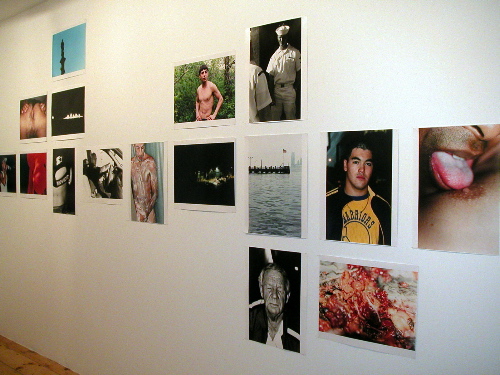
detail of installation of C-prints
No, he’s not a virgin to the gallery world, and it should already be clear that I really like the work of Joe Ovelman, so maybe I don’t have to say much about his current show at Oliver Kamm/5BE Gallery. Actually, the real reason I don’t have to say much is that the installation itself says everything. Even the individual C-prints are as much a part of the space as they are gorgeous independent images.
But you really have to be there. I don’t think I’ve seen a gallery or museum space pulled together to better effect. The works themselves steal through several mediums, they’re as fresh as last night (or this afternoon), and they should excite young collectors. Prices, even for original, handmade work, start at, well, free.

untitled C-print 20 X 16 inches

untitled (2004) C-print 16 X 20 inches
The front room includes a beautiful five-panel text piece titled “When I Grow UP,” dozens of playful, framed post-it notes, a wall installed as a monument to the human/natural landscape reconstructed in the gallery’s backroom, a framed nod to every new enterprise’s iconic first dollar display, and an elegant black and white reliquary document of one of Ovelman’s generous public walls.

detail of When I Grow Up (2004) color xerox and marker on paper 20 X 60 inches
The central gallery space pulls the art off the wall with two plinths, one supporting a handmade book, “Resolution 452,” the other a stack of small papers marked “Blame Cher.”
Finally there’s the back room. Like most, Ovelman’s includes interesting ambient sounds. Unfortunately they are not accessible from this post.

Rambles (2004) color xerox photos, dimensions variable
We’re told Joe blames Cher for everything. Thanks, Cher.
[the images are my own casual record, and cannot begin to reproduce the excitement of the originals]
Daniel Rushton

Daniel Rushton Motorcycle Seat (2004) acrylic on Panel 48″x60″
One of our happiest acquisitions, now from a number of years past, was that of three beautiful silkscreen monoprints by Daniel Rushton. Our guests usually ask about them right away, but until recently we were unable to tell them anything about Dan’s current work, even though we would occasionally run into the tall young Canadian on our gallery walkabouts.
We were finally able to visit his Williamsburg studio earlier this week where we saw recent paintings which began as drawings on his computer before they were moved to canvas with bristle and airbrush. The most exciting image for me was this relatively large homage to the bike covered in a different canvas just outside the door.
Dan spoke of being interested in objects which enclose or are enclosed by the body. With works as strong as this and the others we saw on Tuesday, he won’t have any trouble in getting others to share this interest.
[image furnished by the artist]
Keith’s anger, and his love
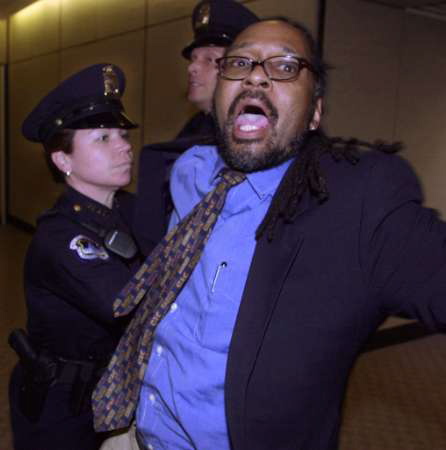
the same Keith Cylar who won the respect of civic officials for his tireless work with Housing Works clients was arrested more than 50 times for civil disobedience: here he is shown visiting the U.S. Senate chambers*
WBAI’s site now has posted part of an absolutely amazing interview which Ben Shepard made with Keith Cylar a little over two years ago.
Keith describes his first experience with AIDS, beginning in the early 80’s, and what his world was like at the time.
At that point I was having sex wherever. It was really schizophenic; there was the fear of contagion, but the unforgiving presence of hormones and the need to have sex. I don’t regret it. I actually wish that I had more sex than I had back then but I was a prude. I was a nerd. I cried a lot back then because of how lonely I was. It was a very alienated world which didn’t necessarily know how to deal with a strong, black, intelligent, jock male who is also a faggot who loves men and loves kinky sex.
Later in the interview Ben asks Keith about ACT UP’s Housing Committee, founded in the late 80’s, which was the forerunner of Housing Works.
BS: What about this Housing Committee? When did housing become an AIDS issue? When did Housing and AIDS become linked? Its not part of everybody’s consciousness?
KC: Let me tell you what was happening. There was a gridlock in the hospital system. Charlie King, Ginny Shubert, Eric Sawyer started recognizing the issue in ’88, ’87. For me working in the hospital, I couldn’t get people out of the hospital because they didn’t have a place to live. We’d get ’em well from whatever brought them in; they wouldn’t have a place to live. They’d stay in the hospitals and they’d pick up another thing and then they’d die. Remember, 88, 90, 91, 92–New York City literally had hospital gridlock and that was when they were keeping people out on hospital gurneys in the hallways. That was when people were not being fed, bathed or touched. It was horrendous. You can’t imagine what it was like to be black, gay, a drug user, transgender, and dying from AIDS.
So housing all of a sudden became this issue. ACT UP recognized it and formed this Housing Committee. I got involved in the Housing Committee when they came to the Majority Action Committee to do a presentation, asking us to help them get money from the floor to go to the First National African American Conference on AIDS. It was going to be in Washington [D.C.]. There was this guy there, Charles King, I sort of ripped into Charles King. We started working together.
The strategy was to push, push, push. It wasn’t different than the general ACT UP strategy about inclusion. But it was always to get those populations also included.
It was easy for the world to deal with gay white men. People of color were so far off the Richter scale, and it was also to hold people of color organizations accountable.
If it was the worst of times, people like Keith made it also some of the best of times.
A lot of this stuff for me became very emotional but I have not focused on it because I plan to do this work for a long time and I have learned. This is the problem that happened with ACT UP. You cannot last forever on anger. You cannot last forever on the negative side of emotions. And you really have to learn how to love. And you have to go to much more positive spaces ultimately if you are going to do this for a long time.
And part of what happened with ACT UP was its evolution had to do not only with this intense creative thing and very brilliant people who created and populated and ran organizations. They were so competitive and so angry and bitter at the outside world and they needed [to] be because we were literally fighting for our lives. But inside we needed to learn how to love. We needed to learn how to care for each other. We needed to learn that I wasnt necessarily your enemy.
BS: There was also the recognition that doing AIDS work meant doing race, class, and gender work.
KC: That came for people of color. We were trying to do that and they were doing “Drugs into Bodies.” So there was always this contention. When ACT UP worked well and there was a real consensus process and you could talk about stuff and you could talk it through, you could work together. And that was when it worked well. The fights that happened out of that lead to people splintering. You cannot build a community in hate, you cannot build a community on anger. You cannot build a community on death and dying. The overwhelming thing about the AIDS epidemic is they died.
We haven’t heard the end of Keith’s story, especially since his work survives as a very succcessful multi-million dollar service organization which has not compromised its activism or its principles. It’s established itself as a very visible and indispensible institution in communities virtually ignored otherwise, if not positively despised.
From almost the beginning, Housing Works has even managed to be considered very chic at the same time as it was saving lives. This was an association which was undoubtedly enormously important both for its fundraising and for the additional self-respect such a cachet was able to encourage among its clients, employees, volunteers and defenders at the barricades.
Remarkably, these were all roles which might be shared even at the same moment by the people associated with Housing Works. Attracting this kind of commitment was another reflection of the large souls both of Charles King and of the good companion we have just lost.
[the image at the top was provided by Terri Smith-Caronia at Housing Works]
UPDATED:
[I neglected to mention yesterday that the interview posted on the WBAI site is credited there: An excerpt from the book From ACT UP to the WTO: Urban Protest And Community-Building in the Era of Globalization Edited by Benjamin Shepard and Ronald Hayduk]
The April 8 NYTimes includes an obituary: “Keith Cylar, 45; Found Homes for AIDS Patients”
Keith Cylar
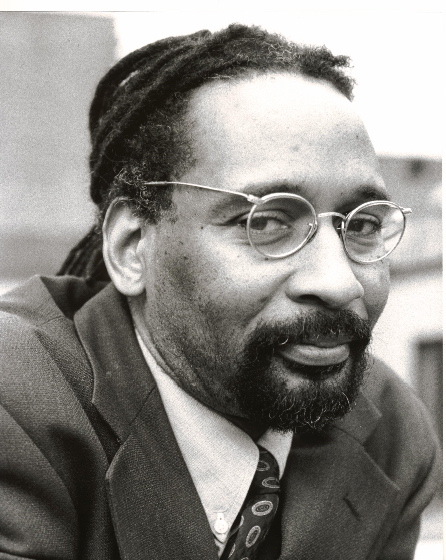
A beautiful man died yesterday.
Keith Cylar was the Co-Founder and Co-President of Housing Works, whose good people announced his death today. Keith had lived with HIV for over 20-years and was diagnosed with AIDS in 1989. In the last year, Keith developed cardiomyopathy, a serious enlargement of the heart. He died in his sleep early Monday morning of a cardioarythmia.
Fellow troublemaker and troublesolver Eric Sawyer reminds us of how much we have lost.
UPDATED:I remember when Charles King first brought Keith Cylar to a meeting of the Housing Committee. Keith had aready been coming to ACT UP – was working for the Minority AIDS Task Force in Harlem and was involved with the Minority (soon to become Majority) AIDS Action Committee.
Keith was this strong, tough as nails, sweet as sugar, fearless scared man child, angry at the loss of his former lover, fierce with rage against the do nothings in power; a handsome, sexy, powerful man – wise beyond his years – determined to help right the wrongs the world was doing to PWAs, to the poor, to the homeless, to the voiceless and to disenfranchised.
Keith was an out, proud, queer, black, positive brother when it was definitely not cool to be so in his community – a leader amongst men and a hero amongst warriors – Keith was my friend and I love him so.
Keith was able to kick back with a homeless person on a street corner, dance with a member of the Congress, break bread with a former Mayor, sip wine with a Cabinet Member and debate a member of the First Family with equal ease. He could also hold the hand of the dying and help them make peace with the Universe.
The world has a huge whole in it’s soul now that Keith has left this plain.
I looked everywhere last night for at least one great picture to include at the top of this post, but with no luck. I think it says a great deal about both Keith and Charles that they seem almost invisible; the work is big, the egos are not.
[April 10: I now have two images, thanks to Terri Smith-Caronia at Housing Works, one sitting at the top of this post and the second at the top of the the April 7 followup]
stupidity and iniquity
The Bushites and their handlers: Although somehow they hijacked command of the most powerful country on earth, they clearly don’t know what they’re doing and they’re doing it for the wrong reasons.
I used to think that their stupidity is what would save the planet, but that was before the “war on terror,” the war on Afghanistan, the war on Iraq and now the wars which will be visited upon the entire world in response to their stupidity and iniquity.
places in history
We also note that, even if he is remembered for Vietnam, LBJ at least managed to deliver on civil rights, a voting-rights bill, a Medicare program for the aged, and measures to improve education and conservation. What will Bushie be remembered for?
Reuters on Monday, via Atrios:
Democratic Sen. Edward Kennedy on Monday accused President Bush of having created at home and abroad “the largest credibility gap” since the Watergate scandal forced Richard Nixon from the White House 30 years ago.
Kennedy, a key backer of fellow Massachusetts Sen. John Kerry’s campaign for the party’s presidential nomination, also charged Iraq has become “George Bush’s Vietnam,” the war that divided the United States and helped drive Lyndon Johnson from the presidency.
In addition, Kennedy said, Iraq has “diverted attention from the administration’s deceptions here at home — especially on the economy, health care and education.”
armageddon, finally, again

It may finally have come down to our millennialists against their millennialists.
Over the weekend a new war may have begun began in earnest in Iraq, a very visible, coordinated, religion-based uprising against the occupation. The Christian soldiers running the U.S. and Iraq these days are driven by visions of the second coming of Jesus. The Iraqi streets and basements are propelled by the appearance of the Mahdi. Unfortunately the two armies are talking about roughly the same thing – the end of the world – but they aren’t going to make it easy for anyone.
The Mahdi Army is the name given to the militia responsible for the current outbreaks of violence. People who study British, african, middle-east and asian history know the enormous significance the name Mahdi assumed at the end of the 19th century when it was both bogeyman and a real terrorist threat for the last bible-thumping, English-speaking empire. At least the reportedly quite observant Blair should remember Gordon and Kitchener, especially this week.
[image originally from Wired]
mercenary brouhaha hysterics, and reason

Paul Bremer, the U.S. administrator in Iraq, shown on Thursday protected by a security guard employed by Blackwater USA, even while in a heavily guarded military complex in the city of Mosul
Tom Moody writes about the Daily Kos teapot-tempest mercenary brouhaha.
Those deaths were terrible but I hate that saying “screw the mercenaries” is being framed as an issue of patriotism or “supporting the troops.” These high-paid soldiers of fortune are essentially a private army dedicated to securing Middle East oil assets and protecting corporate interests abroad. And just a reminder: they’re shooting Iraqis today; tomorrow they could be over here in the States breaking strikes and busting protester’s heads. This isn’t as farfetched as it sounds: the Bush campaign recently hired Vance International, notorious anti-labor thugs, for “private security.” This privatization of military functions is a sick trend, and I actually think it’s more patriotic to oppose it. Unfortunately the Kerry campaign seems to think we should “support the mercs.” [Moody points out at the top of his post that the “unctious Kerry campaign de-linked Kos from its website” when the controversy began]
[image from the NYTimes, pool photo by Ceerwan Aziz]
branding

untitled (caution) 2004
west 23rd Street on the way up

untitled (post no bills) 2004