
untitled (KO) 2004
Image taken from (inside out of) the most excellent and beautiful KOFOO on 8th Avenue between 26-27th Streets
mercenaries, not contractors, not consultants
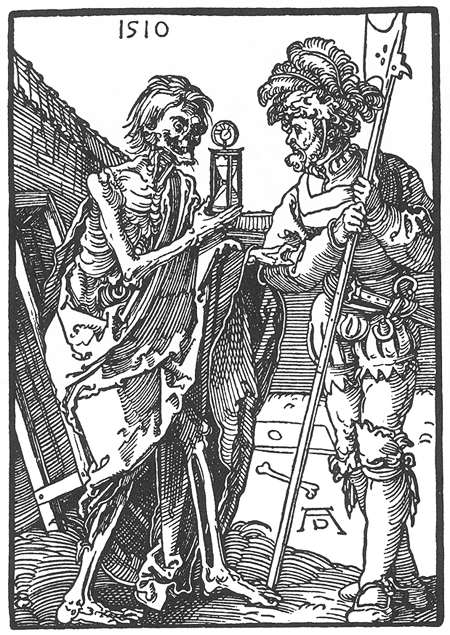
Albrecht Dürer Death and the Landsknecht
The NYTimes calls them “four security consultants” in an editorial today. In fact, they were mercenaries, although no one seems to want to call them that.
In an article which begins on the paper’s front page we do manage to learn quite a bit more about these soldiers of fortune, beginning with some figures:
As many as two dozen [security] companies, employing as many as 15,000 people, are working in Iraq.
The U.S. occupies Iraq, but apparently can’t do it without paid mercenaries. Blackwater U.S.A., the company which employed the victims of the horrific attack in Fallujah Wednesday, guards Paul Bremer, the American administrator.
In the northern city of Mosul, where Mr. Bremer met with about 130 carefully vetted Iraqis on Thursday, Blackwater guards maintained a heavy presence, standing along the walls facing the Iraqi guests with their rifles cradled. More than once, Iraqis and Western reporters moving forward to take their seats in the hall were abruptly challenged by the guards, with warnings that they would be ejected if they resisted.
. . . .
The rapid growth of the private security industry has come about in part because of the shrinkage of the American military: there are simply fewer military personnel available to protect officials, diplomats and bases overseas, security experts say.
To meet the rising demand, the companies are offering yearly salaries ranging from $100,000 to nearly $200,000 to entice senior military Special Operations forces to switch careers. Assignments are paying from a few hundred dollars to as much as $1,000 a day, military officials said.
In the country I live in military base pay begins at a little over a thousand dollars a month for the lowliest recruit. “Imminent danger pay” for a battle area like Iraq adds $225 to a soldier’s base, but last Fall even that pittance was threatened by the same administration which employs expensive mercenaries when it comes to its own protection.
Final note: Mercenaries belong in boys’ fantasy fiction only; they are outlawed by the Geneva Convention for very good historic reasons.
[image from Web Gallery of Art]
“liberationists and assimilationsts”
On page 3 of today’s Washington Post the paper’s New York Bureau Chief, Michael Powell, does a great job covering those within the lesbian and gay community who are sceptical of or even seriously opposed to the campaign for same-sex marriage.
If we had gotten reportage of this quality, this prominently and this timely when the AIDS epidemic first appeared 23 years ago the entire world would look very different today.
Not incidently, because so many of its most creative and energetic minds and bodies would have survived, queer activism would have created a different playing field by now, and Michael Powell’s piece would itself be very different – if not unnecessary.
Today’s reality however is that many of us are clamoring for equal marriage rights. But not everyone is interested in marriage, and its privileges should not be exclusive. We could instead be building new forms of relationships for everyone, and ensuring that society offer to all of its members, regardless of the nature or even the existence of affectional ties, the benefits they are due.
Powell did his homework, and the list of those he spoke to is pretty impressive. Somehow I was included [damn, you never get the quote you wanted], but I’m sure it was only because of a post I made three weeks ago.
One of the most thoughtful statements is that from Alisa Solomon.
“It’s the tension between the liberationists and the assimilationists,” said Alisa Solomon, a professor at New York’s Baruch College and writer for the Village Voice. “Our side made it possible for more conservative gays to come out of the closet, and when they did they brought a more conservative politics and culture to our movement.”
Solomon, like many gay rights activists, argues for redefining all marriages — homosexual, heterosexual — as civil unions. This would provide the legal protections that come with marriage, from health care to taxes to adoption, without the emotional and cultural freight. “The queer marriage movement needs a divestment campaign,” Solomon wrote in the Village Voice. “The only way we will win is if the state’s authority to pronounce is stripped from the ministers, rabbis, imams and priests.”
And jumping back to the ghosts of dead activists – and some of their heirs, überactivist Bill Dobbs has the last word in Powell’s article.
He leafed through the photos of the gay marriages these past weeks. There wasn’t a nose-pierced, pink-haired, breast-tattooed transgressive transgender queen to be seen. He has a nightmare vision of what the future holds.
“We’re going to just put the photo of our spouse on our desk at the law firm and represent some Fortune 500 corporation,” Dobbs said. “We’re not going to threaten to rearrange your finances or change your world in any way. That’s not my gay movement.”
Wangechi Mutu

Wangechi Mutu (view of a work in progress)
I should have known better. The Studio Museum in Harlem opened the studios of its current artists in residence this afternoon, and there I was initially so dazzled by the work of Wangechi Mutu that I didn’t give a thought to whether it had yet been widely seen. It turns out that it definitely has, and, silly I, even by me, both at Momenta and in The New Museum. Still, I think it must never have looked so mature, in fact so damn brilliant as it did today in her cluttered atelier on the third floor.
The work there was all on paper, painted and collaged with magazine cutouts into voluptuous, almost sculptural forms which defy an easy identity for either their medium or their portraiture, but they do sing.
Mutu is included in a group show which just opened at Chicago’s Rhona Hoffman Gallery. Simon Warson is responsible for the terrific roster, whose other names are Tim Lokiec, Nick Mauss, Bradley McCallum & Jacqueline Tarry, Paul P., Adam Pendleton, Aida Ruilova, and Mickalene Thomas.
See Susan Vielmetter for images from 2002 and 2003.
[image, of a work in progress, captured off the artist’s studio wall on Sunday]
UPDATED: caption added to image, second image removed, line with link to Susan Vielmutter gallery added, bracketed attribution at bottom revised
study in pink and blue

untitled (Edsel Ranger on 8th Avenue)
Bj�rk with friends

just hanging out with friends
Two nights ago Bloggy seemed to be suggesting that “a certain Icelandic singer” would show up at the Jack the Pelican Presents opening tonight, and sure enough, the fans were not disappointed. A certain perhaps-the-most-famous-American-artist-in-the-world, her very biggest fan, was also there, by many reliable accounts, but unfortunately we never saw him.
The gallery installation was the North American debut of the three women of The Icelandic Love Corporation collaborative. Oh yes, Hrafnhildur Arnardottir was there as well. Is there anyone left in Iceland who isn’t an artist?
Judging from our modest experience, Bj�rk regularly shows up looking like a fairy princess on a visit from another galaxy, but she doesn’t just breeze in with courtiers and disappear into protected space or speed back out the door. Like the last time we saw her at a gallery opening, she was comfortable in the midst of the crowd and, although she was already there when we arrived, she showed no interest in leaving even by the time our own group had tired of the festivities.
The crowd was gentle with celebrity. Hey, it’s not only New York, it’s Williamsburg. We’re all famous.
still not married

In a column which appears in the print edition of The Nation this week and also on his own website Alexander Coburn tries to introduce nuance into the discussion of same-sex marriage. Like me, he’s against it.
I’m for anything that terrifies Democrats, outrages Republicans, upsets the applecart. But exultation about the gay marriages cemented in San Francisco, counties in Oregon and New Mexico and some cities in New York is misplaced.
Why rejoice when state and church extend their grip, which is what marriage is all about. Assimilation is not liberation, and the invocation of “equality” as the great attainment of these gay marriages should be challenged. Peter Tatchell, the British gay leader, put it well a couple of years ago: “Equality is a good start, but it is not sufficient. Equality for queers inevitably means equal rights on straight terms, since they are the ones who dominate and determine the existing legal framework. We conform — albeit equally — with their screwed up system. That is not liberation. It is capitulation.”
The major media outlets can’t seem to find them, being so incapable of recognizing nuance, but there are apparently plenty of very queer voices out there questioning the current marriage frenzy, and Cockburn airs three of them:
“The pursuit of marriage in the name of equality”, says Bill Dobbs, radical gay organizer, “shows how the gay imagination is shrivelling.” Judith Butler, professor at UC Berkeley, exhibited kindred disquiet in a quote she gave the New York Times last week. “It’s very hard to speak freely right now, but many gay people are uncomfortable with all this, because they feel their sense of an alternative movement is dying. Sexual politics was supposed to be about finding alternatives to marriage.”
As Jim Eigo, a writer and activist whose thinking was very influential in the early days of ACT UP put it a while back, what’s the use of being queer if you can’t be different? “Why are current mainstream gay organizations working to strike a bargain with straight society that will make some queers less equal than others? Under its terms, gays who are willing to mimic heterosexual relations and enter into a legally-enforced lifetime sexual bond with one other person will be granted special benefits and status to be withheld from those who refuse such domestication…Marriage has no more place in efforts to achieve equality than slavery or the divine right of kings. At this juncture in history, wouldn’t it make more sense for us to try to figure out how to relieve heterosexuals of the outdated shackles of matrimony?”
Although I confess I just read it now for the first time, several weeks ago Alisa Solomon wrote in The Village Voice on these same issues, emphasizing the church/state thing, and concluding:
There’s a wider advantage to promoting civil unions for all [and not marriage] as the simplest and most constitutionally sound solution to the vexations over queer vows. Once queer folks’ emotional need to see their love recognized is separated from the practical need for various economic and legal benefits (especially revolving around children), the community can look more clearly at what the state proffers to those civilly unitedand why. Should a home with an amorous relationship at its center be any more deserving of the option to file taxes jointly than, say, a couple of single friends who have decided to set up a household together? Sure, I’d like to be rid of those extra income taxes, but I’d rather see our movement fighting for universal health care so nobody’s coverage depended on having a spouse with a job with insurance benefits.
As we win this the right wayand help lead America away from establishing fundamentalism as the law of the land by getting the state out of the business of holy matrimonywe can pick up the many issues that have been the bridesmaid for almost a decade now: the rising epidemic of violence against transgender youth and the homophobia faced by LGBT elders, to cite only two. Andrew Sullivan has infamously said that once gay marriage is won, the movement can pack up and go home. On the contrary.
[image from Voyager Virtual Season Project]
contrasts

untitled (subway zebra)
tin can phones here and a tin security everywhere

Ray Sanchez has found New York City transit’s Achilles heel, or at least the one vulnerability which is most likely to endanger the lives of the millions of people who use the system every day – a vulnerability which would be devastating after a terrorist hit, since survivors may then have to get out of the tunnels to remain survivors.
It has long been known that the Metropolitan Transportation Authority and New York City Transit have problems communicating effectively with its customers. This was most evident anytime transit officials were asked to explain fare increases and service cuts.
But in a time of train bomb massacres, it is becoming disturbingly apparent that the people who run the New York subway system also have difficulty communicating with one another – including when lives are at stake.
Read Sanchez’s report on Annie Chamberlin’s experience February 29.
But stupidity and incompetence, if not criminal malfeasance in this post 9/11 world, is not limited to New York’s planners and administrators. The Bush administration budget for the upcoming fiscal year calls for $5.3 billion for transportation security, but only $147 million of it is allocated for everything other than air security. That $147 million is supposed to cover ports, roads, bridges, tunnels, power plants and rail systems.
And what is it we’re now told we have to pay for an Iraq war which had absolutely nothing to do with terrorism, fear of which the administration hopes to use to maintain its power? Was it $100 billion? But much more important, I’m thinking that so far the cost is the nearly 600 American lives alone, and the thousands (again only the American count) injured or maimed.
We shouldn’t tolerate the use of terror for political purposes. The Bush regime and its lieutenants have to be thrown out before we cash in more than just our freedoms in exchange for a tin security.*
PAZ.
____________________
*
The evidence could be stacked up forever, but one inarguable fact reported today in the Washington Post [via Atrios] should alone be enough to demolish any remaining illusions about either the sincerity or the competence of the gang in the White House, above all when it’s a question of protecting us from terrorists.
In the early days after the Sept. 11, 2001, attacks, the Bush White House cut by nearly two-thirds an emergency request for counterterrorism funds by the FBI, an internal administration budget document shows.
. . . .
The papers show that Ashcroft ranked counterterrorism efforts as a lower priority than his predecessor did, and that he resisted FBI requests for more counterterrorism funding before and immediately after the attacks.
. . . .
“Despite multiple terror warnings before and after 9/11, [Bush] repeatedly rejected counterterrorism resources that his own security agencies said was desperately needed to protect America,” said David Sirota, spokesman for [the Center for American Progress, a liberal group run by former Clinton chief of staff John D. Podesta], which plans to post the documents on its Web site today.the myria network]
maybe we need a serious mutiny

at the New York Vietnam War Veterans Memorial, the night of its opening to the public
“Vietnam,” author Myra McPherson has written,” was a war that asked everything of a few and nothing of most in America.”
[from the New York Vietnam War Veterans Memorial site],
I’ve been to the New York Vietnam War Veterans Memorial beginning on the day it opened and a number of times since. Until 1987 I lived just one block away and I passed it at least once every day. At first it was never unattended, but visitor traffic has declined in recent years, and sometimes the small park triangle it occupies in the oldest, and during the day the busiest, part of the city is completely empty.
Even since moving uptown I’ve returned, often with friends visiting New York, and I’ll be going again, since the letters of a war’s American participants etched there in the glass are among the most profound modern testaments we have of the stupidity of both the governed and those who presume to govern them.
[tip: probably best to visit after dark, when the wind-swept day’s trash is less visible, and the inscriptions are lit from within the glass monoliths]
Apparently not enough of either group has been visiting lower Water Street at Coenties Slip lately, or the letters which appeared in the NYTimes on Sunday might never have been written. Their authors all died in Iraq since last fall.
Read and you will surely weep.
What follows is an excerpt from among several letters to his mother written by Specialist Robert A. Wise, 21, of Tallahassee, Fla. Specialist Wise was killed six months later, on Nov. 12, by a homemade bomb while on patrol in Baghdad.
Thursday, May 8
Rumor has it that we’ll be on a plane home June 22, so keep your fingers crossed. I’m really going to need your help setting up a budget when I get home and making sure I stick to it. I know the only way I’ll complete my goals of paying off my car and getting all of that furniture for our house by the end of the year is by paying attention to what I spend my money on.
Well, I’m runnin’ out of things to write about. I love you and I miss you. Tell everyone I said hi, and one day I’ll get home.
P.S.: There’s no place like home (click)
There’s no place like home (click)
There’s no place like home (click)
Damn, it didn’t work again!
Since no one seems to be able to stop the senseless slaughter from this end, perhaps a mutiny would actually be a reasonable approach.
[image from the official site itself]