civil liberty gagged

catholic.jpg
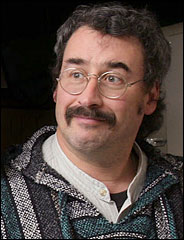
DANGEROUS [Brian Terrell, executive director of the Catholic Peace Ministry in Des Moines, had helped conduct nonviolence training at a November 15 forum on the Drake University campus. He received a federal grand jury subpoena last week]

I don’t know why they’re bothering with the small stuff, since we’re not going to have a free election this November in any event, but the Administration’s Department of Justice is trying to shut down ordinary protest, and in a very heavy-handed way.
In Des Moines, Iowa, that hotbed of revolution, the U.S. District Attorney’s office has subpoenaed individuals and records related to the activities of antiwar protestors. The group had assembled in a forum on the campus of Drake University, a small private institution in the capitol, on the day prior to a pretty routine antiwar demonstration outside a National Guard base last November. The event was sponsored by the University’s chapter of the National Lawyers Guild.
Officials at the University are unable to comment, since they are subject to an extraordinary “gag order” under a separate very broad federal grand jury subpoena directed at its relationship to the November 15 gathering.
The very public forum, atended by 21 people, was filmed by local television and the Des Moines police were invited. The program included the offering of personal safety advice for people who might decide to carry out non-violent civil disobedience the next day.

The school’s subpoena called for detailed information on the lawyers guild and its members, including the names of those who are officers, and guild meeting agendas and annual reports since 2002.
The subpoena also focused on the Nov. 15 antiwar forum, asking for “all requests for use of a room, all documents indicating the purpose and intended participants in the meeting, and all documents or recordings which would identify persons that actually attended the meeting.”

There can be only one explanation for this scrutiny from the Justice Department, a totally disproportionate response to the mildest of provocations: Silence all protest.

Some said it could send a chilling message far beyond Iowa, leaving those who consider voicing disapproval of the administration’s policy in Iraq, or anywhere else, wondering whether they too might receive added scrutiny.
“I’ve heard of such a thing, but not since the 1950’s, the McCarthy era,” said David D. Cole, a Georgetown law professor. “It sends a very troubling message about government officials’ attitudes toward basic liberties.”
Anthony Romero, the executive director of the American Civil Liberties Union, said he feared news of the subpoenas — which was spreading rapidly via e-mail on Monday among activist organizations — might discourage people from showing up to protests, attending meetings at universities or even checking out library books.
“People will have to be asking themselves: will this be subject to government scrutiny?” Mr. Romero said.

Yes, but we’re already there.

[image by Mark Kegans for the NYTimes]

Mexico pictures [updated]

I’ve edited my gallery of images from our trip to Mexico City, adding captions to each image (other than those of the hotel).
I’m afraid the information on the archeological images is rather poor, but I took no notes. I was really recording only those pieces I found both beautiful as objects and suitable for recording with available light. Only now that I am at home do I feel that was insufficient.
If anyone can add to or correct my texts, please email me or comment.
A trip like this is humbling in many ways, not least for me in confirming my inability to properly record images of what I have seen and felt. I’m very shy about pushing my lens into other people’s worlds, and when I am travelling with others I can’t, or won’t, take the time I would really need even to record inanimate objects.
It was a beautiful trip amid beautiful people and places. Even colds [both of us] at the beginning and at the end couldn’t and won’t take that away.
Barry regularly posted descriptions of our activities while we were there, starting here. You can use the navigation links at the top to go on to the other posts.

Tyson Reeder’s Milwaukee

tysonreeder.jpg
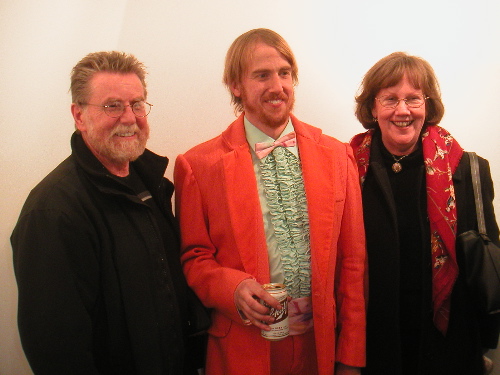
Tyson and his parents

His first solo show in New York was an attraction both for the work and for the smart, beautiful crowd Tyson Reeder was able to attract to the Daniel Reich Gallery on one of the coldest nights of the winter.
Reed’s show and his current home are both called “Milwaukee”. His parents are at home in the somewhat less zany precincts of eastern Michigan.
Because of my parents’ history, and my own childhood, I thought I knew a little about Milwaukee, but this was something very new. The paintings on canvas and the drawings do not really open up in reproduction, but save most of their textural beauty for a visit with the naked eye.

tysonvan.jpg
[the drawing in this image is not part of the current show]

EAT

EAT.jpg
Palacinka, inside out

A wonderful ambience, and good simple food, a world away from Soho – we love Palacinka, and we’re fussy. Nice people and a mellow style go a long way, in this case for just about any budget.

28 Grand Street, west of 6th Avenue
212 625-0362

For an inside, daylit image from another source, see Robert Wright.

stay away from televison, kids!

clarabel.jpg
Clarabel

Clarabel died on Friday!
Most of the people reading this won’t even remember Captain Kangaroo, but for me Bob Keeshan will always be most important as the mischievous and arch Clarabel the Clown on the Howdy Doody Show.
Keeshan seems to have been a very nice man, and he had a fine sense of priorities, perhaps surprising in a television star.

Asked on one occasion how he could star in his own show, engage in lecturing, volunteer, study French and still spend time with his family and his hobbies of photography, fishing and sailing, Mr. Keeshan replied, “One of the big secrets of finding time is not to watch television.”

More than likely he’d lose his job if he were to say this while working in commercial television today.

[image from the Clown Museum]

for the love of it all

becky.jpg
Becky Smith

Friday’s NYTimes “Weekend/Fine Arts” section has some great pleasures, almost without any guilt, for those of us who can’t just surround ourselves with enough stuff about art.
In two long, illustrated front-page articles on the newer New York visual arts scene, one about the youth driving it, the other about its Brooklyn incubator, even those not yet a part of this dynamic can share in its enthusiasms and its delights.
My favorite quotes from the “Youthscape” piece come from Bellwether’s Becky Smith in Brooklyn and from Daniel Reich, who runs his eponymous space in Chelsea. Becky seems to think that the gallery business doesn’t have to be run like the Coke-Pepsi thing.

“We tend to look at our businesses in a different way from another generation of dealers,” said Becky Smith, the owner and director of the Bellwether Gallery in Williamsburg. “We don’t see the art market as one big pie that we all have to fight over, but as something that is endlessly expandable. If we can make people excited about our galleries and the kind of art and artists we show, then we figure this will benefit us all.”

No one would ever expect to find Daniel Reich in a corporate office either.

Mr. Reich says that for the younger dealers the art business is less about making money than about expressing the values and experiences of his generation. “It’s all about being happy about whatever you can be happy about,” he said. “My generation grew up in a time when we didn’t have heroes. You grew up believing you were being hoodwinked and manipulated — and knowing you were, but learning to enjoy it because it came in fun colors or was on MTV.
“The bottom line,” he added, “was that I really wanted to have a gallery, and sometimes you just have to start doing something with whatever you have at your disposal.”

We love you guys.

daniel.jpg
Daniel Reich

[images by Fred R. Conrad for The New York Times]

more on what we would lose

deanst.jpg
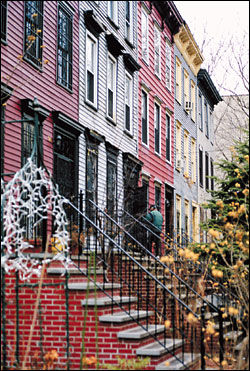
Dean Street

[see yesterday’s “replacing people with a basketball court“]
New facts are emerging about the political and money deals behind the project, and about the vibrant community which woud be destroyed if an “eminent” real estate mogul gets his “domain”.

Anywhere else in New York, time would pass too fast or slow for us to notice this unfolding history [that is, of the Village Voice writer’s neighborhood]. Most of the city has such a high turnover rate, no one would ever bother to learn anything about the prior residents, while those places that pride themselves on their constancy, like Carroll Gardens or Fort Greene, are desirable because they haven’t changed. Now that Ratner and company have awakened us to the possibility of upheaval in our backyard, we’re feeling very protective of what we have: a comfortable community that doesn’t feel bourgie or exclusionary, that makes room for its past while slowly evolving into most people’s present. It’s the best kind of New York, and it’s why we chose to live here. We want our son to feel at home on the block, but we want him to think everyone he meets belongs here too.

The NYTimes, which is enthusiastic about the sexed-up sports arena, mall and housing complex planned to displace hundreds of Brooklyn families, finally admitted to at least one of its ongoing intimacies with developer Bruce Ratner.

The team’s move from the Meadowlands in New Jersey — if indeed it ever happens — won’t occur overnight or without a fight. The $300 million deal to sell the Nets to Mr. Ratner (whose development company is a partner of The New York Times in building the newspaper’s new headquarters) is just a first step. [from an editorial today]

Ratner has just purchased the New Jersey Nets professional basketball company. He intends to install it in a $.5B complex in Prospect Heights, next to six blocks of $2.5B in other new structures. [The dollar figures are already being described as seriously underestimated.] The buildings would be occupied by commercial and residential tenants paying him generous market rate rents. The problem is that they are not his blocks. The people living there now don’t pay Ratner a penny in rent. He will need the city of New York to seize the buildings and the land on a perverse interpretation of the principle of eminent domain. Ratner also has the nerve to expect the city to help pay for his personal obsessions: letting others watch him play with money and watching others play with balls.
Leave it to Newsday to tell us once again what the Times won’t. Ratner said in December that 100 people would be relocated. The real figure may be closer to 1000.
Finally, even the Times can’t avoid covering some of the objections to the project in its story today, although this part of the text comes at the very end.

Councilwoman Letitia James, whose district includes the neighborhood, is a rare voice of opposition among Brooklyn politicians. She considers the project an oversized monster that will destroy a vibrant working-class neighborhood that has rebuilt itself over the past 20 years.
“This is a great day for rich developers and a sad day for working families,” Ms. James said. “It will open the floodgates to public financing of sports arenas.”
Harvey Robins, a former official in the Koch and Dinkins administrations, said the Ratner project is “antithetical” to building communities. “You’re putting up monstrous buildings in a low-density area.”

Boys throwing their weight around. This is a rehearsal for Manhattan’s own stadium boondoggle.

[image from the Voice]