time for our own opera

Rodwin2.GIF

Wonderful, wonderful theater. Music theater. Opera. Whatever.
No, it’s not a “musical”. If it were, I would not have been in the audience tonight. It’s pure art, especially if art must be both human and accessible to be truly pure.
But don’t be afraid. If it’s opera, it’s what Puccini was for his audience a hundred years ago, not what Puccini represents today.
But it’s only here one more evening – this time around.
David Rodwin‘s “Virtual Motion” can be seen tomorrow, Saturday, at LaMaMa for the last time. Sad enough that the entire run was only three days, sadder still that we didn’t see it until tonight and can only write about it now.
I have no idea how Rodwin’s art had escaped us until recently, especially since it relates to and is as exciting as the best work of some of our favorite modern theatrical composers, like Robert Ashley, Conrad Cummings, John Moran, and Mikel Rouse.
Rodwin created the music, the book, lyrics and the choreography, and produces, engineered and performs the piece solo. While he has created larger-scale work in the past, including one opera with a cast and crew of thirty, “. . . I knew I needed a simpler, more economical piece if I wanted my work to be seen by a larger, more diverse audience in more places.” He’s not competing with the Met, since its line of business is essentially that of a well-endowed museum of antiquities. “Virtual Motion” has already delighted people in over a dozen cities, and only some of those would ever be found in a traditional opera house.
In this latest piece the artist is an extraordinarily charismatic and beguiling presence on an almost totally bare stage, both bearing and born on gorgeous waves of live and recorded sounds combined. The music is totally integrated with the theatre in a shared contemporary humanity.
Well damn, the tickets are only $20, and it’s only an hour and a half long, with intermission. Don’t miss it. Years from now everyone will be talking about the birth at the turn of the century of this “new opera” form, but you shouldn’t wait that long to find out what it’s all about. Details:

La MaMa E.T.C.
The Annex
74 A East 4th Street
New York, NY 10003
Tickets: 212-352-3101

Tip: There’s both audio and visual stuff on his website!

[image from jadelake]

why does Rumsfeld worry me?

Last night I wrote that I was scared after hearing that the Secretary of War is going around saying that we’re losing the “war on terrorism”. Why? It just can’t be good news if it’s coming from him. I can’t expect that he’s saying this stuff in order to admit that the whole thing was misconceived in the first place, or because he’s about to resign in favor of a replacement which the world might actually survive.
No, I’ve come to expect the worst from this administration, and I’m still usually unpleasantly surprised. I think Runmmy’s current ruminations are all about preparing us all for something really big.
Things aren’t going well? The problem is obviously the liberals and the Constitution huggers, those who just aren’t taking this war seriously enough. We still have too many freedoms. In fact the world still has too much independence.
Remember that these guys don’t expect to ever leave, so this administration would be more than comfortable with a solution which would be some combination of really scary secret police, an elite security staff and perhaps a federal army command, all of them loyal directly to the White House.
Sound familiar? Well, it doesn’t have to so redolent of another time and place, but similar dispositions find similar solutions. The necessity for all of this would of course become perfectly clear after the next terrorist event, scheduled or otherwise. We’ll hardly notice the imposition of martial law when it comes.
There, I’ve just outlined the worst-case scenario but I really would like to be pleasantly surprised this time.
If we actually do survive this regime, I hope we will finally be a people without illusions – of blessedness, grandeur, superiority, sanctity, whatever. Enlightenment. Let’s go for enlightenment instead of the other stuff.

they felt they couldn’t complain, but they also didn’t cry

Dresden.jpg

These are thoughts of another war, and the state terrorism practiced by all combatants.
Germans are finally coming out of their bunkers only decades after the firestorms of World War II.
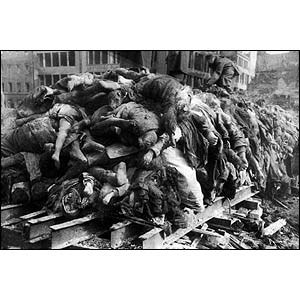
Jörg Friedrich is the author of a new book, Brandstätten (Fire Sites), composed largely of photographs depicting grisly evidence of the civilian casualties which resulted from the allied bombing of Germany’s cities during the second world war. Friedrich himself has now become part of a storm of words, nowhere more than in Germany itself. From The Guardian account:

“The bombing left an entire generation traumatised. But it was never discussed. There are Germans whose first recollections are of being hidden by their mothers. They remember cellars and burning human remains,” Friedrich told the Guardian in an interview in Berlin last week.
“It is only now that they are coming to terms with what happened.”
Around 600,000 German civilians died during the allies’ wartime raids on Germany, including 76,000 German children, Friedrich says. In July 1943, during a single night in Hamburg, 45,000 people perished in a vast firestorm.
But in the immediate post-war period, the German victims of British bombing were scarcely mentioned, being overshadowed by the far greater evil of the Holocaust.
Friedrich believes that most Germans refused to discuss what had happened because they regarded the British destruction of their cities as a sort of retribution for the crimes of the Nazi era.

The author maintains that the allied bombings, which incidently almost totally destroyed the fabric of 160 medieval cities, was a war crime, in particular the bombs dropped on the militarily insignificant civilian centers of a shattered Germany in the last few months of the war.
Reaction to Brandstätten has been critical. A reviewer for the Süddeutsche Zeitung, even suggested that it should be thrown in the bin, and a cultural magazine program on German public television dismissed it as a “provocation” that sought to “compare the air war with the Holocaust”, a reference which is as much an obstacle for free thought in Germany as it is in the Middle East and elsewhere.
The author had originally planned to produce a book which would include images of the horrors visited by Nazi Germany upon civilians in Poland, The Netherlands Britain and elsewhere. For the images he ultimately used in the book Friedrich combed the dusty archives of cities and towns all over Germany, but the larger scale of the project was blocked by the British. The BBC site reports:

. . . he says the British Public Records Office would not release the kind of horrific images that he found of German victims.
“There were 15,000 deaths in southern British cities between September and December 1940. But you won’t see any photos of them,” he says.
“The Germans admired the endurance of the Londoners in the Tube stations. But this is the heroic story. If you look at the image of the suffocated grandmother cradling her grandchild in a [German] bunker, there is no heroism.”
Keeping pictures like that, and the ones in the book, under wraps may be regarded as a sign of sensitivity – maintaining the dignity of the victims. But could it also produce a censored, sanitised version of history?
“Goebbels forbade these photos of our victims from the German papers,” says Mr Friedrich. “In a way, we’ve obeyed his orders until this day.”

Over the Channel too. Odd that Britain still will not permit the release of images of its civilian dead 60 years after the horrors they suffered. A prohibition which might originally have been represented as part of a nation’s campaign to maintain a beleagured people’s war-time morale just doesn’t seem to be defensible today.
Not much has changed. We see no images of Iraqi war dead today, and may never see them. In fact, we don’t even see images of our own dead – or even images of the injured. War is kept very clean for those who aren’t there.

The Leo Baeck Institute and the Goethe Institute will be presenting a panel discussion on this subject here in New York next Wednesday, October 29, titled “German Civilians as Victims? The Evolution of a Perception”.
Participants will include Dr. Frank Bojahr, The Institute for Contemporary History, University of Hamburg; Atina Grossmann, professor of history, Cooper Union; Dr. Volker Hage, journalist for Der Spiegel (Hamburg); and Andreas Huyssen, Villard Professor of German and Comparative Literature, Columbia University. The moderator will be Dr. Frank Mecklenberg, the director of research and chief archivist at the Leo Baeck Institute.
Their announcement includes the following information: The panel discussion is to be preceded by a screening of “The War of the Century-Firestorm” (Der Jahrhundertkrieg-Feuersturm). 2002. Produced by Guido Knopp. Written and directed by Peter Hartl and Annette Tewes. [52 min. In English and German with English subtitles. Courtesy ZDF] The film features historical footage from WWII as well as interviews with German civilians who experienced the massive bombing of such cities as Hamburg, Dresden, Cologne, and Berlin, and with American and British bomber pilots recalling the bombardments.
The film will begin at 6, and the discussion at 7. The location is the Goethe Institute, at 1014 Fifth Avenue, between 82nd and 83rd Streets.
For reservations and information we are asked to call (212) 439-8700.
I’m definitely going to be there. If you plan to go also, please let me know.

[the story and the texts quoted are from The Guardian and BBC News, where images from the book can be found, including that above, of Dresden in 1945]


the tapestry of empire

impero.jpg
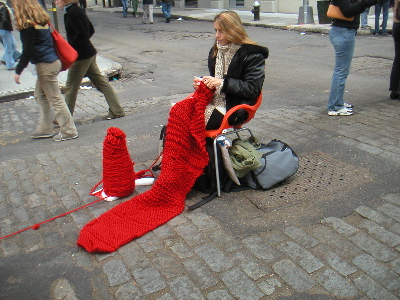
somewhat less than one half of Maria Marinelli’s performance at d.u.m.b.o.

Maria Marinelli was also a part of the d.u.m.b.o. festival this past weekend where she was represented by a performance of “Arazzo,” one of the four parts of her mixed media project, “IMPERO.”
What I saw on Saturday was two women knitting separate long panels or “tapestries” in red yarn of an almost painfully bright hue. They were separated that afternoon by a full block’s length of the same skein of thread each was incorporating into her work.
The two pieces being woven by the performers will eventually meet in the center where no more unused thread will remain. In order for one piece to be completed the other one must be destroyed.
in English, the name of the greater project is “EMPIRE.” The artist explains, “This metaphor makes visible the paradigm by which every imperialistic culture operates.”
“Women’s work,” indeed!

it’s Wojtyla’s ball, so we do it his way

The rules don’t apply to the guy at the top.
It’s all so absurd, from top to bottom, but there’s a reason we’re so attracted to the details.
Let’s see, Roman Catholic Church rules require bishops to retire at the age of 75. The pope is historically and essentially the chief bishop, by virtue of his office as Bishop of Rome. That’s the last position held by the disciple in whose charge it’s reputed founder, Jesus, is said to have placed the organization before, or after, his early death. The current Bishop of Rome is 83.
Church rules also forbid cardinals (an honorific title given certain bishops) who are above 79 years of age from participating in the centuries-old tradition of electing one of their number to the office of pope. The current occupant of that office is himself 83 years old.
Wojtyla would have had to retire by now were he still only a bishop, and he would be ineligible to vote were he still only a cardinal, but in spite of very obvious deterioration he has not submitted his resignation, shows no inclination of doing so, and since reaching the age of 80 he (or perhaps others using his authority) has appointed a total of 74 cardinals on two occasions.
We are encouraged to believe that this pope is not like other mortals, not even like (his) bishops and (his) cardinals, who in truth actually function only as lackies and decorative tassels for an absolute, super-national monarch, not to say a fanatical cultist and tyrant.
Incidently, the current pope has exceeded rules promulgated by his predecessor, and which he himself has reaffirmed, that limit the size of the electoral conclave to 120. Wojtyla has increased the number of eligible voters in the College of Cardinals to 135, but has not changed the conclave voting rules, suggesting there may be charges [“cardinal” or secondary] of voting irregularities should he die soon. Even if he has personally picked all but 5 of the 135 electors, largely on the basis of their conservative or reactionary politics, the next election might be more exciting than Florida or california.
Except as entertainment or as a regular and delicious treat for a history buff, none of this would be of any interest to me or most of the world if what happens to Catholics did not impact us all. Unfortunately it very much does. The disaster that is the Roman Catholic hierarchy, and in fact the entire business model, is also a disaster for the world.