
d.u.m.b.o. art – and real estate
There was plenty of art – and entertainment [is that a problem?] – at the d.u.m.b.o. art under the bridge festival this past weekend even for those who didn’t make it into the many open artists’ studios. Much of it was about real estate. All of the very best outside stuff was conceptual.
One of my favorites was “Endangered Species,” the work of Michelle Handelman and Vincent Baker, located under an arch of the neighborhood’s eponymous Bridge.
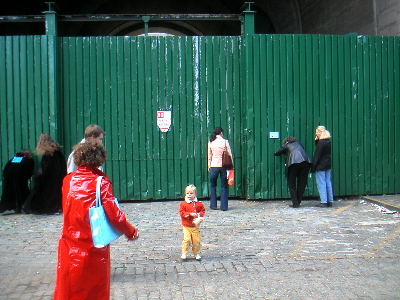
Behind the heavy green-painted corrugated metal wall, and really down under manhattan bridge overpass was a wonderful sound installation of the cries of some very angry elephants. The curiosity quotient was strong, but nothing was actually visible beyond the barrier.
A small placque in the lower right of the picture identified the artists, and added:
harlem, soho, tribeca, the lower east side….we haven’t forgotten.
PLEASE DO PUT HANDS IN GATE
greenmarket (ginger gold apples)

the “one state” solution, still anathema?
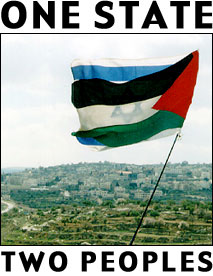
[but surely more than two]
At first I just wanted to post something about the latest horrors being visited upon Palestinians caught between the lines (the Green Line and the new Apartheid Wall line), but I didn’t know where to begin – or end – such a story.
In the meantime I had found my way to the site of The Electronic Intifada, and I there I found my story. I suppose it’s a cop-out in a way, because it avoids describing individual suffering in order to talk about how all the bad stuff might end. But maybe that’s a good thing.
An articulate argument remarkable for its absence of rancor, blame or fury, advanced by Ali Abunimah, founder of the EI, outlines the case for the “one state” solution to the sufferings of Israelis and Palestinians alike. The article appeared on their website last week.
Abunimah begins by observing, “. . . it is inescapable now that what already exists is in effect one state: Israel, in which half the population — the Palestinians — have second-class rights or no rights at all, not even citizenship.” While he apparently writes as a Palestinian, and directs his words primarily to Palestinans, I wasn’t aware of any parochialism while I was reading. The words are for everyone, especially since the entire world is horribly impacted by this, yes, fundamentally parochial conflict. Remarkably, in the end the “one state” argument is also even more practical than idealistic.
It is the moment, therefore, for us to declare the era of partition over and commit to a moral, just and realisable vision in which Israelis and Palestinians build a future as partners in a single state which guarantees freedom, equality and cultural self-determination to all its citizens. Refusing to make this choice now means effectively agreeing to the endless bloodshed and extremism offered by Israel’s political-military establishment and Hamas.
. . . .
The burden to persuade Israelis lies largely with Palestinians, who while demanding equal rights and an end to the Jewish Israeli monopoly on power, must hold out a future in which the two communities express their identities as equals rooted by right and history in the same land.
This is undoubtedly an unfair burden, but it is a fact that oppressed groups must often show their oppressors a way out of the tunnel they have dug. This was true in South Africa, where even in the darkest days of apartheid, the African National Congress under Nelson Mandela offered white South Africans a future of reconciliation, not revenge. As in South Africa, a truth and reconciliation process can help both peoples overcome the pain of the past even as they build a just future together.
Israeli and Palestinian supporters of a one-state solution must build a new movement. This partnership must work to translate the vast international sympathy for the Palestinian cause into active support for the transformation — with international assistance and guarantees — of Israel and the Occupied Territories into a democracy for all its inhabitants. It must be a movement that builds political and moral power through non-violent resistance and civil disobedience, and mobilizes the widest possible base. Only through such a movement, I am convinced, shall we create peace in our lifetimes.
Not part of the essay, but built on a truth understood by jews and arabs throughout the region, is the argument from demographics. The Palestinians will win the population race in the end, and an Israeli state defined by religion or race and controlled by a minority will have burdens which make today’s look like small nuisances.
But it doesn’t have to ahppen that way. The whole world could be an early winner if the “one state” approach described by Ali Abunimah were not absolute anathema for men with small minds and big clubs.
The particulars of the latest news from Israel/Palestine, especially as they might describe what is happening to Palestinians innocent of violence, are both too complex and too horrible to outline here, but they remain virtually unreported in the U.S. In the past I have used this space to give voices to dear and trusted friends who were in the Middle East, but it cannot really substitute for what is missing from the American media.
For that we all have to do our own searches. In addition to the website which produced the text I excerpted above, my friend and Middle East peace veteran Steve suggested several others when I asked where someone who was interested might get general summaries. I have listed them all below. Not surprisingly, and appropriately, they are not always of one voice.
The Electronic Intifada
Gush Shalom
B’TSELEM
Stop the Wall
UPDATE: For more on the few English-language websites which cover Palestinian issues specifically, go to this USC journalism site.
[image from The Electronic Intifada]
greenmarket (broccoli rabe)

greenmarket (blue hubbard squash)

Rauschenberg
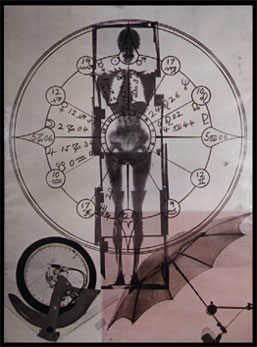
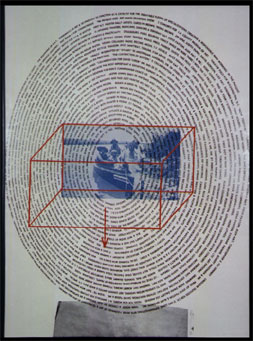
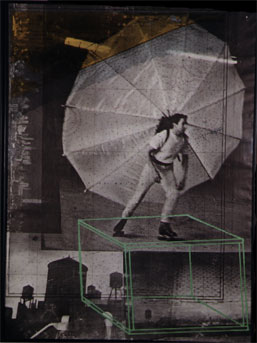
ROBERT RAUSCHENBERG, Autobiography, 1968
The three panels of this large offset lithograph by Robert Rauschenberg from 1968 titled Autobiography are displayed vertically and exceed 16 feet in height. They were printed with the type of press used to make commercial billboards. The three panels are layered with seemingly disparate images that, on closer examination, are probably thematically grouped. The top panel features a composite X-ray of Rauschenberg’s own body superimposed with the artist’s astrological chart, suggesting both the present and the future. The center panel deals with the artist’s past; at its center is a photosilkscreen of the artist as a two-year-old boy with his parents boating on a bayou near his home in Port Arthur, Texas. Surrounding this photosilkscreen is a labyrinthine oval of handwritten text narrating events in the artist’s life. The lower panel seems to address artistic creativity and is dominated by an enlarged photograph of Rauschenberg during his 1963 performance “Pelican,” in which he wears rollerskates and a parachute on a wooden armature harnessed to his back. Rauschenberg was one of several performers and he also choreographed this performance. This particular image suggests both movement and flight, which are themes carried through in Rauschenberg’s art and life.
Autobiography’s visual overlay of seemingly discrete and unrelated appropriated images is quintessential Rauschenberg, but the emphasis on personal or autobiographical subject matter is not. The vision underlying Rauschenberg’s aesthetic has often been interpreted to mean that meaning itself is created through accidental, improvised, intuited, and even illogical juxtapositions and associations. In that sense, what Rauschenberg offers us in Autobiography are images he had at hand but they are also images of personal significance to him. Rauschenberg once stated: “I don’t want my personality to come out through the piece . . . I want my [work] to be [a] reflection of life . . . your self-visualization is a reflection of your surroundings.”
[image and text from Philadelphia Art Alliance]
“bobrauschenbergamerica” in tears
We went to a performance at BAM of Charles Mee’s “bobrauschenbergamerica” tonight. Barry and I both found that like much of this wonderful man’s work, which I’ve now been enjoying for several decades, this evening of theater, which was created and performed by SITI Company and directed by Anne Bogart, took a while to come together. Barry thinks it’s Mee’s plan, and I think I agree.
When it was finally assembled it was magnificent.
I haven’t seen a decent review in the media, so I won’t link to any tonight, and I don’t have the nerve to try one myself, but I will at least say that I was eventually overcome by the piece’ sweet sincerity and delighted with its amazing sense of place. In a dramatic account of the world which produced Robert Rauschenberg’s art that would seem to mean a mission was accomplished.
But it didn’t come easily. It was about halfway through an evening punched through with scattershot American vignettes, at once both perverse and ordinary, that I began to cry. The tears were for the sometime beauty and goodness of this people and for how much has been lost in recent decades, but they were also tears of joy.
Admittedly the play and its performance basically ignored the ugliness and the evil that was also a part of what we regard as the simpler, mid-century America, and it’s assignment was not to dwell on how much the bad stuff remains or has multiplied today. Still, when the stage was emptied tonight, only warmth and especially hope remained behind. Amazingly, there was no sugar on the floor of the theater, but there was also not a wit of jingoism in the air, no rhetoric of any stripe. Quite an accomplishment that, especially these days.
The most moving moment in the theater this evening was an oration whose conceit is that it begins by appearing to be an actor’s address to the audience about this play, but it very soon becomes clear that it is much more. Barney O’Hanlon played Carl, who speaks to the museum visitors immediately after his assassination.
What follows is the complete oration, delivered near the end of the evening, a beautiful ode to art and artists in general, and the art and the artists of this strange people in particular.
[Carl, who has been lying on the stage dead, sits up and gives a speech welcoming everyone to an art opening, while we hear cement mixers, pounding, banging, clanking, sawing.]
OK.
How we put the show together.
First, I want to welcome everyone
I’m glad you could all come tonight.
We don’t often get to do a show like this
where we can just put on whatever we like
figure OK what the hell
lets just do whatever we feel like
and hope you’ll enjoy it.
I often feel those of us who are in the museum world
are particularly blessed.
Because we get to explore our feelings
whatever they may be
that’s a sort of freedom.
You know, that’s how it is to deal with art
because art is made in the freedom of the imagination
with no rules
it’s the only human activity like that
where it can do no one any harm
so it is possible to be completely free
and see what it may be that people think and feel
when they are completely free
in a way, what it is to be human when a human being is free
and so art lets us practice freedom
and helps us know what it is to be free
and so what it is to be human.
But, still, it often seems to me almost miraculous
how we can put things here in the museum
and ordinary folks
my mom and dad and my own neighbors
and I myself
will come to see things
sometimes things that I myself find completely incomprehensible
and really offensive
people will come to our museum
and think: oh, that’s interesting
or, oh, that’s stupid
but they don’t really hold it against the show
they just move on and look at something else and think
oh that’s cool.
And I wonder:
how do we get away with that?
And I think well, we are a free people
that’s why
and we understand that
in a way maybe other people in the world don’t
we like an adventure
often we might think
well, that’s a piece of junk
but that’s how this fellow sees the world
and there’s a certain pleasure in seeing things from his point of view
we are a patient people
no matter what you hear people say
and a tolerant people
and a fearless, open people
that’s how it is for us
I think that’s how it is to be an American.
We’re all unique.
It’s a precious thing to compare ourselves to nothing else.
This is my working attitude.
I don’t feel shame in my joy.
[He looks confused.]
I started out here knowing what I meant to say
and now I have to say
I don’t know what I said.
But I’d just like to welcome you
and let you know
we’re all glad to be here with you tonight
to share this with you
and we hope you have a swell evening.
[The text can be found on Charles Mee’s own wonderful site, which amazingly and very generously makes all of his work available to the public]
greenmarket (sweet potatoes)

it’s official – it really is a religious war!
I haven’t seen this anywhere else yet, so it must be an April fool’s joke. But, wait, this is October!
These people are definitely going to get us all killed!
Defense Secretary Donald H. Rumsfeld and the chairman of the Joint Chiefs of Staff are defending a new deputy undersecretary of defense “who has reportedly cast the war on terror” in religious terms.
Lt. Gen. William G. Boykin, whose promotion and appointment was confirmed by the Senate in June, has said publicly that he sees the war on terrorism as a clash between Judeo-Christian values and Satan, the Los Angeles Times reported Thursday.
Appearing in dress uniform before a religious group in Oregon in June, Boykin said Islamic extremists hate the United States “because we’re a Christian nation, because our foundation and our roots are Judeo-Christians. … And the enemy is a guy named Satan.”
. . . .
Discussing a U.S. Army battle against a Muslim warlord in Somalia in 1993, Boykin told one audience, “I knew my god was bigger than his. I knew that my god was a real god and his was an idol.”
Mine’s bigger than yours? He really said that?
Hey, this just in, spotted here at one in the morning. The NYTimes has the story in Friday’s editions. It’s there that we finally learn how Bush became president.
In another speech, General Boykin said God had selected George W. Bush as president. “Why is this man in the White House?” he asked. “The majority of Americans did not vote for him. Why is he there? And I tell you this morning that he’s in the White House because God put him there for a time such as this.”
The Times tells us that he was he was wearing his military uniform and was speaking at religious functions each time he is reported to have delivered the messages now being reported.
I guess they’re no longer trying to hide the nature of the regime, but we can’t expect that to help turn off many Americans.
UPDATE Thanks to Cursor today, we’re now reminded that back in April The Nation had already reported on the nature of Boykin’s magnificent obsession, but his appointment was still easily approved by Congress in June.]