
dull straight white men with money & power score again
FOLLOW UP on “two shades of green”
Yesterday it was an article in New York magazine which triggered my despairing post about developments at the World Trade Center site. Today it’s the New York Times. Why are they getting upset only now, when it’s almost certainly too late to stop the grinding gears of business-as-too-usual as we stand on the side awaiting the arrival of banality-and-much-worse?
The first paragraph of the following quote appears as the introduction to the piece in the NYTimes print edition this morning, but is curiously missing on the website, depriving David Dunlap’s text of much of its sense for electronic readers, and even producing quite a different spin.
The faces staring upin horror that morning from the streets of Lower Manhattan were every color. So were the faces staring out from the “missing” fliers around the city. But the hands drawing the plans for the new World Trade Center are almost all white.
What may have been lost in the transition are voices; voices that might have questioned basic assumptions about a program in which skyscraping commercial development is to accompany the memorial, cultural and open spaces; voices that might have asked whether a public domain under tight control is truly public.
The New York architect J. Max Bond Jr., whom the paper describes as “both black and an éminence grise in architectural circles,” advocates a process which would include not just minority voices but those of poets, philosophers and artists.
He also takes issue with proposals to put pseudo public spaces in private hands, [a development which has increasingly burdened New York over the last few decades], and suggests that opening participation in decision making to the larger community would have exposed such follies.
Many designs for the site called for gardens, shops, museums, restaurants and viewing platforms on high floors or at the top of buildings. But Mr. Bond said any space under strict scrutiny was not universally welcoming.
“It’s always been difficult for young blacks, for young Hispanics, for anyone who looks aberrant to get access to the upper realms of Wall Street towers,” he said. “For a city of immigrants, the public realm is more than ever now the street. If I’m a Dominican kid and my immigration papers are not quite right, I’ll never go up there because I’ll never dare show my fake ID.
“All these public spaces are going to be like shopping malls: privately controlled. You won’t be able to wear a T-shirt that says, `Down with Ashcroft’ because that will be viewed as hostile or threatening.”
And on the subject of skyscraper superlatives Bond’s comments show the full extent of his modern humanism:
“There’s a macho thing that keeps coming out: we should build a building that tall to show them,” he said. “Not everyone shares that sensibility. It’s a particularly male, Western sensibility.
“I’m not saying people of color are wiser. But women, people of color, gays, immigrants have all had to look at themselves. They have experienced the underside of society in a much more profound way.
“Architecture inevitably involves all the larger issues of society.”
Including, obviously, the issue of who really retains the power.
Tim Rollins and K.O.S. at A.R.T.
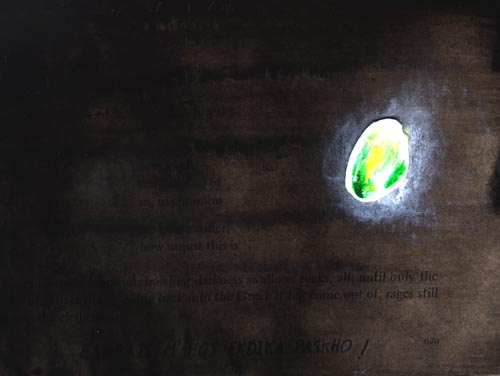
Tim Rollins and K.O.S., untitled, from Prometheus Bound, 1997
[image not in the show at Art Resources Transfer]
It’s a gorgeous mini-retrospective, or, better, a retrospective of the smaller-scale parts of 20 years of collaboration. Tim Rollins‘s work with the Kids of Survival (K.O.S.), studies in this case, mostly on paper alone, are now being shown in three rooms at the Art Resources Transfer (A.R.T.) space in Chelsea until November 15.
What for me had until now been available only in scattered glimpses of separate projects is now assembled in what admittedly is still only a tantalizing suggestion of the larger, finished pieces in each. But what a treat these suggestions are!
Each of the 40 works is inspired by and is physically lying upon the text of a major literary work or musical composition. Art has seldom been so literate, especially if we remember that the Tim Rollins and K.O.S. collective is as much about teaching as it is about painting and drawing.
The artists’ chronology begins with a 1983 delicate sketch of Jesse Owens on a page of Mein Kampf. Chapter: “Race.” It ends with Bush II in 2003, drawn as a two-legged squirel stretched across a page of Animal Farm which includes the creatures’ Seven Commandments, which begin with, “1. Whatever goes upon two legs is an enemy.”
In betwen there is Aeschylus, Ray Bradbury, Dante, Hawthorne, Haydn, Kafka, Stoker, Strauss, Wells and dozens of others, all of them beautifully illustrated and intelligently and powerfully amplified in the process. It’s a great treat, and a moving encounter on any level.
A.R.T. is located at 210 11th Avenue, between 24th and 25th Streets, on the fourth floor, and open Tuesday though Saturday from 11 until 6. 212-691-5956
[image from Dia Art Foundation]
greenmarket (freckled red apples)

“marriage needs to be tickled until it screams”
Happy Marriage Protection Week! Yup, it’s finally arrived. Our chief theocrat has decreed that this very week be so honored, in lieu of the threat posed by fags and lezzies.
I don’t think I’ve even alluded to the subject of marriage on this site before. It just doesn’t interest me. In fact it normally disgusts me. Maybe it’s mostly an aesthetic thing. But this is just ridiculous, and I just can’t keep out of it. I’m still no fan of marriage in any form, and I suspect I’m not alone in believing that the real threat has always been to the unmarried. That has obviously not changed.
Still, Marc Morford is pretty persuasive as he nears the end of his tribute to Simpleton’s proclamation with these generous thoughts on the subject, brilliantly articulated:
Let’s make this perfectly clear: Marriage does not need protection. Traditional marriage does not need any forcible recommitment by right-wing Christian zealots who try to force everyone into little shiny happy heterosexual SUV-sized boxes of sameness and sanctimony and bad rented tuxedos and engraved gravy boats.
In fact, much like the church and the concept of “family” and Jenna Bush, marriage needs to be busted wide open. Marriage needs to be allowed to move and progress and dance as the culture moves, as consciousness progresses, as times and mores change, recognizing along the way that what might have been some toxic nuclear-family ideal in 1953 holds nearly zero relevance today, and in fact only makes us more uptight and rigid and confused.
Marriage needs to be tickled until it screams. Marriage needs to be stripped down and sprayed with whipped cream and licked all over. Marriage needs to be blown apart with the dynamite of new possibility and put back together again in ten thousand different kaleidoscopic configurations, each one encouraged and celebrated and applauded, even those that don’t involve ridiculously expensive cakes and tepid church ceremonies and the bride zonked on Valium as the groom slams another scotch to calm his nerves.
This is the only way. Evolve or die, honey. Because it’s exactly when you try to force-fit love’s modern, ever-evolving mutations into archaic, increasingly bitter boxes of ideology and Right wing-approved blandness and sactimony that the culture suffers most. Legislating love is never the answer. Hey, just ask your neighborhood Catholic priest.
two shades of green
Kelly and money.
The results are in, ladies and gentlemen.
Forget two years of agony and hopes for resolution, two years of arguments and competitions, two years of talk and spin, we now have an answer. The World Trade Center site is going to look nothing like what we wanted, what we were told we would get, what we should have.
Liebeskind’s design, whatever its value, is dead, even if Liebeskind, complicit in his own defeat, is still there for cover (and surely a fat paycheck). The public be damned, money is talking, and the conversation isn’t pretty or smart, because Larry Silverstein is in charge.
We’re going to have to suffer years, actually decades, of construction messes in order to end up saddled with a huge affront, the usual New York contemporary corporate high-rise junk. There is no coherent plan, no monumental architecture, no humanity, no spirit, and not even a cold aesthetic geometry survives.
Last week I was once again struck by the absolute rightness of Ellsworth Kelly’s magnificent WTC site proposal in his ‘Ground Zero’, when I visited the Whitney Museum, which is currently displaying his “red green blue work.” The simple newsheet collage he sent to the NYTimes architectural critic Herbert Muschamp early in September has been donated to the Museum. It hangs, modestly-framed and almost invisible, near the elevators in the lobby.
Sublime. It’s what we need right now. We can build towers on other lots. There’s nothing to keep us from getting Kelly’s green, except the money that talks.
more of Phil Collins
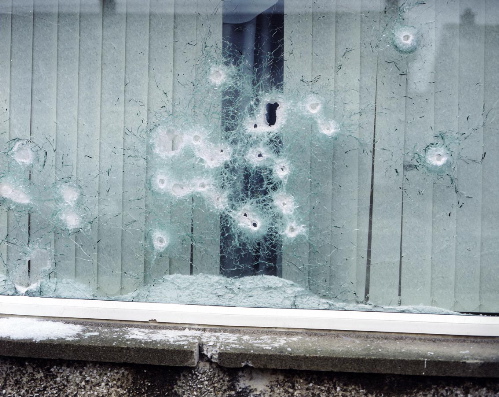
Phil Collins, holiday in someone else’s misery II 2003
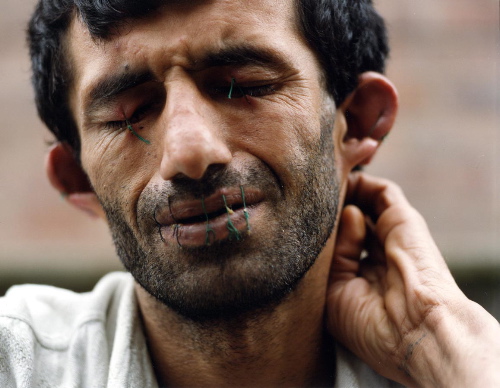
Phil Collins, abbas amini 2003
These are two more images from the current show at Maccarone Inc.
misery likes faith
The NYTimes is talking about religion this week, in articles on two successive days.
You needn’t read all of what occupies more than two full pages in the print edition to realize that the conclusion is basically religion is down in happy countries and up elsewhere. Note to Americans: Faith is an expanding industry here.
Europe has all but abandoned religion. In the United States it shapes politics and society and indeed our view of the world. In the third world, Christianity in particular is growing by leaps and bounds.
The article explains that the secularization of Europe and the increasing importance of religion in the U.S. is one of the forces pushing the continents apart.
Americans are widely regarded as more comfortable with notions of good and evil, right and wrong, than Europeans, who often see such views as reckless.
In France, which is predominantly Catholic but emphatically secular, about one in 20 people attends a religious service every week, compared with about one in three in the United States.
“What’s interesting isn’t that there are fewer people in church,” said the Rev. Jean François Bordarier of Lille, in northern France, “but that there are any at all.”
Christianity is booming in Nigeria and elsewhere in Africa.
Here nobody, it seems, can afford not to pray.
“In countries where everything is very O.K., where they take care of their citizenry, people are very lethargic when it comes to religion and God,” said Oluwayemisi Ojuolape, 27, a lawyer in Lagos, who attended this all-night vigil, called Holy Ghost Service. “They are not encouraged to ask for any help. They seem to have all of it.”
I knew we need help, but more religion in America can only mean disaster. From a professor of religious studies:
“I’ve been struck by the way in which religion now serves to underpin the divergence between Europe and the United States, and where I particularly saw that over the last year or two was in attitudes about the Middle East,” said Philip Jenkins. Dr. Jenkins is a British scholar who teaches history and religious studies in the United States and wrote “The Next Christendom” (2002), about changing patterns of Christian worship around the world.
“Americans still take biblical and religious arguments very seriously, and therefore give a credence to the Zionist project that Europeans don’t,” Dr. Jenkins said.
He said that for many Americans, the frequency with which President Bush invoked morality and religion in talking about the fight against terrorism was neither striking nor discomfiting. “But in Europe,” he added, “they think he must be a religious nut.”
Me too.
dream duty
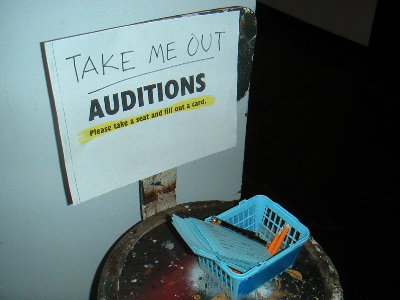
Public Theatre hallway, Monday afternoon
greenmarket (puntarelle)