“With a people denied so many basic rights for so long, the only way to stop the terrorism (of the few) is to end the suffering (of the many).”
For an understanding of what actually is the thinking within the beleaguered Palestinian community, both that of the different leadership groups and that of the population generally, read Anees’s description posted last night.
“Let’s talk about terrorism!”
“The villagers can’t get to the schools or the medical centers. They are surrounded by settlements, extremly aggressive ones, and are not allowed to travel on the Jewish roads. Yes, the Jewish roads. Palestinians are not allowed to travel on the road that goes right past their own villages and towns. They are also not allowed to use their own roads as they have all been blocked. No passage. No movement. If they are caught driving on the Jewish roads, they are fined, jailed or beaten. Sometimes all of the above. They cannot get to work, they cannot get to hospitals, schools, etc. There were hundreds of men walking along the road as we drove, they were walking because they cannot drive and there is no transportation for them. Coming back from what work they manage to keep. They are walking because their roads are blocked and they cannot use the Jewish roads.”
Our friend the activist and filmmaker Ellen Flanders writes today from a tiny, almost totally isolated Palestinian village near Hebron.
Hi folks,
well what can I tell you? The situation once again has spun out of control, dead people everywhere, ongoing violence and no-end in sight. Spending time in the West Bank and Gaza as opposed to Tel Aviv and Jerusalem is of course night and day. I read all the reports various others send out and few people who are here doing solidarity work seem to move between both, perspective however, is everything.
Even city to city, village to villlage, it is important to draw the distinctions and the realities of daily life. Leaving Jerusalem for the day and heading to Ramallah in the morning, back to Jerusalem, and then to the Hebron area in the evening, gave me a chance for some of this perspective and perhaps wide-angle lens. I met with a gay Palestinian-American man who was kind enough to take me and my cameraman, Chris, on a little tour of the road from Jerusalem to Ramallah. I was wanting to try and find a visual way of describing this journey and landscape. Words are insufficient and I find that comparing it to Apartheid or ghettos, or anything like that not all that useful in the end. This place has its distinct appearance and history, much of it grisly and worthy of its own terms. I can only try and describe it as I have seen it both over the years and presently. It’s funny you know, because in some ways while I know this place and spent some years growing-up here, there are many ways that I do not know it or the people at all. I know slogans, ideologies and symbols. I know the landscape from one angle and then another. But people, take a lifetime to know. And people are what *place* is in the end. And while I have forged friendships here, both Israeli and Palestinian, we have not grown-up together, lived together, or shared in each others lives daily over the years. So I will continue to know this place from anew everytime, which can both be a benefit and a loss.
I will try to describe for you some of the things that seemed both new and old in the past days: The roads leading from Jerusalem to Ramallah are often named in the most honest and blatent of terms. At some point we were on the *Okef Ramallah Road.* Okef means to go around, hence it was the road that bypassed Ramallah. As an Israeli, one does not want to be anywhere near Ramallah, one does not want to see what is happening there. Ignorance is serving the Israeli population all to well. It is amazing how many Israelis I talk to that know NOTHING of these towns, nothing (well, except that they are dangerous). The road leads to all the settlements surrounding Ramallah from Jerusalem. The settlements are spreading like a tangled web, getting longer, wider and more populous. They are sometimes quaint, sometimes more like small cities. They surround the nearby Palestinian villages and towns, cutting them off from their fields and taking the surrounding agricultural land as their own. This then impoverishes the Palestinian villages/towns, as they now have no means of income. They take the water, 80% of it, and control whatever flows in and out of the Palestinan towns. And the electricity. Visually, when you stand high above the settlements you can see them virtually strangling these places. It is quite clear. And then we passed the outposts and the new settlements being built. What? You say there has been a halt on settlement activity? No fear! They are growing rapidly, often attaching the new settlement to one right next to it, so hence now it is a *suburb* of the former settlement. Using it’s name allows the Israelis to claim that no new *legal* (although all are in fact illegal), settlements are being built. Then there are the ones that we don’t even talk about, as they slip under the radar screen of all press and media, not to mention general public interest.
When you look at the network of settlements you think, this is not going anywhere. These *facts on the ground* that have been established long ago, so incredibly strategically, and continue to do so, does not give me much hope. When the mainstream Israeli peace group, Peace Now, says *dismantle the settlements,* most of the individuals (the few that are left there anyhow), have no idea what would really be involved in this and how intricate and intrinsic they have become (hece there has never been a real plan in place to do this removal). How they choke and clog all that they surround and at the same time have families, trees, yards, dogs, schools, shops etc many who have been lead here by a government offering many benefits, easing the economic burdens they would experience elsewhere. I read this over and over, but a walk around brings it home again differently everytime.
Now contrast this with the lovely cafe that Chris and I sat in for lunch in Ramallah, talking to our neighbours about what we are doing there etc. It all can seem like anywhere else in those moments, lunch, drinks, cafe, conversation and a beautiful breeze. Nasser, who is at the next table inquiring what we are doing here, teaches at Beir Zeit University. He starts to give me a lot of pointers about all the politics and surrounding areas etc. When he realizes however that I seem to be quite in the know, he asks me how I know what I do? Am I local? I tell him, no, but I did grow-up in Jerusalem for years in my youth and so I am somewhat familiar. He asked me if my father was a diplomat or something? I said no, they were Jews, Zionists, coming to live in Israel. He was stunned for a moment and then said *Really? so you are a Jew?* *Really,* I said, I am a Jew. *And you are here, talking about Occupation?* Yes, there are many others like me, I am by far unique I told him. But nonetheless Nasser was shocked. And I continue to have this experience. There are only two sides to this conflict heavily endorsed by the media, there is us and them. The people are all but removed.
We leave Ramallah via the Kalandia crossing and it takes us an hour to cross. We sit in the car with the smell of garbage all around, the dust flying and a view of the new fence cordoning off Ramalla. The soldiers are rude by the time we get to the checkpoint and wave us through. We were lucky, some people saw that we had a camera and obviously wanting this documented, told us to go ahead of them. It is bedlam and it causes such frustration that you think you are going to lose it. But here, everyone does this daily. Humiliation does not begin to describe what it is like to be at the mercy of these 18 year olds that decide whether you pass or go back.
We then pick-up Rauda in Jerusalem, one of the women in my film, a Palestinian lesbian and poet, who is joining me and Chris and Ezra, another character in my film, to head down on the road to Hebron. Ezra has been working with this one tiny village that has had their access to the nearest Palestinian town completely cut off. He helps them to remove roadblacks, only to be replaced the next day. The villagers can’t get to the schools or the medical centers. They are surrounded by settlements, extremly aggressive ones, and are not allowed to travel on the Jewish roads. Yes, the Jewish roads. Palestinians are not allowed to travel on the road that goes right past their own villages and towns. They are also not allowed to use their own roads as they have all been blocked. No passage. No movement. If they are caught driving on the Jewish roads, they are fined, jailed or beaten. Sometimes all of the above. They cannot get to work, they cannot get to hospitals, schools, etc. There were hundreds of men walking along the road as we drove, they were walking because they cannot drive and there is no transportation for them. Coming back from what work they manage to keep. They are walking because their roads are blocked and they cannot use the Jewish roads.
We got to the village to help open one of the blockades by removing a steel highway barrier and by removing enough of the mound of dirt that had been piled high to cut off access, to get one car through. Ezra says this is the third time in a week he has done this as the army or the settlers come and reblock it daily. We worked at night, in the dark mostly, with the hood up on my car, pretending whenever a settler of army jeep passed that we were having car trouble. If anyone from the village is caught doing this, they are severly punished.
After, when we were invited to sit for tea with the villagers, I was told horror stories. The settlers coming into the village and chasing the women and children in jeeps, beatings of old and young (the head of the village’s mother who is 80 was beaten by nine settlers and had to be hospitalized). Ta’ayush, a Palestinian-Israeli peace group, brought a tent to the village where they set-up activites for the kids (as they couldn’t get to school). They were chased from the tent and told, the children that is, by settlers and army, that if they have anything to do with peace groups or go near that tent again, they will come in the night and chop their heads off. Needless to say, the children did not return. I was talking to a little girl who was about three and was asking her about her sisters etc. She turned to her mum after our chat and asked her if the army would come and slice her head off that night because she was speaking with me. They sleep on the roofs of their houses in the summer because of the heat and the ants. The settlers come by at night and throw rocks as they sleep. They have torn down some of their few olive trees, destroyed their few vegtable patches, drive their jeeps through the village, terrorizing them, especially as they have now had contact with peace groups. Let’s talk about terrorism!
The village has no electricity or water beacause the settlements will not allow them to run a wire or a pipe. The village has about 20 houses.
Again, I read these stories as you must as well, from others who are spending time working here, but truly words are insufficent to describe how horrific it is. When you are sitting there, listening, you are also trying to figure-out what these people have done to deserve this lot? To be treated as less than human, as people without children, without elderly or illness, without any needs. I am sitting by the light of the kerosene lamp under the most incredible desert sky and I am paralyzed. I am helpless and my rage surges. I can see how easy it is to want revenge, to want to take a machine-gun and terrorize these bullies back, to take away their rights and dignity. I climb down the stairs to my car, the dogs of the settlers are barking in the night and their towns glow from above in the most menacing of ways. I try not break-down and leave most reluctantly, both wanting to stay and help and flee at the same time.
That was just one day, and I get to go home.
That’s the update for this week,
with love,
Ellen
Ellen Flanders
Graphic Pictures
wigs and stuff not stock
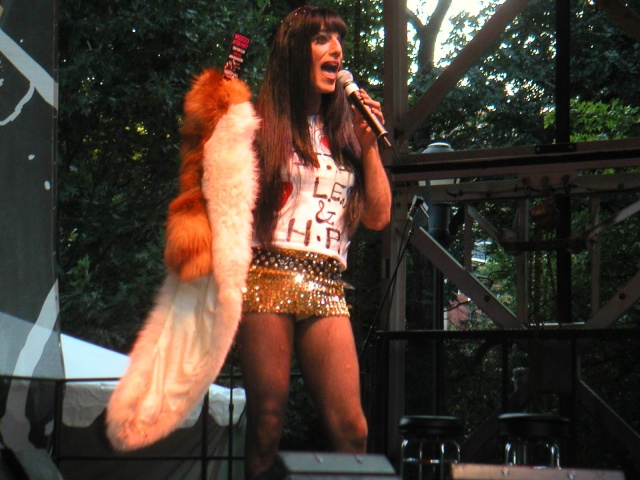
TABBOO!
click here for more pictures
On Saturday my Wigstock experience began on a sour note, and it had nothing to do with wigs. As Barry and I were about to cross Avenue A at 8th Street I spotted a small, dedicated contingent from ACT UP with their table of literature on the sidewalk. They had been thrown out of Tompkins Square Park by the HOWL! Festival organizers because they had not paid a concession fee.
ACT UP doesnt pay concession fees, and ACT UP has always been a part of Wigstock. [In the interest of complete disclosure I must say that I have been a member of ACT UP almost since its beginnings, but in recent years I have been more neglectful than supportive.] I understand the costs of the festival have to be met somehow, but I also understand that, at least the last time I checked, Tompkins Square is a public park. Surely something could have been arranged for the inclusion of genuine public service organizations in a celebration of the creative and radical tradition of the East Village.
Now feeling a little like contraband myself after hearing of their experience with the authorities, we entered the park which had once been a very major civic battleground.
Wigstocks return to the park where it was first conceived (and delivered) 18 years ago by a gaggle of not-so-mad drag queens was of course wonderful – with at least one, no two or even more, reservations. The Lady Bunny emceed of course, operating in the customary, tired bitchy form she shares with too many of her sisters, and significantly she had even managed to sorta witches-kiss and make up with Mistress Formica in consideration of this momentous occasion. But where were the new artists? The question could, and should well, be asked of the entire HOWL! enterprise.
The Dazzle Dancers wound up the afternoon’s program with a spectacular salute to the ultimate irrelevance of costume as a quantity except of course for the glitter, which they generously shared with the first hundred feet of the fans packed around the stage.
I was sorry to see that in spite of the good vibe among those in the bois propre below the latest Wigstock incarnation had attracted far less spectator hair, makeup and costume involvement than those of legend, and yet I have to admit that I didnt wear my wired golden pigtails this year myself.
The tiny ATM Gallery on Avenue B (yes, it’s behind the ATM machine), just north of the park, was showing what was billed as the First Annual HOWL! Invitational through late Sunday. Just inside the door on the right in this group show were Chris Tanners three colorful works on fabric with built-up patterns which suggested chenille bedspreads gone mad. They were pretty wonderful.
The Festivals community-driven “Art Wall” around much of the park was, not surprisingly, very political, and some of its statements managed to ignite tempers, arguably a good thing even for a festival. Much of it had something to do with Bush, Israel, police states, etc., and we can report with satisfaction that Michael Stewart has not been forgotten.
The East Village today is not your fathers East Village, and ironically the best evidence of that may have been the strong presence of child-friendly elements in the HOWL! Festival schedule.
Local color to straddle the two generations: At 8pm Saturday night, while we were walking about the neighborhood, we passed a barely-30-something mother and her young 7-something son out walking their house pets. The mother was pushing a folding grocery cart which supported a gold fish in a stormy bowl of water on its lower shelf and a hamster merrily racing on its treadmill in a cage on the upper.
As darkness replaced twilight, we slipped into the Sixth Street and Avenue B Garden for a few minutes to walk through the green stuff and to listen to the music of Mr. Ragas Neighborhood players (a very nice ECM-ish ambience).
As we started to go out I realized the beautiful tree we had been standing under was a perfectly healthy and fructiferous fig, something I am still not accustomed to, having lived most of my life in northern temperate zones. Do the magnificent branches and the perfectly-formed fruits reveal gardening care or betray global warming?
We managed to find a table at Raga on 6th Street for a leisurely dinner, followed by a slow walk home.
The next afternoon we returned to the same scenes to meet our friend Kate, who is visiting from Antwerp for a few weeks. We went back to the ATM Gallery, which was just then cleaning out the bottles from what appeared to have been a very successful opening party the night before. We talked to Bill Brady, the delightful artist behind the space, and we easily became somewhat enchanted with his very adventurous curatorial choices.
Aside from the work of Chris Tanner, the show, which was created especially for the HOWL! Festival, included UFO-imaged work by Ionel Talpazan, the geometric devices of Vince Roark, the sweet/scary world of Min Kim, the graphite Altamont of Mike Paré, Karen Finley’s efficient, Titian-esque nudes, and her menstrual blood flower drawings, the delicate collage-drawings of Yuh-Shioh Wong, Jack Davidson’s cloud landscapes which were oil paintings passing as cottoncandy pastels, David Leslie’s wonderful soap sculpture of a not-quite-successful Evel Knievel outing, and Bill Brady curating himself with an exciting, strangely iconic, somehow-non-objective, neo-op oil in very primary colors.
We lingered at the music lot on Avenue A and 11th Street for a bit, unfortunately missing the magnificent John Moran but very pleased and provoked by Rebecca Moore and her band, Prevention of Blindness. We bought her CD. We already owned all of the recordings of Johns operas spread out on the table next to it, and a good thing, too.
Passing through the willow tree oasis of La Plaza Cultural Garden we hung out for a few songs by a wonderful [unfortunately unidentified to us] performer who was part of the WOW Café Cabaret, before we had to leave to call our friend Anees to settle on a time and place for dinner, always the days paramount event for the both of us.
We now four soon found ourselves at Gnocco on 10th Street, in their beautiful back garden sheltered by Trumpet Vines and heating ductwork ready for the winter. Anees had arrived bearing gifts from Palestine, two keffiyahs and a beautiful CD of a young Palestinian oud player, Samir Jubran.
And so, after another hike home to the northwest, to bed.
report from Palestine August 24, 2003
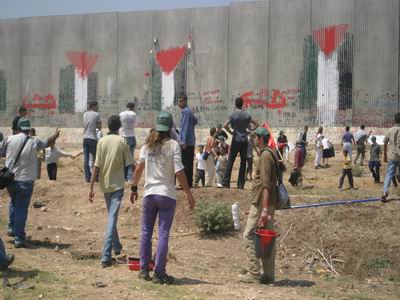
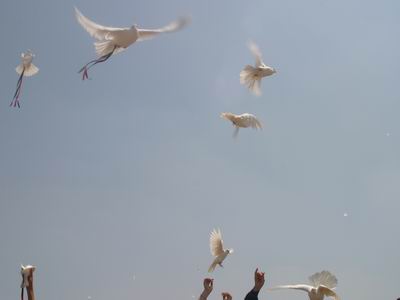
Steve writes from Tel Aviv, on his last full day before he returns to New York.
The pictures above, of the Apartheid Wall from the side of the imprisoned, are my own choice, from the International Solidarity Movement site.
Context Is Everything
Tel Aviv, Sunday, August 24, 2003
I came to Tel Aviv from Jayyous on Thursday evening
intending to stay for one night, but I awoke on Friday
morning with one of my all-too-familiar sinus
infections. I saw a doctor, got some antibiotics, and
extended my stay at the Tel Aviv hotel until my
departure in the wee hours of Monday morning. It’s
Sunday afternoon now and I’m fever-free, although
still a little nervous about flying with congestion.
My hotel is right on the beach, and it’s lovely here.
Lots of people out and about, bar-restaurant-cafes
right out on the sand, streets bustling until late
into the night. Jayyous is 10km from here, and my
friends there haven’t seen the sea for 4 years. You’d
never know here that there’s so much suffering so
close, being inflicted by the Israeli army.
On Wednesday night two Palestinian-American friends
were staying at the same hotel. They were not
permitted to bring their Palestinian Israeli friends
to the room–the armed security guard was quite
insistent. I, in contrast, have had free run of the
place, welcome to come and go as I please, even when I
was their late-night guest before I registered at the
hotel myself.
I’ve been pretty starved for news all summer. I’ve
been living without radio or TV, in communities where
all the newspapers are in Arabic. Poor email access
kept me away from Internet news sites. Now that I’m
in Tel Aviv, lolling about in front of the TV and with
English-language newspapers, I see how the present
grisly turn of events is being framed.
Israeli media are forefronting the suffering inflicted
by the bombing in Jerusalem. This is perfectly
reasonable. It was a horrific attack, and its
ultra-Orthodox victims conjure up images of terrible
Jewish suffering in Europe in the 20th century and
before. The sequence of events presented in the U.S.
and Israeli press seems to be (1) bombing in
Jerusalem, (2)assassination in Gaza (3) end of Hudna
[cease fire]. Journalists (or their editors) don’t
seem interested in what happened prior to the
Jerusalem bombing, in what the Hudna was really like.
A look at the website of B’Tselem, the Israeli
Information Center for Human Rights in the Occupied
Territories (www.btselem.org) shows that between July
1 and August 13 of this year, 9 Palestinians (1 of
them a minor) were killed by Israeli security forces
in the Occupied Territories. In addition, the
construction of the Apartheid Wall and destruction of
Palestinian property continued apace, as did the daily
violence and humiliation that is part and parcel of 36
years of military control of a civilian population of
millions.
During the same period, 4 Israeli civilians (none of
them minors) and one member of the Israeli security
forces were killed by Palestinians.
Then came the Israeli attack on Askar Refugee Camp in
Nablus, in which 4 Palestinians were killed by Israeli
security forces. The Rosh Ha’Ayin and Ariel bombings
followed, with one Israeli death in each case,
followed by the Israeli assassination of an Islamic
Jihad student activist. Then the bombing in
Jerusalem.
The attack on the bus of worshippers was not
justified. It was sickening. Its planners and its
perpetrator distort Islam beyond all recognition. But
it was, without a doubt, provoked, and the Sharon
government knew it. They knew it when they attacked
Askar, and they knew it when they went into Hebron.
Now the situation has spun out of control again,
Israelis will again see their buses, cafes, and
restaurants blowing up, and Palestinians will die (as
always, in much larger numbers) as the occupation army
storms through Nablus, Jenin, Tulkarm, and Gaza. The
Israeli media today are proudly showing photos of
dozens of tanks assembled at Erez Checkpoint ready to
reinvade Gaza; I can only think of the 1.3 million
desperately poor Palestinians packed into ramshackle
housing in the tiny Gaza Strip, and what these killing
machines are going to do them.
So now Bush and Powell and Rice have stopped bugging
Sharon about the Apartheid Wall, and Mayor Bloomberg
is flying to Jerusalem tomorrow to stand with Israeli
victims of terror, even as the Israeli army creates
untold numbers of Palestinian victims of state terror
in the Gaza invasion. So it seems like the Sharon
government got exactly what it wanted.
I’ll he home tomorrow afternoon. I’m looking forward
to doing lots of public speaking about the occupation,
as well as reconnecting with family and friends.
Peace,
Steve
[images of Qalqilya on August 12, 2003, by Niki Dean of the UK]
don’t have to wear brown shirts to behave like fascists
Bloggy has an extended post “On Israel/Palestine, violence, and ethnic cleansing.”
“but as for its people . . . .”
Silipups explains.
He’s describing the intent of his own weblog, but on the subject of Palestine he could be speaking for many of us.
Hi, my name is Anees. As per many questions I was recently asked:
I THINK SUICIDE BOMBINGS AGAINST ISRAELIS ARE AN ABOMINATION AND A CRIME. LIKE ALL CRIMES, I WISH THEY WOULD STOP FOREVER.
I AM NOT A JEW-HATER AND HAVE MANY DEAR JEWISH FRIENDS. DO I HATE ISRAEL? ANSWER: I RESENT ISRAEL FOR HAVING INFLICTED MUCH PAIN ON A POWERLESS PEOPLE FOR SO LONG. DO I BELIEVE ISRAEL HAS THE RIGHT TO EXIST? ANSWER: AS THE FORCE WHICH ENACTS A RACIST AGENDA IN BRUTAL WAYS, ‘ISRAEL THE IDEA’, DOES NOT HAVE THE RIGHT TO EXIST AS IS. IT MUST CHANGE. BUT AS FOR ITS PEOPLE, I BELIEVE ISRAELIS LIKE ALL HUMANS HAVE THE RIGHT TO EXIST IN THE LAND WHICH HAS BECOME THEIR HOME.
THE MAIN PURPOSE OF STARTING THIS BLOG WAS TO SPREAD INFORMATION ABOUT ISRAEL’S MISTREATMENT OF PALESTINIANS. WHY NOT SPREAD INFORMATION ABOUT PALESTINIAN’S CRIMES AGAINST ISRAELIS AS WELL? THE ANSWER IS: BECAUSE AMERICAN MEDIA ALREADY COVERS THAT, AND I BELIEVE THAT IT IS BIASED TOWARDS OBSCURING THE SUFFERING OF PALESTINIANS UNDER ISRAEL’S BRUTAL RULE.
WHY JUST TALK ABOUT PALESTINIANS? AREN’T THERE OTHER PEOPLE WORTHY OF MORE ATTENTION BECAUSE OF THEIR SUFFERING? ANSWER: YES THERE CERTAINLY ARE AND PALESTINIANS DO NOT HAVE A MONOPOLY ON BEING VICTIMS, AND IF YOU CONSIDER THE AFRICAN CONTINENT AND WHAT’S BEEN GOING ON THERE, IT IS EASILY MORE HORRIFIC AND WORTHY OF MORE URGENT ATTENTION. BUT ONE FIGHTS AND PROTECTS THE PEOPLE AND THE AREA AROUND HIM, BECAUSE THESE ARE WHAT HE SEES AND FEELS. THIS IS HOW HUMAN EXISTENCE WORKS.
MY HOPE (SOME WOULD SAY AN UNREALISTIC DREAM) IS FOR PALESTINIAN ARABS AND ISRAELI JEWS TO LIVE IN PEACE IN ONE STATE.
how foreign?
Stupid can’t even hear himself. Bush to reporters in Seattle today:
“There’s a foreign element that’s moving into Iraq.”
Bloomberg’s “special relationship” with folly
The mayor of New York is going to Israel to show his support.
Am I the only one who finds this news appalling? Are Israelis the only victims of this horrible conflict?
Bloomberg’s either a fool or a political opportunist who asssumes there are no New Yorkers, even Palestinians, who will question the limited object of his sympathy. Here is his reading of the current situation in Israel and Palestine:
“You can’t let somebody start to bomb you or shoot you and then give up everything that they want in return for them to stop. They stop terrorism, then you talk. They don’t stop, you hit back and you hit back with everything you have and as hard as you can repeatedly. And if you don’t do that, shame on you.”
“They” equals terrorists equals every Palestinian. Simple. Stupid. Disastrous policy. Moreover, the history of terrorism in the areas which he will visit began earlier in the 20th century. Palestinians did not start the conflict, and Palestinians cannot end it.
Our mayor should know that.
“Reporter! Kill! Kill!”
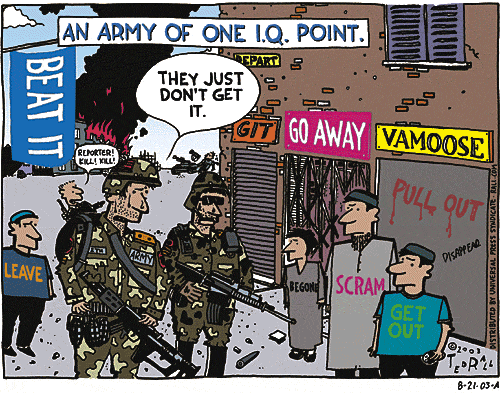
Ted Rall
Not only does the new world order keep its own subjects from the real news, but it keeps those who would report it from reaching an audience anywhere. Two days ago we murdered a journalist in Baghdad. It wasn’t the first time.
Bloggy has lots more.
angels waiting for the dark spirit
I guess it’s probably a very good thing when activists are also very beautiful.
For the story of these two very young International Solidarity Movement volunteers chained to a Palestinian house in the dark, see this site, sections in the post below and in this post, and reports across the world web.
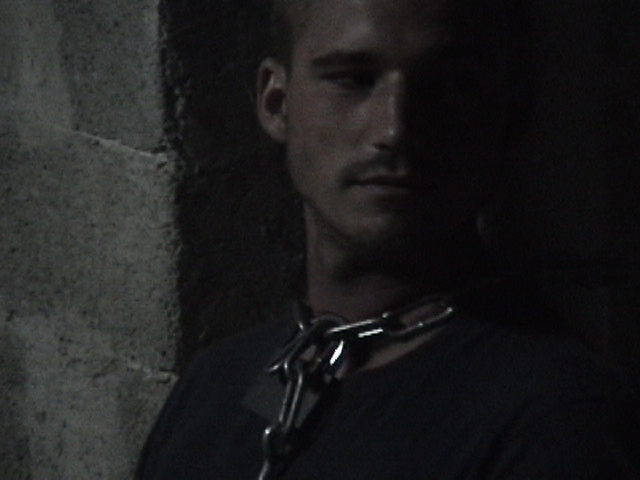
Andreas Koninek
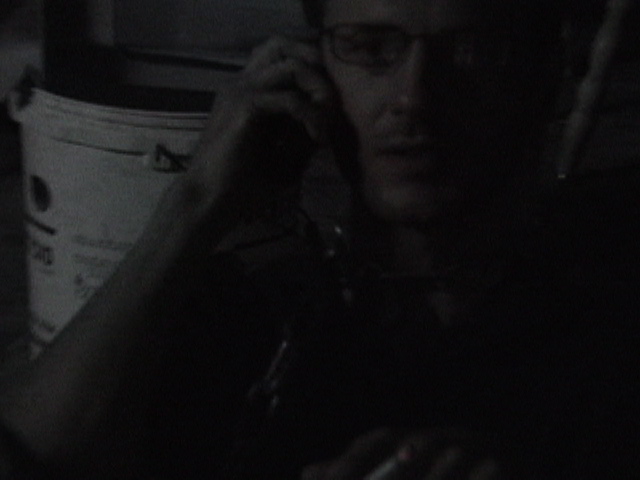
Andrew Muncie