the “Room Tones” of the Convent of St. Cecilia

Nathan_Dilworth.jpg
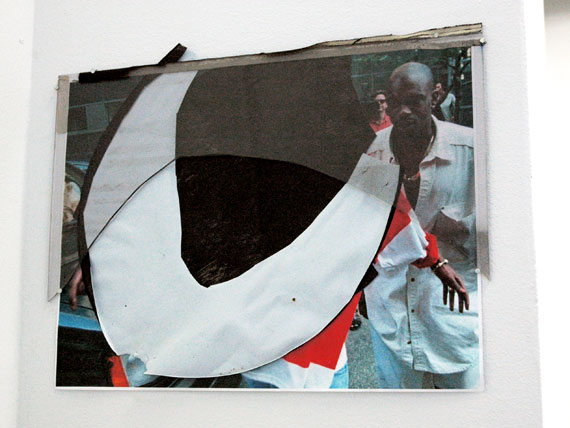
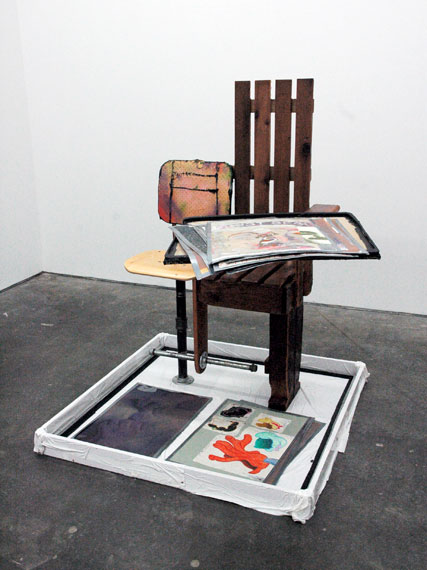
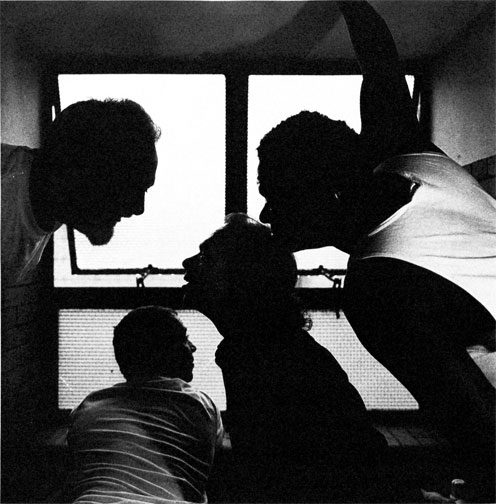
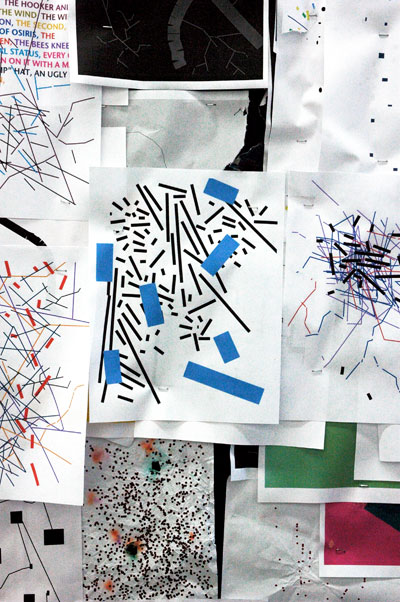
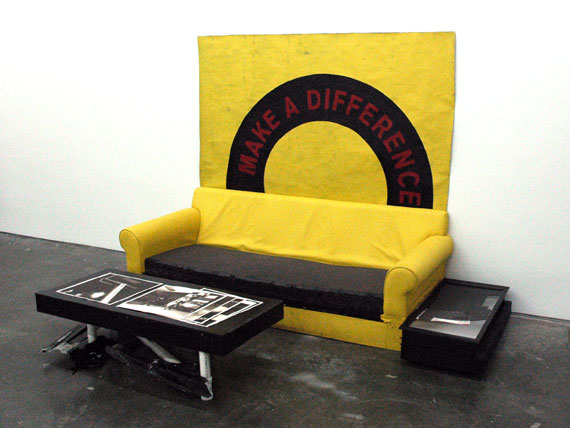
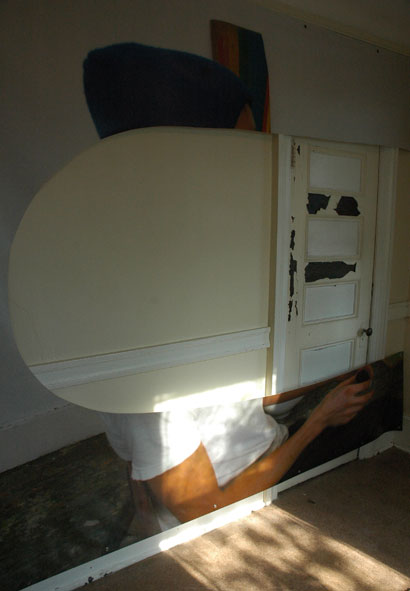
Nathan Dilworth‘s monster-size cut-out photo prints address the architecture
Molly_Lowe_K-mart_shopping.jpg
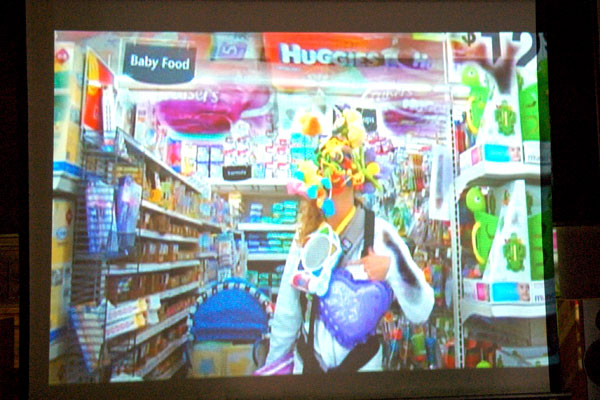
Molly Lowe‘s video of compulsive consumption, “K-mart shopping”, is in the former chapel
Julio_Cesar_Gonzalez_wired_light.jpg
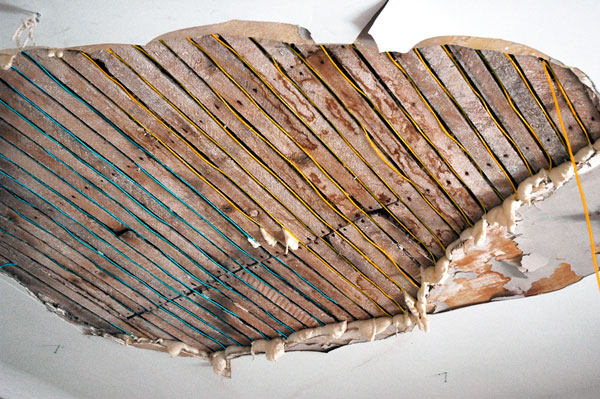
Julio Cesar Gonzalez‘s thin cables of light are strung between ceiling laths
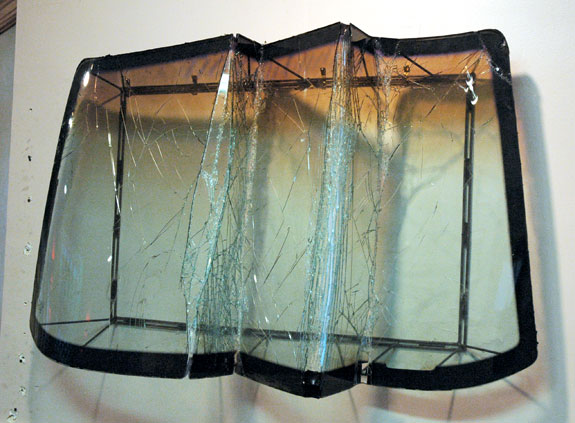
Aaron_Frank.jpg
Aaron Frank sculpts found windshield glass into fluid forms
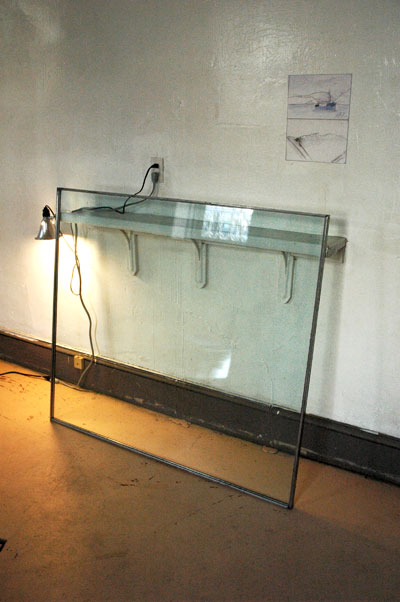
Brian_Kain_St_Cecilia.jpg
Brian Kain‘s room installation includes an abstract video on a vintage TV (seen in reflection)

There’s no need to go to the islands this weekend for some fresh air, as Barry and I learned on a sunny afternoon last weekend. We arrived in the big-sky country of middling-far Greenpoint when we emerged from the Graham Ave. station of the L line and we found fresh art after we made our way to “Room Tones” installed inside the four floors of the now-emptied rooms which once described Saint Cecilia Convent.
The participating artists are Rebecca Adams, Paolo Arao, Jason Bartell, Nathan Dilworth, Brock Enright, Aaron Frank, Chris Georges, Julio Cesar Gonzalez, Colt Hausman, Adam Henry, Colin Hunt, Brian Kain, William Latta, Qing Liu, Molly Lowe, Owen McAuley, Susan Sabiston, William Sabiston, Mike Schreiber, Emily Mae Smith, Nathan Spondike, Ryan Sullivan, Kristina Williamson, Leah Wolff and Katherine Wolkoff.
The website describes the environment of the temporary space which hosts the show:

An exhibition reflective of our contemporary atmosphere, Room Tones is also a return to an early and influential site of western art. The Catholic convent of St. Cecilia in Greenpoint was once a robust institution, home to a steady then slowly decreasing number of nuns until it was closed and vacated in 2008. Like many empty storefronts throughout New York City, the situation of this particular convent is a barometer of the complex social and economic changes taking place in Greenpoint and its neighboring L train enclaves. Spiritual views and orientations aside, Father Krische, pastor of St. Cecilia, has generously worked with organizer Nathan Spondike and his team making Room Tones an event that will reinvigorate this unique 97-year-old building into a testament of the new thoughts and ideas emerging from artists around it.

I just found out the show has been extended through Thursday, Friday and Saturday of next week (and can also be seen by appointment), so if your feet are already buried in the sand miles away from the City you’ll still have a chance to tune in to this fresh, scrappy show in one of the neatest neighborhoods of Brooklyn.
Check the site for days and exact times.

NOTE: The convent continues to function on at least one level: We noted the presence of a neighborhood “emergency food pantry” inside, and now I learn here that “Gifts of Love” had recently been opened by volunteers from St. Cecilia’s parish “as a means of offering a few days sustenance to those who are unable to stretch their funds”.

I almost forgot to upload one more image. It was taken from within a room formerly occupied by one of the nuns. It may be a part of the work installed inside there now, or it may just be a casually-placed window prop.
UPDATE: I’ve learned that the image is of “7 of hearts”, a part of a much larger installation by Kristina Williamson.
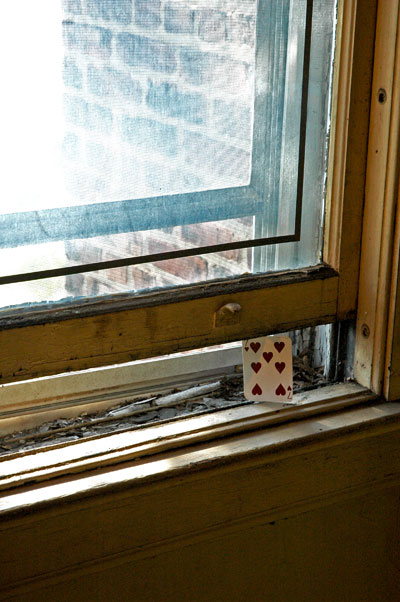
St_Cecelia_cell_window.jpg
Christina Williamson‘s installation included these seven hearts
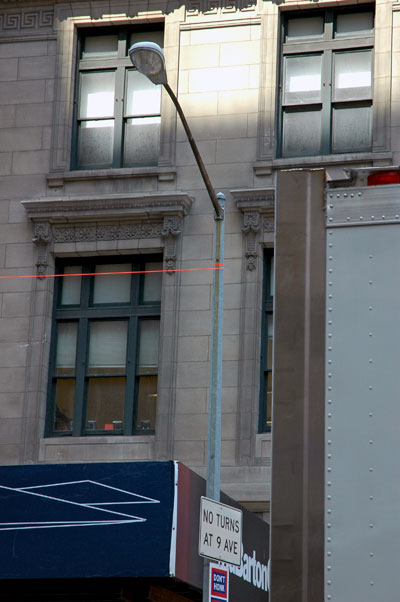
high above 23rd Street, a tape intervention (no eruv)

tape_across_23_street.jpg

tape_across_23_street_2.jpg

This time it wasn’t an eruv, for the line enclosed nothing and went nowhere – nowhere, that is, but diagonally across 23rd Street. It started high up the lamppost in front of the Gotham Comedy Club and ended, at that same height, on the one standing outside the Muhlenberg Branch Library. There was a slight downward bow all along the way, but even the tallest trucks managed to avoid it while I was there.
It was only an inch or so wide, but it was a very bright day-glow orange-pink color. I spotted it as soon as I started to cross the street a couple hundred feet west. At first I thought some fool had stung an electrical cord across the street, and then I noticed it was just tape.
I still don’t know who did it (or how). I see a part of Sam Bassett‘s work on the sidewalk shed across the street in the first photo above and there may be some correspondence in the lines of the work he designates on his site as sculpture and the single line of tape linking the two sides of the street, but I’ve not usually excited by the former and I’m much taken by the latter. I think it’s pretty cool, for its extraordinary minimalism, although it occupies and addresses a very large public space. It’s also (almost) intrusive and (almost) invisible at the same time. Is it a nod or a bow to community?
While I was looking into the identity of the artist, Vartanian wrote back that for him part of the appeal of the image I showed him is that it is “location conscious”.

sorta loving it, next to the Union Square Greenmarket

monk_coupling_with_rabbit.jpg
Elbow-Toe Divine Hammer 2009

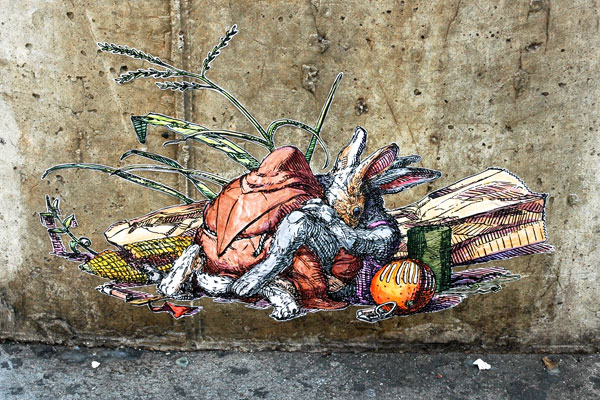
I spotted this curious image on my way to the Union Square Greenmarket this afternoon. It appears to be a monkish hare coupling with another (boy?) hare in the middle of some scattered groceries. It’s about two feet wide and the medium is that of a tinted b&w sticker attached to the concrete base of a lamp pole at the northwest corner of the square. I know I should recognize the indecorous artist, but I don’t.

UPDATE: Hrag Vartanian infoms me the artist is Elbow-Toe, and that the Wooster Collective has a post about the piece here, indicating that its inspiration is Rembrandt’s “The Monk in the Cornfield” (with farmer or milkmaid?)
An image of another, more sylvan, installation, this one in Brooklyn, appears on myloveforyou.

Klaus von Nichtssagend: The Musical

Klaus_von_Nichtssagend_Musical.jpg
“SOLD” OUT

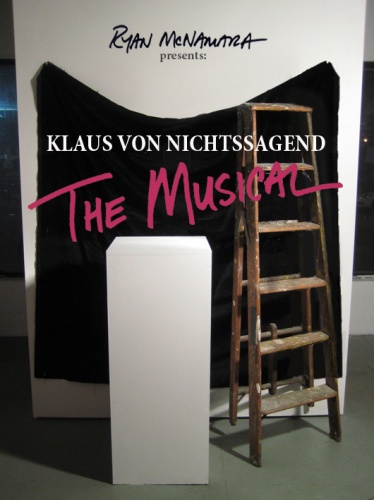
Klaus von Nichtssagend is putting on a show tonight, three in fact. Actually the show is being mounted by Ryan McNamara and “his accomplished troupe of actors, singers and dancers”, in the gallery’s description. They will be describing the story behind the legendary Klaus von Nichtssagend, answering the questions, “Why did he open this space? And why are we all singing?”, in “Klaus von Nichtssagend: The Musical“.
But all three performances, at 7, 8 and 9 tonight in Williamsburg, are already sold out (actually, they are free), so unless you’ve already reserved, you’re out of luck. For fans of the growing phenomenon of arts performance, Jacques Vidal and Noel Anderson offer an alternative in Chelsea. Unfortunately it’s going to be impossible to make both.
We’re definitely in the midst of a period of transition in the visual arts, and it’s only partly related to the economy going belly up. Plenty of institutions have survived, and there probably aren’t a lot more people creating things this year than the last, but artists aren’t waiting for galleries, museums or curators to find them and let them in.
They are creating art which is not just composed of objects – or even mere concepts. I don’t know what to call it but it’s not just “performance art”, because while it owes much to the breakthrough phenomenon associated with the 1960s, it often goes much further. It’s definitely not minimal; it loves props; it’s virtually a given that recycling of some kind is involved; it will go almost anywhere to put on a show; it sometimes involves large numbers of people who may not be aware of their participation; it doesn’t mind leaving behind some objects which, yes, can treated as commodities (product); and it almost always incorporates real humor, even riotous fun. This time around the younger artists are also a much larger genuine community, and they have killer communication tools.
Most lovely for all of us, as in the 60s, this art is free – in every respect.
I love it. I love the energy, the intelligence, the courage, and the infectious wit. I love the community. We may only be passing through a cultural corridor; what will follow is unimaginable to us today, but in the meantime we have these shows – and their enigmatic constructions and relics, the remnants, (and their documentation on gazillions of tiny cameras) to guide us.

[image from Klaus]

Kate Levant’s “Blood Drive” at Zach Feuer

Michael_e_Smith_and-_television_screen.jpg
Michael E. Smith Untitled 2009 digital print on paper with latex and television screen 8.75″ x 11.5″ [installation view]

Jacques_Vidal_Forced_Friendship_Kate.jpg
Jacques Vidal FORCED FRIENDSHIP, WITH COLLABORATIVE BASE WITH KATE 2009 wood, plastic, pipe, black caulking 61″ x 53″ x 50″ [installation view]

Elaine_Stocki_Nelson.jpg
Elaine Stocki Nelson platinum print 22″ x 22″

Brian_Faucette_Blood_Drive_Flyers.jpg
Brian Faucette Blood Drive Flyers inkjet print on paper 11″ x 8.5″ each [detail of installation]

Kate_Levant_Waiting_Area.jpg
Kate Levant Waiting Area 2009 mixed media, dimensions variable [installation view]

CORRECTION: The blood collection is today (Wednesday) and Thursday, not Thursday and Friday. The show comes down at the end of the day on Friday.

Kate Levant appears to have pulled off a pretty amazing stunt at Zach Feuer with her exhibition, and performance, “Blood Drive“, what the artist describes as the product of “an open platform invitation towards a commission to produce promotional material for a blood donation drive.”
Not your usual late summer art show.
The visuals have already been assembled in the gallery for some time, but the art all comes together over the next three days, beginning with a performance tomorrow night at eight by Jacques Vidal and Noel Anderson, “a glue that will stick anything together forever”. A real-time community blood drive will follow from 1:30 until 7 on both Wednesday and Thursday, with the show wrapping at the end of the day on Friday, September 4. You can sign up by emailing the gallery at info@zachfeuer.com. I have no idea how it’s going to go off, but this last act will be as interactive as the crowd wants it to be, and I trust these artists to make it more than interesting.
The artists “commissioned” for the installation itself are Noel Anderson, BOBO, Brian Faucette, Michael E. Smith, Elaine Stocki and Jacques Vidal.
Levant already has an auspicious triumph, but this is hardly a surprise to anyone who has had the privilege of encountering her before.
We first met Levant in October, 2006, when she arrived to help Vidal install his large light box, “The Holy Art Project“, while we were installing the show we curated at Dam, Stuhltrager, “Dangling Between The Real Thing And The Sign In The Window“. Just two months later we were delighted to learn that her art was as impressive as her ability to pitch in for a friend and charm the pants off two strangers. We saw her work in a wonderful installation, “Attic“, inside Anton Kern’s 21st street annex for a couple of weeks in the middle of December. That show, which was curated by Erin Somerville, also included work by Smith, who is represented in “Blood Drive”. Barry put together a small slide show of images from “Attic” on Bloggy.

There are more images of this show on 16 miles of string, and documention of other work by Levant and Smith at Detroit Arts and tryharder.

Jason Eisner on 24th Street, and around town

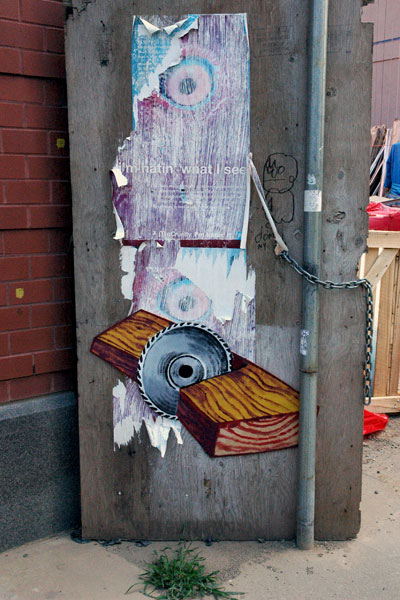
Jason_Eisner_cutting_wood.jpg
Jason Eisner installation
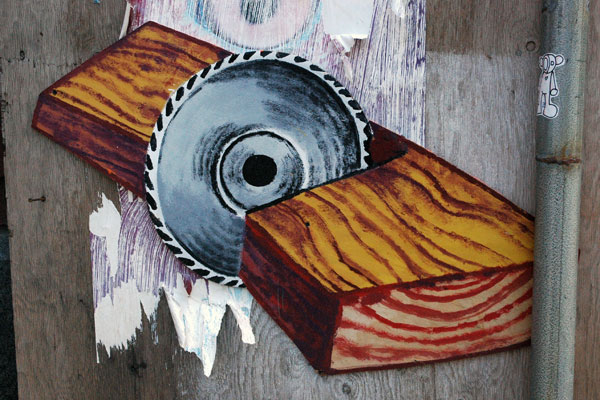
Jason_Eisner_cutting_wood_closeup.jpg
closeup

Barry spotted it first: We had just left “Blood Drive” the excellent installation curated by Kate Levant at Zach Feuer (more on that in my next post) when we saw this plywood piece attached to a plywood section of a construction fence outside of what is arguably Chelsea’s baddest monument to pure excess, 200 Eleventh Avenue condo project, which includes “En-Suite Sky Garages“*.
I was embarrassed that I couldn’t identify the artist and had to ask for help from an authority. Our friend Hrag came through with the answer: It’s Jason Eisner. Eisner collaborated with Jason Balicki in the exciting installation, “Back & Forth”, at English Kills earlier this summer, and the two of them (as “J & J”) are a part of the group show at P.P.O.W. which closes today.
And there’s still more, much more, of Eisner on Flickr.

Oops. Looking for the links I’m using in this post I just discovered the identity of the artists who created the bench in Ascenzi Square. I don’t know why it took me so long, when the English Kills site makes it pretty clear: It was Jason Eisner & Jason Balicki.

*
Here there appears to be more than one message in the almost-painted-out posters underneath Eisner’s piece. They read, “i’m hatin’ what I see“, the text of PETA’s anti-McDonald’s campaign against McDonald’s chicken-slaughtering practices (which play on the corporation’s familiar “i’m lovin’ it”).

Scott Reeder at Daniel Reich

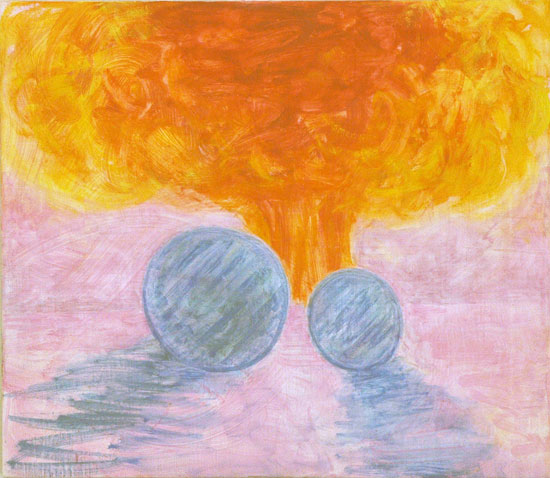
Scott_Reeder_Nickel_and_Dime.jpg
Scott Reeder Nickel & Dime (End of the Road) 2009 oil on linen 26″ x 30″

This is another excellent show closing this week, although in this case there are two days left. Scott Reeder’s “Painter, now at Daniel Reich, is scheduled to remain up through Saturday.
It’s worth a trip. If there are any doubts, a skim through the press release might dispel at least some of them, especially for those not already familiar with Reeder’s work:

Reeder’s virtuoso mixture of functional humor, painterly skeins and readily encyclopedic vocabulary gleans from art history to articulate something resolute and wonderfully “out-of-style” in this exhibition.

Or not:

Reeder conveys real fear and the anxiety of somehow failing the airport baggage check. Reeder’s bread and butter paintings pertain to need, an instinct further emphasized by the nourishing materiality of his brushwork.

In any event, once the work has been seen this extravagant prose may seem to have been both a draw and a suitable complement to Reeder’s (illusion?) of rough simplicity, or just plain irrelevant to the enjoyment of some very good pictures.
You don’t have to be a history nut, although you’ll have even more fun if you are.

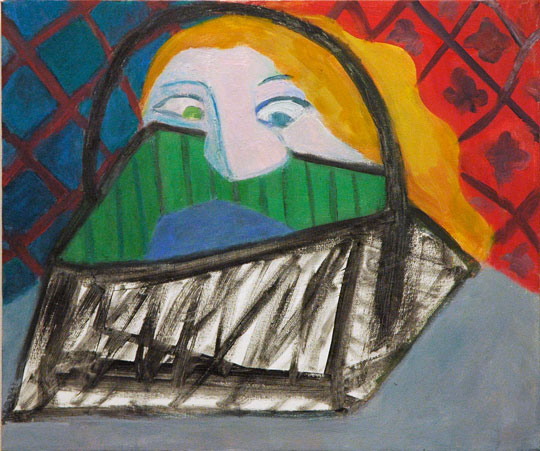
Scott_Reeder_Cubist_Cokehead_Woman_with_Purse.jpg
Scott Reeder Cubist Cokehead (Woman with Purse) 2009 oil on canvas 24″ x 20″


Scott_Reeder_Cops_Ascending_Staircase.jpg
Scott Reeder Cops Ascending Staircase 2009 oil on canvas 50″ x 34″

“Young Curators, New Ideas II” at P.P.O.W.

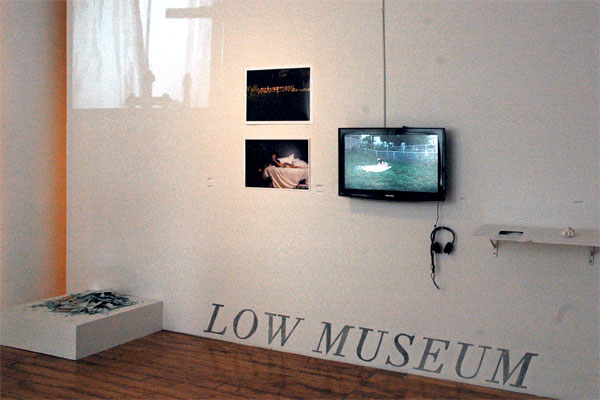
Low_Museum_Karen_Archey.jpg
“Low Museum”, curated by Karen Archey, including a work by Jason Lazarus and Archey’s collaborations with Daniel Chew and Tara White [installation view]

Young Curators, New Ideas II” is an exhibition featuring the creations of 21 artists, installed in seven parts or “rooms”, the parts corresponding to the work selected by seven young curators, or collaborating curators, and in one instance “work” by curators which one group of these curators collectively admire or respect. The curatorial responsibility for the entire concept was shared between amani olu projects and P.P.O.W. Gallery itself.
It sounds like the show’s about the art of curating, and it is, but don’t let the concepts get too much in the way of your enjoyment of some dynamite pieces.
The show closes tomorrow, Friday, at six.
The curators are Karen Archey, Cecilia Jurado, Megha Ralapati, Jose Ruiz, Nico Wheadon, Cleopatra’s (Bridget Donahue, Bridget Finn, Kate McNamara & Erin Somerville), and Women in Photography (Amy Elkins & Cara Phillips).
The artists, working alone or in collaboration, are Karen Archey, Daniel Chew, Jason Lazarus, Tara White, Tom Fruin, Norma Markley, Jaret Vadera, Alejandro Diaz, Las Hermanas Iglesias, J&J, Jessica Ann Peavy, Bryan Zanisnik, Taylor Baldwin, Boyd Holbrook, Dawit L. Petros, Segtram, Noelle Lorraine Williams, [selected working curators], Michele Abeles, Tierney Gearon, Els Vanden Meersch, and Victoria Sambunaris.

Medicare for all: it’s just, and it works

health.jpg

In a functioning community, “I’ve got mine” is not the beginning and the end of civic responsibility.
When did the discussion of promoting public health degenerate into a discussion about promoting the health of private insurance companies?
I’m hoping that we’re going to find out soon that there aren’t enough votes to pass a health-care bill either with or without the “pubic option”, and that Congress will then have the courage and good sense to produce the only solution which would serve people rather than corporations: Single payer. I know it sounds crazy, but it could actually happen, and the insane mechanisms being tossed around right now really are crazy.
Medicare for all: It’s the only rational and ethical solution, both for delivering health care and for controlling its costs. It’s our selfishness which has always been behind our horror of “socialism” (and from our beginnings as a people, our distrust of any government). It’s time to just get over it. Were it not for those fears, fanned on the subject of health care by the insurance corporations which have owned the discussion for longer than anyone alive today can remember, we’d have already been living with its benefits and its savings for half a century, perhaps longer.

ADDENDUM: Obama doesn’t seem to be a part of the process these days, and perhaps he never was, but for what it’s worth, the man we now address as Mr. President once favored a single-payer system. In his post on creators.com, “Health Care’s Enigma-In-Chief“, David Sirota reminds us of a speech Obama delivered at the AFL-CIO Civil, Human and Women’s Rights Conference in 2003:

[He] declared himself “a proponent of a single-payer universal health care program” — i.e., one eliminating private insurers and their overhead costs by having government finance health care. Obama’s position was as controversial then as today — which is to say, controversial among political elites, but not among the general public. ABC’s 2003 poll showed almost two thirds of Americans desiring a single-payer system “run by the government and financed by taxpayers,” just like CBS’s 2009 poll shows roughly the same percentage today.
In that speech six years ago, Obama said the only reason single-payer proponents should tolerate delay is “because first we have to take back the White House, we have to take back the Senate, and we have to take back the House.”

[image from education-portal]

the Guggenheim, Frank Lloyd Wright, and the rest of us

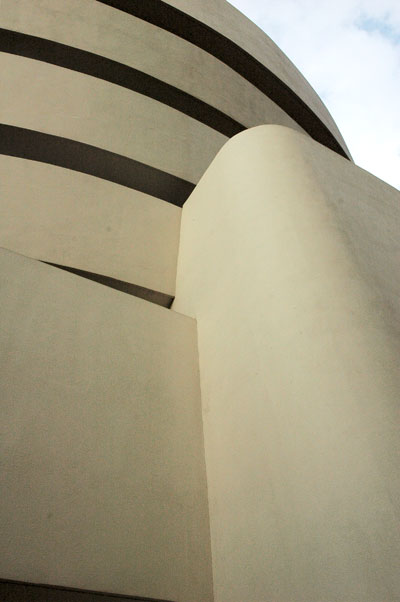
Guggenheim_outside_sw_corner.jpg
color: it only looked really white in bright sun; when we left at 6 it actually was more of an eggshell

Barry and I almost missed another show which we had decided long before was a must-see. But yesterday we headed for the Guggenheim, where the newly-restored museum’s fascinating exhibit, “Frank Lloyd Wright: From Within Outward“, closes tomorrow, Sunday.
The show is part of the Guggenheim’s celebration of the 50th anniversary of its landmark Frank Lloyd Wright-designed building, whose exterior renovation was completed last year.
I’ve been a fan of Wright’s almost from the moment Hilla Rebay and Solomon Guggenheim first approached the great man to design a permanent home for the Museum in 1943. I’m pretty familiar with his work, and not blind to his inadequacies (or those of the Guggenheim: “The Art of the Motorcycle“?), but I was often surprised by what I learned from the materials assembled for the show, and my criticisms of certain of Wright’s obsessions have been somewhat blunted after my progress down the Guggenheim’s ramp. Yes, we took the elevator up and walked down the ramp, which is how I always experience this museum (and what I understand Wright himself thought was the proper approach), even though we soon realized this exhibit is clearly arranged, chronologically, to suggest a progress up from the bottom.
I go back and forth on which of Wright’s work excites me more, the private houses or the public designs. Although it actually doesn’t really matter, even to me, this handsome retrospective didn’t resolve my ambivalence. Until we got down to the second-level annex we saw not one house design. While I was very much aware of this, and mentioned it to Barry, for almost two hours I was pretty much lost inside the grand schemes of his larger projects (which I was happy to be reminded had actually included apartment houses). Then we were suddenly looking again at the brilliance – and the variety – of his plans, over seven decades, for single-family dwellings – some specifically designed for pretty modest budgets.
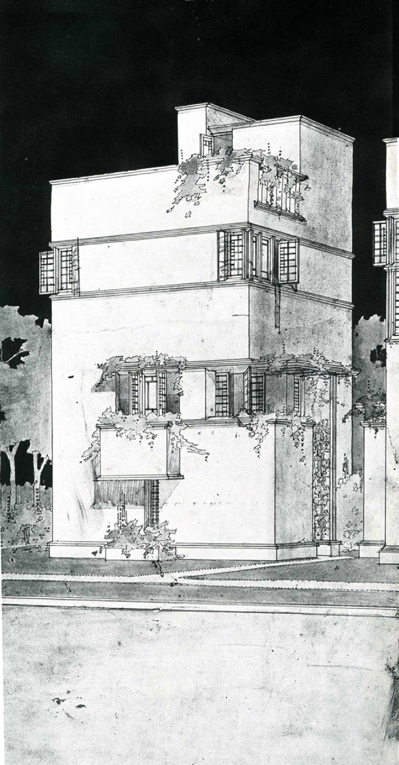
My favorite new discovery within this part of the exhibition was the beautiful small unattached house which was a part of the architect’s “American Ready-Cut Houses” project. It was represented by a pencil drawing on a single sheet of paper of an elevation and plans for two floors of what Wright described as “small town house – plastered 1912-1913”. There seemed to be another (half?) floor below the first, which had a sun room and a small balcony, and a roof terrace above the second, bedroom floor. Lovely.
Thinking now about Wright’s sketched plan for the first floor, which included furniture outlines, I’m reminded of how here and in most of his other living room plans, even though there’s an eating area off of the kitchen, a handsome collection of table and chairs dominates the floor area of the room, unless the client can afford a particularly large living space. Our own apartment has a conventional living room arrangement, and we’re lucky to have a dining gallery as well, but I think that I would be quite content with entertaining people sitting around a dining-height table. There food, drink and anything else which could be spread out might be shared along with the conversation. I could pretty much do without a lounge area altogether. It’s very much how we live now, whether we have guests or not.

Wright_small_town_house.jpg
elegantly sufficient, sufficiently elegant still today

The visit would have been worth the trek uptown on a sweltering day, the long line, and the cost of the tickets, just for the look into a few of Wright’s more iconic designs alone. For me the most amazing, and melancholy, almost-discovery was his huge body of work devoted in 1957 to “The Plan for Greater Baghdad“, intended for an undeveloped island in the middle of the Tigris and of the city, sadly, unbuilt of course.
Although there are plenty of other candidates for an appreciation of his genius, I’m thinking especially of the 1913-1922 Imperial Hotel, and of course The Illinois of 1959 (unbuilt), Wright’s magnificent, plant-like, utopian (he would probably eschew “visionary“, since he believed it was totally practical) skypenetrator which has captivated me for half a century:

FL_Wright_The_ Illinois.jpg
I swear I saw gold leaf near the very top, probably intended to show the sun blessing the hero’s tower

Did I mention the line? We were both aghast at the appearance of the ground floor lobby when we first walked into the museum. It was Friday, a weekday, and the time was 2:45:

Guggenheim_crowd.jpg
at least there’s no door person at the end, ready with a thumbs down if your look’s not up to snuff

These people are slowly advancing between row after row of ropes in order to get to the desk to pay for admission ($18, students and seniors $15, or order on line for a little more). It took us a full half hour to get to the head of the line, although this being New York there was good humor and a certain amount of eye candy for entertainment while we shuffled back and forth.

[image of “The Illinois” from the website of Rich Hilliard; that of “a small town house” from savewright.org]