
Usually there’s a tree of some kind in the middle of these things, but then the grasses don’t grow so luxuriantly as they have in this little curb garden, seen on Waverly Place this afternoon.
Yes, the usual neat iron wicket is still there under the green. It gives the installation a little definition.
Category: NYC
forget about “design” here – just enjoy it

[spotted in Astoria last evening, squeezed between a Cosco and Socrates Sculpture Park]
good design can still surprise

is it a “make-do”?
I spotted this wall sconce in a stairwell at PS1 this afternoon, and I thought it was an rigged one-off. Then I found another, virtually identical to this one. What does it mean? They looked like they had been improvised from electrical boxes, round flourescent tubes and circular, drill-punched and white-painted metal grills snatched from some abandoned machinery.
There wasn’t a curatorial label in sight.
Excellent lighting solutions for a museum fashioned out of an old school which has barely been renovated, these pieces represent almost perfect design.
good design is forever
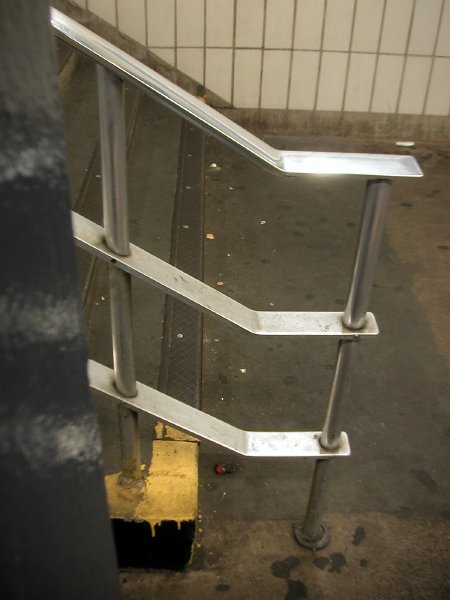
still looking good
I’m thinking it’s a design from the 1950’s, but someone out there probably knows for sure. In any event, my point is to show how beautiful it is. Look at the stuff the MTA has installed in our stations ever since and you’ll begin to appreciate what we were once able to do with public money.
I took this picture of a common subway stairs railing the other day while waiting for a train. Something about the light and the many straight lines attracted my interest at the time, but when I saw the image at home I decided there wasn’t really any thing in it.
Today, while I was looking for another picture I came across it again and this time I thought a bit more about the design of the metal. It’s beautiful, it’s clean, and it’s very functional. I was going to write: “Don’t look at the mess surrounding the stainless steel (aluminum?); just admire the design of the thing.” But part of the success of this bit of subway furniture is its ability to survive in a pretty tough environment.
And give us some joy while doing so.
so, what was the difference this time?
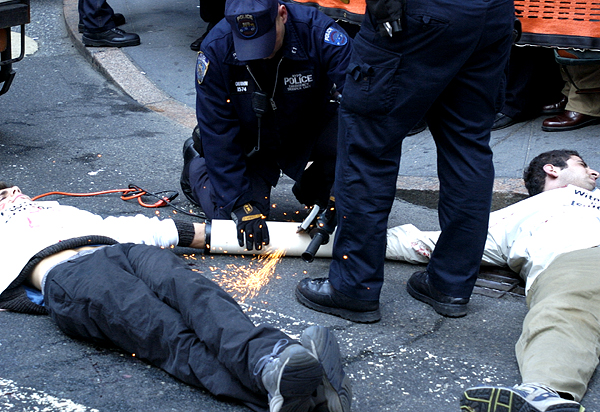
the signs on Fifth Avenue read “Witness To Israeli War Crimes,” and that seems to have stuck in more than one important craw
Steve Quester and his remaining four co-defendents in the trial of the M26 arrestees were sentenced in New York Criminal Court this morning. It’s been more than two years since their involvement in a non-violent demonstration where they joined with others in blocking Fifth Avenue, protesting the Israeli occupation of Palestinian territories and the invasion of Iraq.
The four are free today. Well, sort of free.
They were arrested on March 26, 2003 and later that year all 16 were convicted in Manhattan Criminal Court of disorderly conduct and obstructing governmental administration [interfering with vehicle traffic]. Twelve of the activists were sentenced to community service, a common punishment for a demonstration of this sort, and two of those twelve were given fines in addition to the sentence of community service. The Manhattan District Attorney unsealed prior dismissed and sealed arrest records as a basis for subjecting the four remaining protestors to up to one year in jail, but on July 6 the New York Court of Appeals ordered the protestors’ prior dismissed cases to be resealed.
Steve Quester reports that the four were sentenced this morning to 10 days each of community service. He himself was also sentenced to pay a $500 fine in addition to his service. There was no jail sentence, despite the District Attorney’s best efforts.
Each of the four was also sentenced to a year of conditional discharge. If any of them is arrested before August 1, 2006, she or he will go to jail on the M26 conviction. As Steve writes, this is still “a scary prospect, considering that in New York City one can get hauled in by the police for walking down the sidewalk or riding one’s bicycle.”
Steve continues, in an email sent this evening:
Our pre-sentencing statements will be going up on
www.m26.org soon, and I’ve copied mine, below. My
interview on www.actuporalhistory.org will go back up
when the webmasters return from vacation. Kate’s is
up.
Judge Stolz commented on my ACT UP Oral History
Project interview, from which he concluded that I’m a
“narcissistic, self-absorbed exhibitionist”. For the
record, I’m immensely proud of my years in ACT UP, and
am filled with admiration for people, like my
co-defendants Staci and Kate, who remain active in the
organization.
Stolz also commented strongly and negatively on my
argument that the district attorney was motivated by
political animus towards our solidarity with
Palestinian people rather than the pursuit of justice.
I think the facts of the case speak for themselves.
Occupation is a crime, from Iraq to Palestine.
ACT UP, fight back, fight AIDS.
Peace,
Steve Quester
I’ve copied Steve’s entire pre-sentencing statement below, because it answers the question posed in this post’s headline better than anything I could come up with – and because both his activism in New York and the directness of his statement are very much a piece with his volunteer work in the Middle East and his reports from Israel and Palestine published on this blog in the past.
The Manhattan District Attorney has turned from the
illegal�unsealing dismissed cases�to the merely
unethical�quoting an oral history project�in his
ongoing attempt to have us jailed. As a Rutgers
sociologist wrote this past Friday when she heard of
the D.A.’s new sentencing letter: “Any social
scientist who has done oral history would be
astonished by this invasive abuse of oral history by
the courts. When we do research on human subjects, we
are generally obliged, by the rules of U.S. Office of
Human Research Protection, to specify that none of our
respondents would be harmed by the research.”
So what’s going on here? Assistant District
Attorneys Glasser and Sullivan would have us believe
that Kate Barnhart and I are harmful to society, and
that only a jail sentence will get the message across
that we have to respect the law. But on March 22,
2004, Messrs. Glasser and Sullivan asked Judge Stolz
to jail all sixteen of us, even though most had no
record of any kind. This after a trial that never
should have happened; all sixteen of us offered for
months before the trial to plead to a lesser charge,
an offer the D.A. rejected in every one of the sixteen
cases. From what we have heard from other criminal
defense attorneys, it is nearly unprecedented that the
Manhattan D.A.’s office would take a case to trial
that concerned allegations of non-violent civil
disobedience, with no allegations of property damage.
So why this time?
The D.A. has always maintained that we were treated
differently because we were locked down. But
demonstrators using lock boxes in New York City are so
common that a police officer testified at our trial
about the training he received at the academy on how
to remove them. No locked-down demonstrators before
or since our action have been refused a plea agreement
and dragged through a trial, much less been subjected
to an illegal and unethical campaign to have them
jailed. What’s different this time?
When Mr. Morgenthau was inundated with letters and
calls from elected officials, angry at the March 22
2004 jail recommendation, his staff responded with the
infamous April 9 2004 sentencing letter, in which jail
was recommended for every defendant for whom they
could dredge up any excuse, however weak. One
defendant should be jailed, they told the judge,
because back in college in New Jersey he had been
busted for pot. They neglected to mention that his
conviction had since been expunged. Another should be
jailed because she was once arrested in Washington,
D.C. They neglected to mention that the arrest had
been nullified, without prosecution, when it came to
light that the police had simply swept up a crowd in a
park, regardless of individual actions. To the credit
of this court, the D.A.’s ridiculous justifications
were ignored when sentencing those particular
defendants in May of 2004.
On July 6 of this year, the system worked. New
York’s Court of Appeals resealed the records of the
remaining four of us, clearly establishing Mr.
Morgenthau’s illegal conduct. Undaunted, Messrs.
Glasser and Sullivan waited until the last business
day before our sentencing to present material from the
Internet they’d been sitting on since sometime before
March, oral histories that establish that Ms. Barnhart
and I are longtime activists. As if that were a
crime.
So what’s behind this extraordinary sequence of
events? It’s not the lockboxes. It’s not the traffic
jam. It’s not our activist histories. The same
factors have been present in dozens, if not hundreds,
of similar cases in Manhattan, but have never elicited
similar behavior on the part of the D.A., before or
since. The unique factor in this case is the
political message of our demonstration. Ten days
after the murder of American Rachel Corrie by an
Israeli soldier in the occupied Gaza Strip, images of
our action were beamed all over the world by CNN.
Business at the branch of Bank Leumi at the corner
where the demonstration occurred was disrupted that
day. Opponents of the war on Iraq often engage in
civil disobedience in New York City; Palestine
activists rarely do. The events of March 26 2003 gave
Mr. Morgenthau an opportunity to send a message:
Criticize Israel in New York City, and we will throw
the book at you.
Your honor, I’m not asking you to ignore the verdict,
or your own concerns about the events of March 26
2003. I am asking you to consider our motives, which
were to draw attention to a human rights disaster, in
the context of our lives of service for the public
good. I heard, loud and clear, what you said on May
12 2004 about ambulances. I risked my life riding in
a Palestinian Red Crescent Society ambulance in
Bethlehem in 2002 so that the EMTs would not get shot
by Israeli soldiers. I’ve been a healthcare activist
for a decade and a half. I’ve advocated for better
Medicaid coverage, for the inclusion of women and
people of color in clinical trials, for expedited
review of promising AIDS treatments. I’ve sat at the
bedside of many dying friends.
I have a keen sense of the need to support New York
City’s emergency services. In the months following
the September 11 attacks, I did what I could to
support our devastated fire department. When
firefighters said that they were having trouble
getting enough people to the hundreds of firefighter
funerals, I began attending and bringing friends to
the funerals not just of the firefighter I knew, Peter
Vega, but of firefighters I’d never met.
The idea that we didn’t consider the effect of our
actions on emergency services is mistaken. Had an
emergency vehicle needed to get through that day, we
would have seen to it that they did. Nothing in our
past, or in the many letters about us you’ve received,
would indicate otherwise. In fact, we posted
observers on the scene specifically to alert us of any
emergencies.
I am asking you as well to consider the district
attorney’s motives, which seem to be based in a desire
to suppress advocacy on behalf on Palestinians, rather
than to see justice done.
[image by Fred Askew from the M26 site]
a greeting for developers?

spotted yesterday on North 3rd Street in Williamsburg
miniature Manhattan wildlife

Eastern Fence Lizard, Northern fence subspecies
I think it was one of his relatives.
I don’t know when a modest garden of pots on a low Manhattan roof qualifies as a natural wilderness, but I’m thinking that ours must be getting pretty close. We’ve watched birds of all kinds visiting the scene for water, berries, grubs or house-building materials, and one parakeet decided to come in out of the cold and stay. I’ve also collected and resettled a few snails in the last couple of years, but today I spotted a tiny lizard on the wall above the pots. Its body couldn’t have been more than an inch long, excluding its tail, and because of its size and line-markings I thought at first that it was some kind of centipede or water bug. I just don’t think of lizards as being big on New York real estate.
I didn’t get a picture while I stood out there with my hose. I guess I couldn’t quite believe what I saw, or maybe I couldn’t imagine it was an unusual sighting. I still don’t know if it was: Try Googling “New York City” and “lizards,” and you’ll see what I mean. Also, the critter was so small and well-camouflaged on the brown-grey stucco wall that I doubt it would have shown up at all even if I had my camera with me.
If he stays around I’ll try to do better next time, but I don’t want to frighten him away.
[image from eNature]
before Billy Joels, before potato barns, before the Shinecock,

untitled (rose scallops) 2005
. . . there were these communities.
I’m very fond of shellfish, and my taste in art and food, especially food preparation, includes a powerful strain of minimalism. I spotted this gorgeous cache of shellfish at the Union Square Greenmarket this afternoon. Our plans for the evening precluded my bringing any home today, but at least I was able to take away the memory, the pleasure and this captured image.
The suppliers of this happy bounty were the smiling people of Pura Vida Fisheries, from Hampton Bays, Long Island.
I’m going back next Friday.
what to do if stopped for a subway search
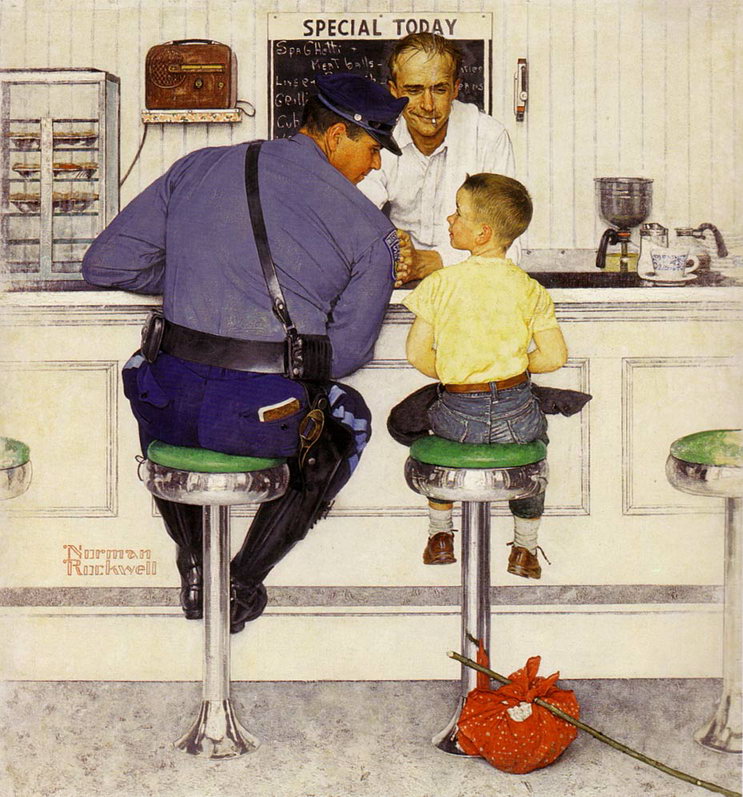
not so simple now, even for white guys, but maybe it never was
UPDATE: I received a very constructive comment on my last post, “bag the entrance searches, we need exits!“, from Matt of the “Flex your Rights Foundation,” and I thought it would be extremely useful as a post of its own.
Go here for The Citizen’s Guide to Refusing New York Subway Searches. The site includes an excellent introduction to its practical advice on how to “safely and intelligently ‘flex’ your rights”:
In response to the recent London terror attacks, New York police officers are now conducting random searches of bags and packages brought into the subway.
While Flex Your Rights takes no position on the usefulness of these searches for preventing future attacks, we have serious concerns that this unprecedented territorial expansion of police search powers is doing grave damage to people’s understanding of their Fourth Amendment protections against unreasonable searches and seizures.
In addition, as innocent citizens become increasingly accustomed to being searched by the police, politicians and police agencies are empowered to further expand the number of places where all are considered guilty until proven innocent.
Fortunately, this trend is neither inevitable nor irreversible. In fact, the high-profile public nature of these random subway searches provides freedom-loving citizens with easy and low-risk opportunities to “flex” their Fourth Amendment rights by refusing to be searched.
The site includes a handy guide-flyer which can be downloaded and printed for giving out to friends and strangers, dressing up a refrigerator or carrying in your . . . er, . . . bag.
[image of Norman Rockwell’s 1958 “The Runaway” from the artchive]

bag the entrance searches, we need exits!
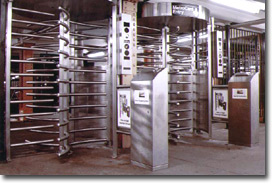
the wrong kind of crowd control
It’s a good thing it was Penn Station, because virtually none of New York’s Transit system stations could be evacuated for either a real or a false alarm.
Chief Kelly and Mayor Bloomberg’s new policy of passenger searches absolutely will not prevent a terrorist hit in our subway system. A real terrorist will just take another train or set off a weapon on the spot. But if something does happen tomorrow, any survivors of an initial attack are likely already doomed by today’s official negligence.
They’ll never get out.
Sometimes there are a few regular low-bar turnstiles at a station, but most of the time passengers have to exit through ceiling-to-floor turnstile cages which admit only one person at a time. In addition, even though there are often a number of exit stairways in each station, during many hours of the day (or permanently) all but one of them is locked, even those which can only be used as exits!
There’s no chance a number of cars and a platform could be emptied in anyone’s definition of a hurry. Up to 2000 people may be on a single train, and many more might be on the platform, waiting or leaving, at the same time. Most everyone will have to pass through cages one at a time. I sounds to me like this could easily take a half hour or more.
In addition, it won’t help any of us to survive if the system’s emergency lighting is still connected to the third rail, as it is now. When train power is cut for whatever reason there is no light anywhere in the tunnels.
Looking to the near future, the MTA is still proceding with plans to eliminate clerks in the stations, conductors in the cars, and even motormen at the stick. Where is the sanity?
Our politicians and public guardians hope to give us the impression that they are making us all safer with unconstitutional searches. Certainly they know the policy is wrong and useless, so why are they not addressing a very real danger but jumping at the chance to push this obviously bogus remedy? I think it’s because sending the police in to go through the bags of people of color is much less trouble, much less expensive, and, above all, much less like an embarrassing admission of continuing incompetence – that is, until something really does happen.
For a personal account of our own experience of MTA incompetence in a real incident, fortunately with neither serious injuries nor terrorism involved, see this post.
[image from the MTA]