more on Smolkatown

DaveNewfield.gif
for picking weeds

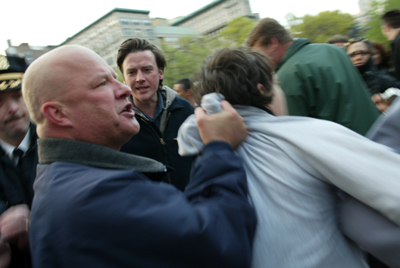
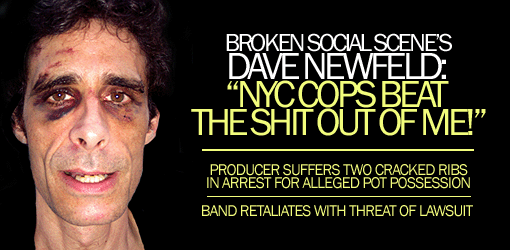
It probably won’t be news to anyone in the new music scene, but this account of vicious New York city police thuggery may be a surprise to many of my readers, even those who have seen my Chief Smolka posts; and even those who are familiar with the police camp that the Village’s Washington Square Park has become in recent years. Smolka is in charge of the street crimes unit which assaulted the Broken Social Scene‘s Dave Newfield in the park last Thursday.
The cop’s official title is “Commanding Officer Patrol Borough Manhattan Assistant Chief Bruce Smolka,” according to the NYPD site. I call him very dangerous.
Who will protect us from those who say they will protect us?
This is an excerpt from the pitchforkmedia report:

So, [his friend] exchanges $20 with a dealer in the park while Newfeld stands by watching the events unfold. As Newf tells it: “We walk around the corner, and all the sudden I’m tackled in a football style attack, like a mugger would do, you know? You grab the person and catch them by surprise and they ambush in a football tackle. And then they’re like, ‘Police, police, police! Fucking put your hands behind you!'” Due to the lax drug laws in Canada [his home], Newfeld says he didn’t connect what he assumed to be a mugging with his schwag score, assuming the “police” claim was a ploy by thugs to keep their victims passive for an easy stick-up.
“They started punching me in the face and beating the shit out of me and throwing me on the ground, so I’m trying to get away– not fight them back, because I’m not capable of that, but just to escape. And then they threatened to break my hand and I’m like, “No, don’t break my hand! I’m a musician. I gotta fuckin’ play tomorrow! And so I’m really freaking out, and at that point I thought, ‘Just take my wallet, whatever. Don’t break my hand. My wallet’s not worth it.'” By now, Newfeld’s pal was cuffed on the ground, and finally decided it was time to break the news: “They’re cops! Submit!” Oh, and P.S., whoops!
After being thrown in the back of a paddywagon, Newfeld was left to sit with a handful of shady characters while the 5-0 went around picking up other perps. He was then taken back to the station in pretty poor shape, strip-searched (whuh-oh), and, having been left in a cell for an hour or two, taken to Bellevue Hospital to have his beatings checked out. It turned out he’d suffered two cracked ribs. While in his hospital bed, he was given a report detailing the charges against him– four counts of assaulting an officer and possession– which still stand as of press time.

[image from pitchforkmedia; story tip from a reader, whose email subject line read, “where’s there’s smolka, there’s fire…”]
MTA: stadium treated as emergency, but security gets yawn

MTAseesomething_hi.jpg
leaving it up to the riders

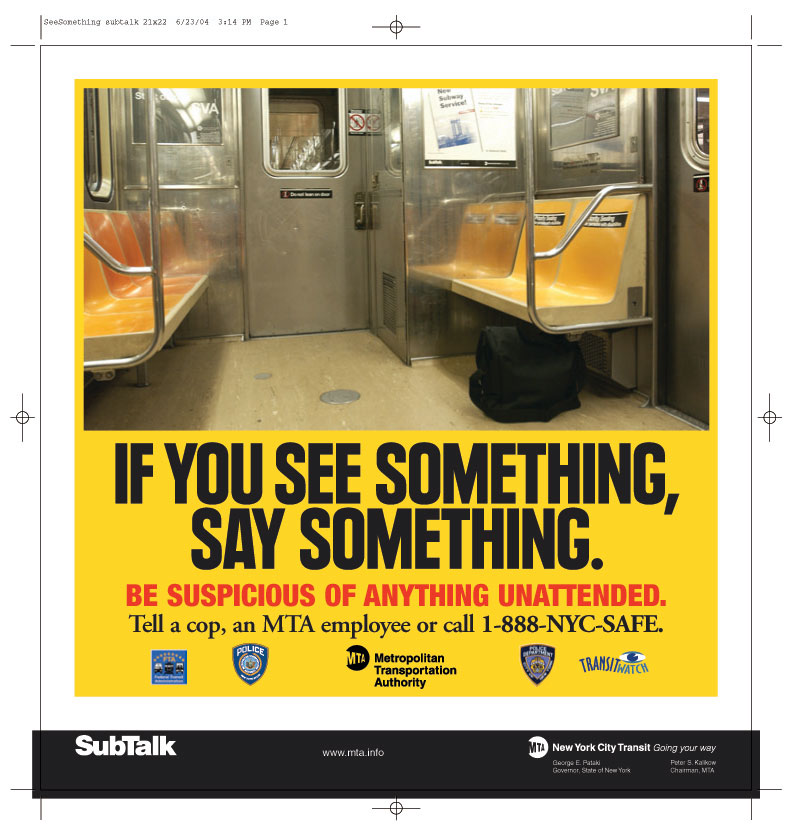
Barry has just about covered the issue, with the help of Newsday‘s estimable Ray Sanchez, but a letter to the editor published in the NYTimes helps to illustrate the scale of the criminal incompetence and negligence of those at the top by bringing up the most recent scandal involving the MTA:

To the Editor:
The terrorist blasts in London and a similar attack last year in Madrid dramatically point to the vulnerability of New York’s transit system to a similar attack.
Despite setting aside nearly $600 million [state and federal money] to secure the transit network against a terrorist strike, the Metropolitan Transportation Authority has accomplished little since 9/11. It was not until March 2003 that the agency announced a plan to address the transit system’s weaknesses.
In fact, the lion’s share of the money has not been allocated. The agency’s most public initiative is a failed proposal to ban photography by straphangers.
Its foot-dragging is especially unsettling when contrasted with the speed with which it rushed through a deal for the proposed West Side stadium. [the italics are mine]
Instead of issuing color-coded alerts, the federal government and the M.T.A. should urgently undertake measures with existing money to enhance security.
Manuel Cortazal
Bronx, July 7, 2005

Wish us all luck. It looks like we’re going to need it.

[image from the MTA]

meet Bubba

Bubba.jpg
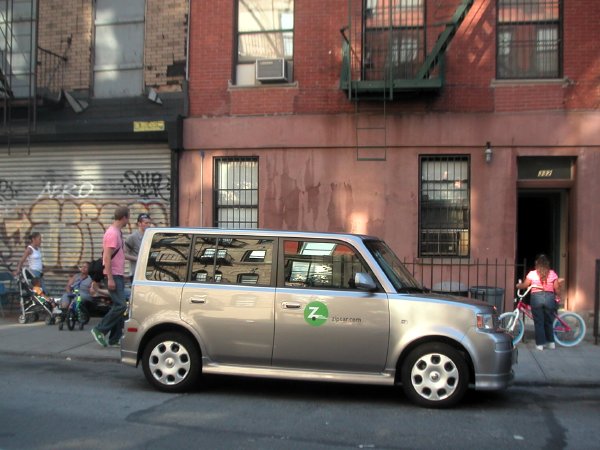
Bubba waiting for us on Bedford Street in Williamsburg today

I have always been interested in cars. Actually, I’m something of a car nut, in spite of my interests and principles otherwise. Yeah, I know, it’s 2005 and we now understand how much the automobile has done to destroy the world, but I can’t explain my fascination. And I can’t help it, if for no other reason than that I live in that world, where the automobile is necessary at least occasionally, even if you’re a New Yorker and you really, really hate its cabs.
Barry and I have a new magic carriage. It comes when we call it, a little like Aladdin’s ride.
I’ve always described the subway as a magic carpet, because its there when you need it, it never has to be parked and you can take all your friends with you. But sometimes carpets get tired and they start falling apart. I’m thinking in particular of my experiences with the unreliability of the L train between Manhattan and Brooklyn on weekends, but the cancer has been spreading. It shouldn’t take us nearly an hour to get to our home in Chelsea from Soho (that’s about two kilometers, or a mile and a quarter), as it did this past Friday.
A few weeks ago we decided to activate a dormant Zipcar membership for the first time because we wanted to get to several openings in Chelsea and a few in Williamsburg on the same night. Alright, I admit it: I missed driving a car. Anyway, we picked “Bubba,” which is the name assigned to the wonderful little Scion Xb in the picture above, and that night we carried five friends (two or three at a time) between the boroughs and around the town. We had a ball, in the end stopping for dinner with three of them before we floated back to the garage, crossing the Williamsburg Bridge again and continuing our stately progress up a lively Clinton Street and Avenue B before turning West and heading for home, on a perfect summer evening.
It’s a fantastic carriage, and I use the noun advisedly, since we sit high inside a comfortable box, with six or eight extra inches above our heads and several feet between our noses and the upright windshield. A number of travelling trunks can ride secure and dry inside behind the second row of seats. The four doors open wide and if you want you can cross your legs while sitting in each of the passenger seats. There’s excellent air conditioning and a great sound system. The car is whisper quiet, well-built and incredibly practical, and you can rent it on line or on the phone, by the hour or the day, picking it up and dropping it off at a garage around the corner (there are no check in or check out lines and no clerks to deal with). The Scion is two feet shorter than a Volkswagen Golf (or is it the Toyota Corolla?). Anyway, it’s pretty short, and you can park it almost anywhere. It’s just about the unAmerican car.
I have to admit Zipcar’s biggest appeal for me was the kind of cars they have available, and not just the short-term feature which must account for much or most of its popularity (you can rent some models for as low as $8.50 an hour, or $65 a day). It’s been years since I rented a car in New York (for a day or weekend trip), and I think I only indulged myself twice. I blame my lack of interest in repeating the experience on the incredibly junky choices available from the standard rental companies. And what does it cost now to rent a car in New York on a weekend? I’m guessing around $130 to $150 a day.
I had decided that if I wanted a decent ride I would always have to wait until I got to Europe, where they have cars for people who really like to drive. Zipcar has Volkswagen Golfs, new Beetle convertibles, Scion Xbs, Mini sedans and convertibles, even small Volvos and BMWs for the big spenders, but I’m not going to give up Europe. They have the Smart, and the roads are wonderful too.
We revisited Bubba this afternoon and evening, because we were trying to get to a number of galleries in different parts of two boroughs not easily accessible by subway and on foot. And because we had so much fun last time.
Next up: a short trip into the country, and maybe even a splurge on a little convertible – short term of course.

Madame Jumel continues to entertain

MorrisJumelSylvanTer.jpg
view of the eastern end of Sylvan Terrace through a window of the octagon drawing room inside the Morris-Jumel Mansion

George Washington slept there.
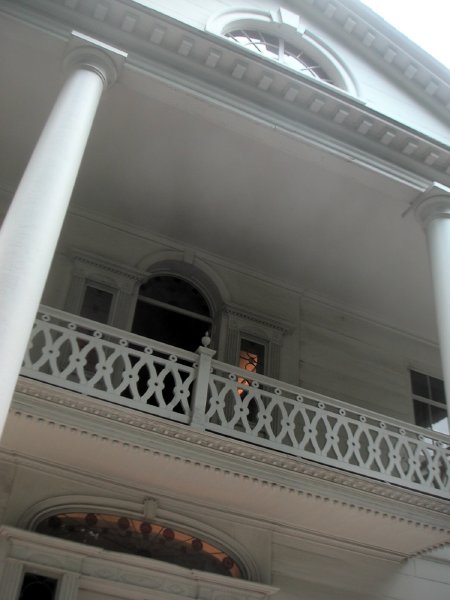
A 1765 wooden American Paladian villa sitting in upper Manhattan on a rise which originally commanded both the Harlem Valley to the east, the Hudson River to the west and New York City some ten miles south, the Morris-Jumel Mansion (actually a country summer home) still offers its considerable pleasures to visitors. Today that means both the community immediately surrounding it and a much larger world beyond; two hundred years ago it regularly meant most of the founders of our republic.
Barry and I visited the house which for most of the nineteenth century belonged to the amazing Madame Eliza Bowen Jumel both out of curiosity about the place and for the attraction of an interesting program of eighteenth and nineteenth century English and German art song presented in the kind of space for which it was composed. It was a concert which could well have been enjoyed by this woman’s own guests in that same room over 150 years ago.
On Saturday afternoon we sat in the drawing room below Washington’s quarters, listening to songs in English by Haydn and some of his more obscure contemporaries. After an intermission we returned for two lieder cycles by a similarly-neglected Franz Lachner. Birds sang and could easily be seen playing in the trees outside the open windows decorated with red silk hangings.
The performance by the wonderful tenor Rufus Müller and Donsok Shin, his accompanist at the fortepiano, was artistry of the highest order, and would have been an enormous sensual pleasure even without the extraordinary peace and beauty of the venue. Some three dozen guests seated themselves in the octagon drawing room of Madame Jumel’s chateau, the walls covered in a painted Chinese wallpaper of flowers and birds on a deep blue ground. We sat in a magic pagoda cooled by large beech and horse chestnut trees standing in what remains of an estate which once covered 130 acres across the width of the island.
After the performance we joined the museum hosts and the two artists for refreshments upstairs in the large central hall which runs behind the front balcony. A huge portrait of the redoubtable dowager Madame Jumel was very much a part of our company.
These intelligently-programmed concerts are scheduled regularly by Music at Morris-Jumel, and we’re on the mailing list. Because of its delightfully small scale however, it’s hard to imagine how this wonderful series of chamber music performances will survive in this city of mammon. I hope I’m wrong.

NOTE: I can’t let this story go without lamenting that no one has yet written a satisfactory biography of the remarkable woman who became Madame Eliza Jumel. I wasn’t even able to find an adequate account to link to for the purpose of this post, but the National Park service offers a tease:

The stately two-story Morris-Jumel mansion, built in 1765 in a Georgian style modified to suit a country setting, was purchased by Mr. and Mrs. Stephen Jumel in 1810. Though Stephen Jumel was a former Caribbean plantation owner and successful wine merchant, it was the colorful and controversial Madam Eliza Jumel who became the talk of New York City society. Eliza Jumel’s life typified the limited options of ambitious young women born into poverty in late 18th-century America. Forced into prostitution early in life as a means of survival, Eliza’s fortune turned after meeting and marrying Stephen Jumel in 1804. The prejudices of society against those with such a background forbade any acceptance of Mrs. Jumel. Wealth permitted travel, however, and the Jumels sailed to France in 1815. There, Eliza found social acceptance, mingling with aristocrats while adopting openly Bonapartist sympathies. Such convictions, voiced soon after Napoleon’s exile, proved too controversial for the new French government, and in 1816 Louis XVIII ordered Mrs. Jumel to leave France. Eliza returned to the mansion, but her marriage was soon in decline over Stephen’s discovery of her early life and the dwindling Jumel fortune. While Stephen remained in France, Eliza sold business holdings and kept the profits, pursuing social acceptance through wealth while leaving Stephen penniless and hastening his death. Fourteen months later Eliza, then 58, married 77 year-old, former Vice-President Aaron Burr. The marriage was marked by Burr’s misuse of the Jumel fortune and the two were formally divorced on September 14, 1836, the day of Burr’s death. Jumel spent the rest of her life in the mansion, dying here in 1865 at the age of 90.

MorrisJumelporch.jpg
a grand two-story portico protects a small second story balcony at the front of the house

MorrisJumeloctagon.jpg
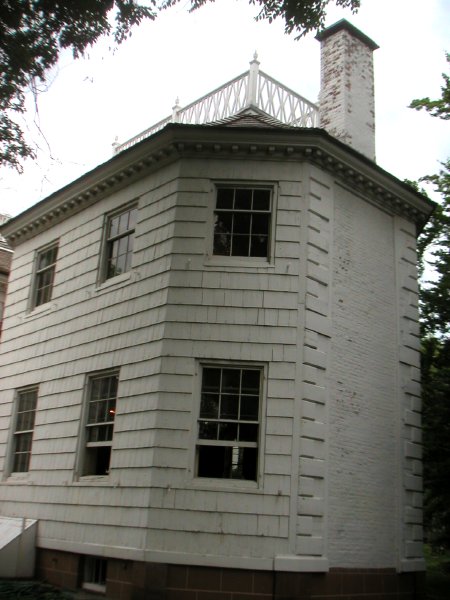
the octagonal drawing room and an upstairs chamber and cabinets is almost a separate garden folly, as it is attached to the rear of the house only at the short plane of one of its narrow ends.

disgusted, but not quite shutting up

stadium.jpg
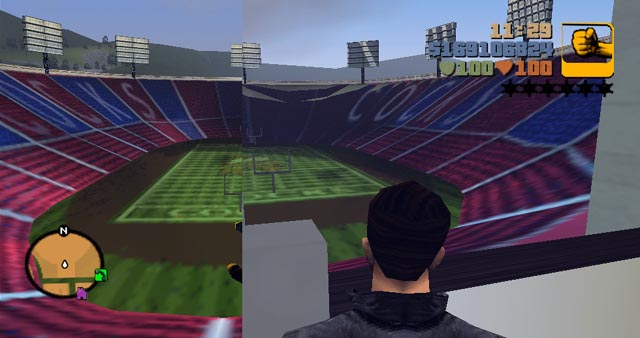
” . . . the inside of the stadium in Liberty City”
Yes!
Just when I think I’ve been doing pretty well with my own campaign of “inner emigration”* [because, basically, we are clearly not a democracy; I don’t think anything else we can do will make a difference; there are no institutions left in place to turn this country around; etc.], something gets me going again. This time it’s Barry, with whose frustrations [“I rarely post about politics anymore. I’m too disgusted.”] – and limits of patience – I am totally in agreement.

* For discussions of the subject, see a discussion centered on Thomas Mann and his contemporaries, and one devoted to the experience of Karl Amadeus Hartman.

[image from colinfahey.com]

the World Trade Center site as a grand public plaza

plazaMexico.jpg
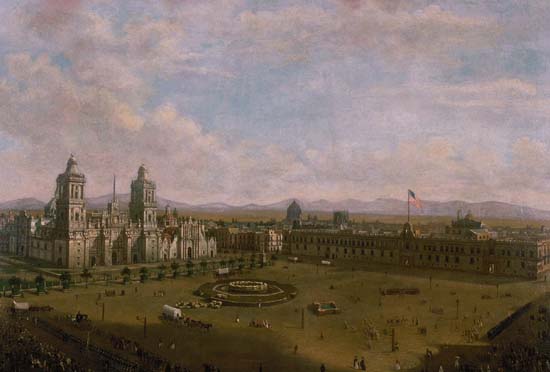
Pietro Gualdi Grand Plaza of Mexico City, Following the American Occupation of September 14, 1847 1847 oil on canvas [one of my all-time favorite public squares, for the richness of its life – once we left]

Over seventy years ago the Empire State Building was completed within thirteen months and yet we’re still staring at a hole downtown.
As we approach the fourth anniversary of the attacks on the World Trade Center we have no idea what’s going to be built on the still-empty site. Every intended purpose and every proposed design has ended up being compromised or rejected for one reason or another.
Except for the shopping mall.
The cultural spaces are out; people are apparently terrified of the idea of sitting at a desk high above “ground Zero,” so no one is talking about building the tall office buildings first included in the proposals; and no one knows where the little Greek church is going to be. The only projects now left on the table are something called the “Freedom Tower,” which has just been put on hold once again (because of the name, it’s a not-so-surprising augury for Bush’s America) and the even more tenebrous “Freedom Museum.” The current state of plans for a memorial to the events of September 11 is a mess, and it was ill-conceived from the start.
And as far as real freedom is concerned, forget about it; gotta stay off the grass and stay off the streets. Maybe watch it on TV.
So I have a modest proposal to resolve the problem. Actually it’s not modest in its implications or in the scale of its ambitions, only in the simplicity of its utility and its physical design.
New Yorkers have been told that they have no right to assemble in large numbers in Central Park to party or address political grievances, and they have seen how impossible it is to find any alternative in a city without great open public spaces. I suggest that the site of the old World Trade Center be made a true monument to freedom by reserving every acre of its surface as a public square devoted solely to the enjoyment of the people and to their right of expression, whether in joy or in anger.
It absolutely must not be a lawn however, even if there were any way to ensure that great assemblies of people would not damage it. We need a great plaza worthy of a great city. Plazas welcome free assembly. Downtown, in the new World Trade Center there will be trading in ideas and grass is not part of the kit.
We would be perfectly happy with cut stone or the happy-sounding, gravel-like surface used almost universally in the grand parks of European towns and cities. Trees, yes. Include trees perhaps, but only around the perimeter. London Plane trees would do just fine. Above all, let us have light and air. Freedom thrives on it.

ADDENDUM: A year and a half ago, Barry did a post describing a provocative, minimalist WTC proposal from Ellsworth Kelly, although his concept involved the grass thing.

[image from Louisiana State Museum]

Smolka photo found!

smolka_NYT_INDYWEB.jpg
Chief Smolka doing his thing

UPDATE/FOLLOW UP: When I posted my April 30 story, “political police thuggery in New York,” I wrote that I was unable to find the dramatic photograph which acccompanied the print edition of the NYTimes article. I’ve now located it on New York indymedia, thanks to the photographer, Antrim Caskey.
I’ve also changed my post’s link for the Times news story to this indymedia site, reducing the chances that it will disappear very soon. There are some additional comments about the incident on this site, including a call for photographs and video from anyone who witnessed it.

[image by Antrim Caskey from nyc.indymedia]

Wiener Kunst for the outsider

ACF-UPS.jpg
Richard Hoeck and John Miller Something for Everyone 2004 video installation view

ACF-Twin.jpg
Sabina Hörtner Twins 01 2002 Eddy marker on multiple cardboard sheets installation view

ACF-pool&video.jpg
Marko Lulic Hart und weich Nr.2 [Hard and Soft No.2] 2002 painted wood platform with vintage film by Dejan Karaklajic and Jovan Acim installation view

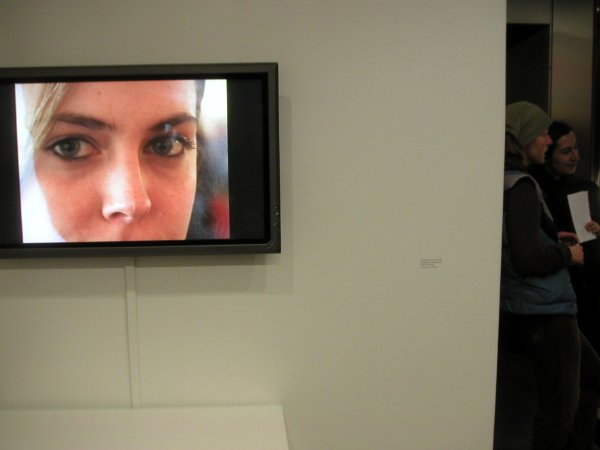
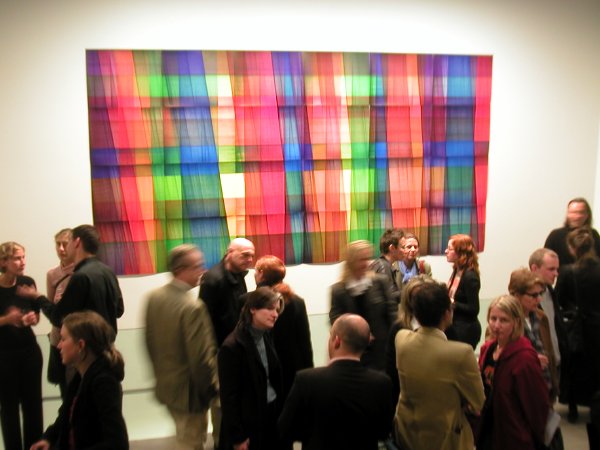
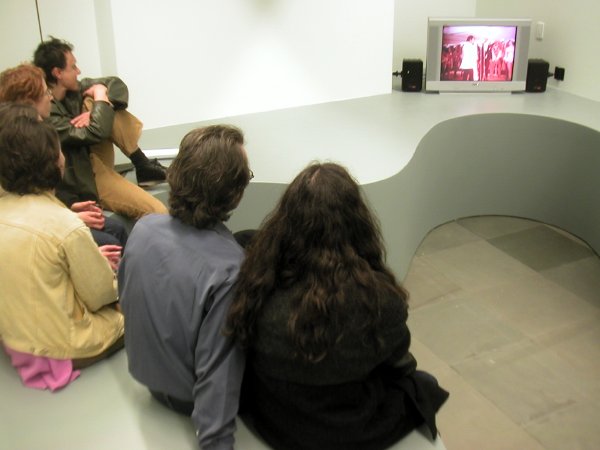
I feel like we just came back from a trip to Vienna (again), or more specifically a visit to the studios of nine emerging artists living and working in the city which could arguably be described as the geographic and cultural center of a Europe which has rediscovered the treasure of its eastern lands. The Austrian Cultural Forum (ACF) is hosting this group exhibition curated by Trevor Smith of the New Museum through August 20.
Smith points out that although his assignment has placed these artists in a geographic context they do not necessarily define themselves geographically.

Many of the artists’s works that I have chosen for the New York version of “Living and Working in Vienna” are marked by this tension between somewhere and anywhere, using architecture or film as the site for mediations on history, memory and cultural critique.

If artists are outsiders regardless of where they find themselves, we should all be delighted to see what creative minds can do with the fantastic kind of “outside” which is described by this gorgeous and surprisingly modern city today.
Go to this little bit of Austria on 52nd Street for the show and for how well it has been integrated into the spaces of this very interesting building. For the rest of this week there’s the additional incentive of the avant garde festival “Moving Patterns: Electronic Music and Beyond,” which is fully described on the website. Go early in order to check out the visual art, especially since its arrival seems timed perfectly for the cross-genre festival of sound.
Oh, and ACF performances are always absolutely free.